The Estate Agent Website Guide That Wins Listings

Most articles on estate agent websites read like checklists. SSL, mobile responsive, contact form, virtual tours, blog. Tick, tick, tick. They miss the point so completely that I have rebuilt sites for agents who followed all of that advice and still lost out on instructions to the agency three doors down, because the website was solving the wrong problem.
The wrong problem most agent websites solve is "show our listings to buyers." Buyers, by the time they reach an agency website, have usually already found the property on Rightmove, Zoopla, or whichever portal dominates their region. They are not arriving at your site to browse. The right problem, the one a well-built estate agent website should solve, is "convince a homeowner three streets away to invite us to value their home before they call anyone else." Until you accept that the vendor is the visitor that pays your bills, every other decision about the site will be slightly off.
I run DignuzDesign, a studio that builds custom property websites on Astro, Webflow, and Cloudflare, and I have spent the last several years watching what happens after estate agents launch sites built on different philosophies. This guide is what I would tell an agent or principal sitting in front of me asking how to think about a new build, what to spend on it, and what features actually move the needle on instructions.
What an Estate Agent Website Is Actually For
The job of an estate agent website, in priority order, is to win vendor instructions, retain existing landlord clients, demonstrate enough local expertise that buyers register with you for off-market and pre-launch properties, and only then to show your current listings nicely. Most agency websites have those priorities inverted. The homepage leads with a property search bar pointed at the agency's own tiny inventory, which is a strange thing to do when Rightmove has a far larger search experience one tap away.
The shift in mindset matters because it changes what counts as a success metric. If the site is for vendors, the metric is valuation requests, not gallery views. If the site is for landlords, the metric is property management enquiries from existing landlords looking to expand their portfolio. The redesign of the homepage, the order of the navigation, the structure of the content, every decision flows from that one question: who is this page actually for, and what do they need to see in the first ten seconds.
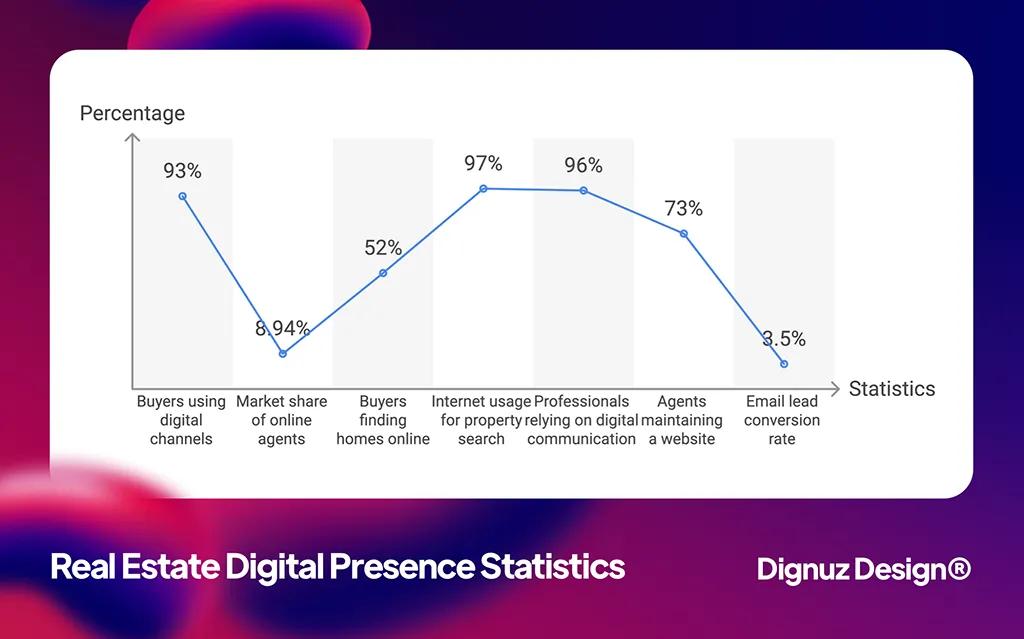
The National Association of Realtors Profile of Home Buyers and Sellers consistently finds that essentially every buyer uses the internet at some point in their search, but they overwhelmingly transact through an agent. The website's role is not to replace the agent in the buying process. It is to position the agent as the local expert worth calling. That positioning is what makes the homeowner who has been thinking about selling for six months finally fill in a valuation form.
The Vendor Is Your Most Valuable Visitor
Every estate agent I have worked with eventually arrives at the same realisation: listings are inventory, and inventory is what they compete for. The agent with the most appropriate listings in a given postcode wins the buyer registrations, the viewings, the offers, and the chain. Vendors are therefore worth ten times what a buyer enquiry is worth, and the website should reflect that ratio in how it is built.
What does that look like in practice? It looks like a homepage where the most prominent call to action is "Book a Free Valuation" or "What Is My Home Worth," not "Search Properties." It looks like an instant valuation tool, even if the figure it produces is a wide range, because the friction of getting a number is what hooks the homeowner who is "just curious." It looks like a sold prices page, broken down by street, with your own sale featured prominently and credibly. It looks like vendor testimonials placed where buyers might normally see lifestyle photos.
One agent I worked with had the standard layout: hero with a property search, then a row of featured listings, then a small "thinking of selling?" banner near the footer. We flipped it. The hero became a valuation request with a postcode field and three friendly questions. Listings moved to a separate "Properties" tab in the navigation. Within four months, valuation enquiries had roughly tripled, and listings traffic from the agency site barely budged, because the listings were always coming from Rightmove anyway. The site had stopped pretending to be a portal and started doing the one job a portal cannot do for you.
Beating the Portal: What Your Site Has to Offer That Rightmove Cannot
If you are an estate agent in the UK, your single largest competitive reality is that Rightmove is bigger than you, faster than you, and the first place buyers and sellers look. According to Rightmove's own data services, the platform receives billions of visits annually and is used by virtually every agent in the country. You are not going to out-portal the portal. You will not out-rank it on "houses for sale in Sevenoaks." Stop trying.
What you can do is offer everything the portal structurally cannot. Portals cannot publish your honest opinion of which streets in a town are over-priced this quarter and which have room to move. Portals cannot run a vendor case study explaining why a particular house took eleven weeks to sell despite three offers in the first ten days. Portals cannot give a homeowner a credible answer to "should I do this kitchen before listing, or sell as is?" Your website can do all of those things, and a homeowner who finds that content is far more likely to invite you to value the property than the agent whose only online presence is a thumbnail next to a listing on a portal page.
This is also where commercial and lettings agencies have the biggest open lane. Investor-focused content, yield analysis by neighbourhood, lettings legislation updates, all of these are searched constantly and answered badly by generic blog farms. An agency website that becomes the authoritative local source for that content stops competing with the portal and starts competing on a completely different axis: subject-matter authority. The wider strategy I lay out in estate agent digital marketing strategies goes deeper into how to structure that content.
The Listing Detail Page Is Where Most Agent Sites Quietly Fall Apart
Even though listings are not why the site exists, they still have to work properly, because a slow or broken listing page tells a vendor far more about your competence than any "Why Choose Us" page can. The listing detail page is, in my experience, where the majority of estate agent sites quietly fail.
The failure pattern is consistent. The homepage loads quickly because it has been polished. The listing page, which inherits a heavy gallery, a Matterport iframe, a floor plan image, a map, and four or five marketing widgets, takes six to twelve seconds to become usable on a mid-range Android phone. By the time the buyer can interact with the gallery, they have already switched apps. Google measures this responsiveness through Interaction to Next Paint, which it added to Core Web Vitals, and the threshold for a good score is under 200 milliseconds for at least three quarters of interactions. A surprising number of agent sites I audit blow past that on the listing page and pass everywhere else, which is the worst possible distribution because the listing page is the one a paying vendor is judging when they look up their own property.
The fix is unglamorous but specific. Images delivered in AVIF or WebP with proper srcset, lazy loading below the fold, the Matterport embed deferred until the user scrolls or taps to open it, the floor plan rendered inline rather than as a separate page, and the entire page served from a content delivery network with sensible caching. If the developer building your site does not mention any of those things, the listing page is going to be the slow page on the new site too, just with a nicer hero image. I cover the technical detail in the guide on real estate website speed optimization.
The other piece of the listing page that quietly fails is the gallery itself. Zillow's Consumer Housing Trends Report finds that buyers consistently rate detailed property photos as the most useful content on a property page, followed by floor plans, and that a meaningful share of buyers consider advanced media features such as 3D tours essential. If the gallery is jerky on a phone, if the floor plan cannot be expanded properly, if the 3D tour pauses the rest of the page, the property is being undersold to the buyer and the vendor will eventually feel it.
Local Area Pages Are the SEO Engine Most Agents Ignore
The traffic an agent site can realistically win is not "houses for sale in London." It is the long tail: "best primary schools near Reigate," "is Beaconsfield a good commute to London," "what is the asking-to-selling price ratio in Tunbridge Wells this year." These are the queries homeowners run before they invite anyone to value their home, and they are queries portals do not answer well because portals are structured to show inventory, not opinion.
A serious estate agent website has a page for every town, suburb, or postcode the agency covers, and each page has real content. Not a list of recent listings, which everyone has. Real content: average days on market, recent sold prices with commentary, school catchments, transport links, what is happening on the high street, where buyers are coming from. A vendor reading that page is not researching their home, they are auditioning you. The page is a sample of the conversation they would have with you at their kitchen table.
Three rules I would offer for building these pages. First, each page has to be genuinely different from the others, not a swap-the-town-name template. Search engines see through templates instantly, and so do vendors. Second, sold prices and statistics should be updated at least quarterly, or the page becomes a liability. Third, link each area page from the agency's individual valuer or branch profile, so a homeowner reading the Sevenoaks page can click straight through to the person who would actually visit them. The connection between content and contact is what converts.
Lead Forms, Valuation Requests, and the Anatomy of a Vendor Capture
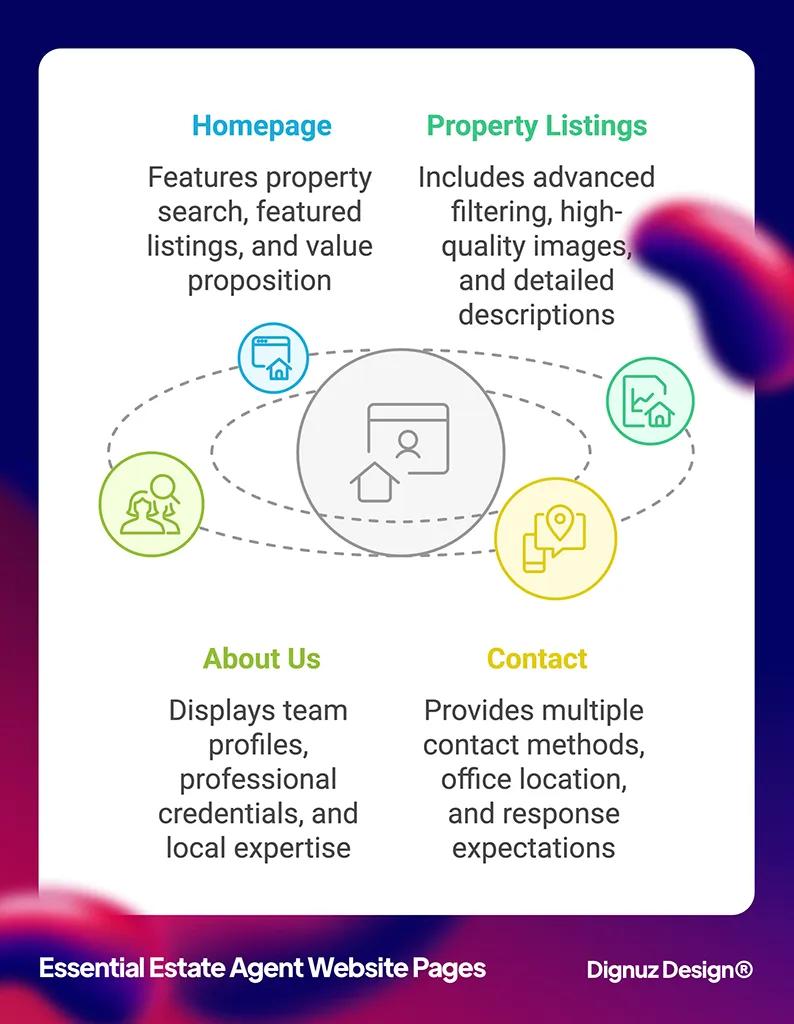
The valuation request is the single most important conversion path on the site. Treat it with the seriousness it deserves. Most agency sites have a perfunctory form with eleven fields, sat on a generic page reachable only from a small button in the header. That is a form designed by someone who does not want valuation requests.
A form designed to win them looks different. The first interaction asks for the postcode, nothing else. Once the postcode is entered, the form expands to ask address, then asks one or two qualifying questions about the property (number of bedrooms, approximate condition), then asks for contact details only at the end, when the homeowner has already invested attention. The trick is not to reduce the total number of fields, the trick is to delay the friction until after the prospect has committed psychologically.
The form should also offer a choice. Instant online valuation now, with a follow-up call from a senior valuer, versus an in-person valuation at a time they pick. The instant option captures the cautious homeowner who is still six months from listing. The in-person option captures the serious vendor. Same form, two outcomes, and your CRM gets both leads tagged appropriately.
A few details that disproportionately affect conversion. The form should never demand a phone number before an email is offered. The form should never require account creation. The form should give a clear, named human response time ("Sarah, our senior valuer, will be in touch within one working day") rather than the generic "we will get back to you soon" that signals an indifferent agency. The guide on writing website copy that converts goes deeper into the language around these moments.
Visual Content: Photos, Floor Plans, Video, and Why 3D Is Not Optional Much Longer
If there is one area where the gap between competent estate agent sites and excellent ones is widening fastest, it is visual content. Buyers, and increasingly vendors evaluating which agent will best represent their home, are calibrating their expectations against the best listings they have seen on any site, not just yours. A pristine professional photo set is the floor now, not the ceiling.
The floor plan deserves more attention than most agents give it. A clean, accurate, dimensioned floor plan converts buyers to viewings at a rate that surprises agents who have never measured it. It is also the asset a vendor most often shows to family and friends when comparing how their property has been presented against the agent down the road. If your floor plans are scanned hand-drawn relics, the vendor will notice.
Video sits in an awkward middle ground. A two-minute walkthrough with a knowledgeable agent voice-over outperforms drone-only montages for serious buyers, because it explains the property rather than just glamourising it. For premium properties, both have a place. For mid-market, the agent walkthrough is the higher-leverage option, and far cheaper to produce.
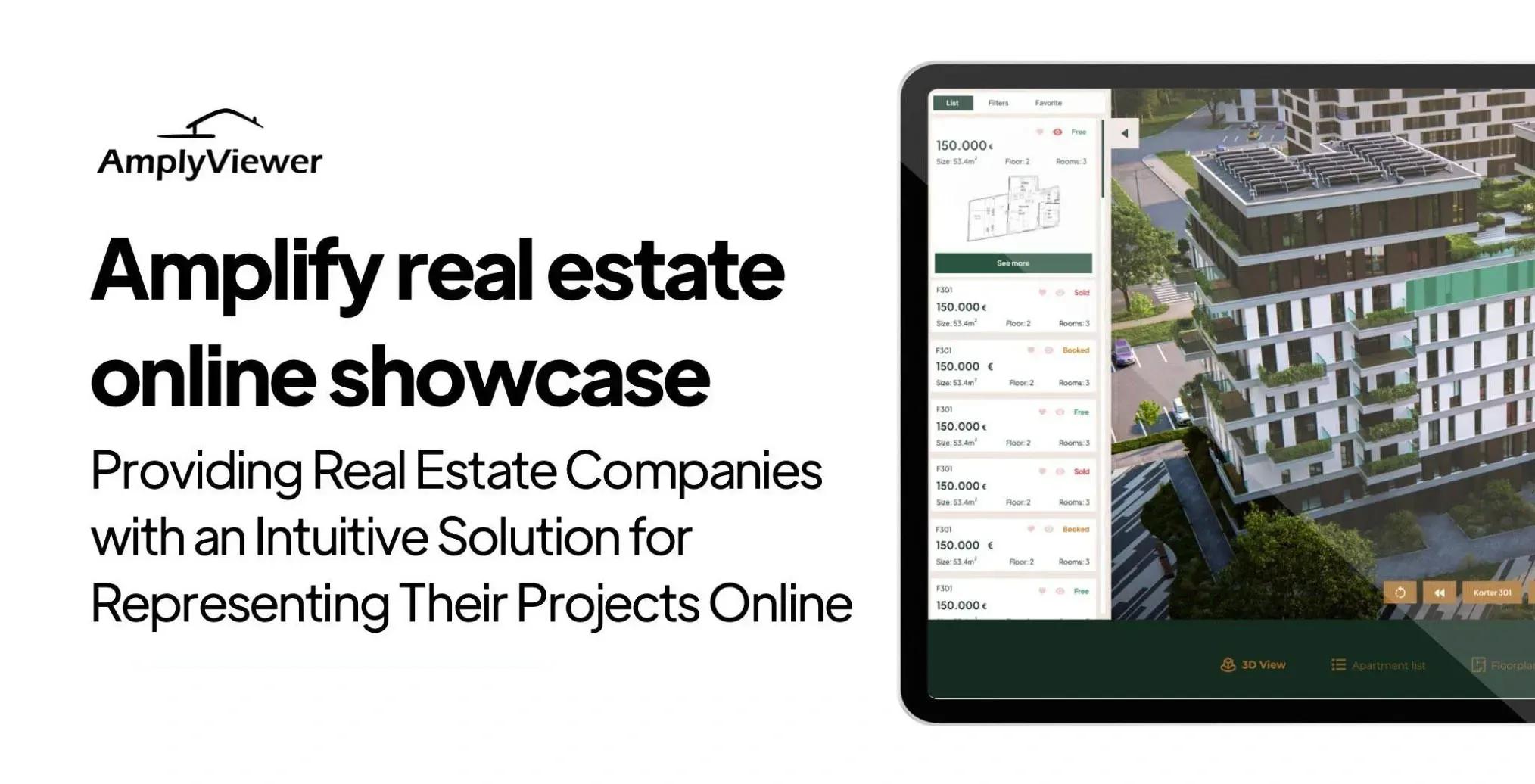
The category that is shifting fastest is interactive 3D. Zillow's research shows the share of buyers considering an advanced media feature essential keeps climbing, and the agencies that adopted Matterport or its equivalents early are already pulling ahead on the listings where it matters. The catch is that bolt-on 3D tour iframes are slow and feel awkward inside a listing page. I built AmplyViewer to address exactly this: an interactive 3D viewer that runs inline within the listing page itself, so the buyer can rotate, walk through, and inspect the property without being kicked into a third-party experience that pauses the rest of their journey. Whether you use AmplyViewer or another tool, the principle is the same: 3D needs to feel like a native part of the listing, not a bolted-on novelty. More on the broader visual category in the piece on essential property marketing visuals.
Trust Signals That Actually Move Vendors
The standard advice is to display credentials, awards, and association logos. Fine, but those move the needle by a few percent. The trust signals that genuinely move a vendor from curiosity to enquiry are different and more specific.
The first is named, photographed people. Not stock photo "our team," but real headshots of the people who would actually answer the phone, with a sentence or two about how long they have been working that postcode. Vendors hire individuals, not brands, and the website should reflect that.
The second is recent, specific results. Not "we sold over a thousand homes last year." Specific: "We sold 4 Acacia Road in Sevenoaks in 11 days at 3% above asking." Vendors mentally model their own home against these examples, and the more local and recent the example, the more credible the agent appears.
The third is published opinion. An agent who has a clear, dated point of view on the local market, even an unpopular one, is more credible than an agent who never says anything publicly. The vendor who reads three of your articles and finds them genuinely useful is half-sold before they pick up the phone. This is exactly why a content strategy modelled on how to stand out as a realtor works for agencies too.
The fourth is a transparent fee structure, or at least a transparent explanation of how fees work. The agent who explains their fee in plain English on a page anyone can find is communicating confidence that vendors register and remember. The agent who hides the fee until the kitchen meeting is communicating something else.
💻 Let us help you create a stunning online showcase for your projects that works seamlessly across all devices. Ready to amplify your real estate business? 👉 Explore AmplyViewer now
Choosing the Stack: WordPress, Webflow, or Static
Stack choice is unglamorous and yet decides more of the site's long-term performance than any design choice. There is no universally correct answer, but there is a correct answer for your scale and team.
WordPress remains the default for small and mid-sized agencies because the plugin ecosystem covers property feeds, CRM integrations, and listing imports. The risk is well documented: WordPress sites accumulate plugins over time, and each plugin adds load to the listing page. I have inherited estate agent sites where removing four plugins moved Core Web Vitals from failing to passing without changing any design. If your team is going WordPress, get strict about the plugin budget from day one.
Webflow is the right answer for many independent agents and lettings agencies, particularly those who want a site that looks designed rather than templated and do not need to handle thousands of listings through an MLS-style feed. The visual editor lets the agency update content without depending on the developer, which is usually the long-term cost saving that matters most. The detailed reasoning is in the look at why custom real estate websites outperform template solutions.
Static and headless stacks, including Astro, are where I have moved most of my work for agencies who care about speed and search performance at scale. The listing page is rendered ahead of time and served from a CDN, the JavaScript footprint is minimal, and the site stays fast even as the inventory grows. The trade-off is that you need a developer who actually understands modern build pipelines, which excludes a lot of WordPress-only shops. If your agency has serious traffic ambitions or a content strategy that depends on dozens or hundreds of area pages, this is the path I would recommend.
What to Spend, and Where the Money Actually Goes
Budget questions get asked first and answered last because the honest answer is "it depends." Here is the rough shape of what it depends on, drawn from the projects I have priced.
A single-branch independent agent with a clean brand, ten to twenty unique pages, a property feed integration, and a valuation tool can have a genuinely excellent site for somewhere between eight and twenty thousand pounds, end to end. Most of that money is in design and copywriting, not the development itself. A multi-branch agency with custom area pages for each branch, more complex feeds, lettings and sales workflows, and ongoing content commitments lands somewhere between twenty-five and seventy thousand, with the variation almost entirely explained by how much the agency wants to bring to launch versus build out over time.
The numbers I would push back on, in either direction, are the bottom and the top. A site quoted at two thousand pounds for a custom agent website is being built from a template with a property feed plugged in, and it will look and behave like one. A site quoted at six figures for the same brief is paying for an agency's overhead and not the product. The cost trade-offs are explored in detail in how to think about an affordable custom website.
Maintenance, Content, and the Year After Launch
The mistake I see most often is treating the website as a project that ends at launch. It does not. The site that wins instructions in year three is the site whose area pages have been updated quarterly, whose sold prices ticker is current, whose blog has at least one piece of genuinely useful local content per month, and whose technical performance is being measured. The site that loses to the agency down the road is the one whose owner stopped looking at the analytics after the launch party.
Plan for content from day one. The most effective agencies I have built for keep a simple content rhythm: one substantial market commentary piece per month, a recurring "what sold this month" recap, and four to six refreshed area pages per quarter. That is genuinely sustainable for a small agency, and it compounds into search traffic and authority over twelve to eighteen months.
Measurement is the other piece. If you do not know which page converted the last ten valuation requests, you have no basis to decide what to improve. Event tracking on the valuation form, on instant valuation tool completions, on phone clicks from mobile, and on email link clicks from email signatures is a launch-day requirement, not a nice-to-have. Without it, the site will get worse over time because no-one will know which decisions to defend and which to revise.
Frequently Asked Questions
Do estate agents really need their own website if their listings are on Rightmove and Zoopla?
Yes, but not for the reason most agents think. The website's job is not to compete with the portals on listings, because that competition is already lost. The website's job is to win vendor instructions, retain landlords, and demonstrate enough local authority that homeowners invite you to value before they call anyone else. A portal cannot do any of that for you because a portal sells inventory, not the relationship that produced it. The agencies that treat their website as a vendor-acquisition channel rather than a buyer-facing listings page are the ones the portal model cannot displace.
How much should an estate agent spend on a website?
For a single-branch independent agency that wants a genuinely well-built site with a property feed, valuation tools, and credible local content, expect somewhere between eight and twenty thousand pounds. For multi-branch agencies with branch-specific area pages and more complex feeds, twenty-five to seventy thousand is realistic. Below those ranges, you are buying a template; above them, you are usually paying for agency overhead. The honest test is whether the agency you are commissioning can show you live work that is fast on a mid-range phone, not just beautiful on a desktop screenshot.
What features matter most on an estate agent website?
In rough priority order: a frictionless valuation request flow, credible local area content with current sold prices and market commentary, named photographs and biographies of the team, a fast listing detail page with proper floor plans and gallery performance, a transparent explanation of fees, and inline 3D or video for premium listings. Features that look impressive in proposals but rarely move the needle include full-screen video backgrounds, mortgage calculators, and detailed mortgage-broker partnerships displayed on the homepage. The features that win instructions are the ones that demonstrate local expertise and reduce friction at the valuation request.
Should an estate agent website include an instant online valuation tool?
Yes, with a caveat. An instant valuation tool is a high-converting top-of-funnel hook, particularly for cautious homeowners who are six to twelve months away from listing. The caveat is that the figure it gives has to be a credible range and has to be followed by a personal touch, ideally a named valuer offering to refine the estimate in person. A bare instant figure with no follow-up trains homeowners to ignore the agency. A range plus a personal follow-up converts the same lead into an instruction with notably higher reliability.
How long does it take to build a good estate agent website?
For a single-branch independent agent with a clear brief, ten to twenty pages, and a standard property feed, six to twelve weeks is a realistic timeline from kick-off to launch on Webflow or Astro. For a multi-branch agency with bespoke area pages, lettings and sales flows, and CRM integration, three to six months is more honest. Discovery phases longer than two weeks for a project where the requirements are obvious are usually padding, not value. The faster timelines apply when the agency has its photography, copy, and brand assets ready at kick-off, which most do not.
Is WordPress good enough for an estate agent website, or should we go custom?
WordPress is good enough for many small agencies if it is built with a strict plugin discipline and a fast, well-coded theme. It becomes a liability when it is built on a heavy page-builder theme with twelve plugins, each adding JavaScript to the listing page. If your team will be the ones updating content and your inventory comes through a standard CRM-to-portal feed, WordPress is often fine. If you are serious about speed, search authority, and a content strategy that depends on dozens of well-performing area pages, a Webflow or static build will serve you better over the long run.