Estate Agent Digital Marketing: What Actually Pays Back

Most estate agency marketing budgets I review have the same shape. A fixed portal spend that nobody questions. A monthly retainer with a social agency producing posts the team is too busy to read. A few thousand a quarter on Google Ads that runs whether or not anyone is watching it. A "content strategy" that produced four blog posts last year, all written by someone who has never sold a house. The website itself, the thing every other channel points to, has not been touched since the rebrand three years ago and loads in five seconds on a phone.
The agency owner usually senses something is wrong. The leads are inconsistent, the cost per qualified viewing is rising, and the channels that look busiest in the dashboard are not the ones generating instructions. But the budget keeps flowing along the same lines because nobody has time to interrupt the pattern.
I run DignuzDesign, a studio building custom websites for estate agencies, property developers, and architects, and Faraday3D, the visualization arm. Sitting between the marketing pipeline and the technical infrastructure that actually delivers it gives me a particular view of where agency budgets pay back and where they leak. This article is about the leaks.
The buyer is mid-decision before they ever call your office
The starting point for any honest conversation about estate agent marketing is what the buyer is actually doing before they reach you. The 2025 NAR Profile of Home Buyers and Sellers reported that every single buyer in their survey used the internet to search for a home, with a median ten weeks spent searching, and 43% naming online property search as the first step they took. The Zillow Consumer Housing Trends data tracks a similar picture in the United States: 89% of buyers use at least one digital tool during their search, and a meaningful share now find the agent they eventually hire through online research rather than personal referral.
The strategic implication for an estate agent is sharper than these numbers suggest at face value. Buyers are not just using the internet to look at listings. They are using it to decide which agencies to talk to in the first place. By the time someone fills in your contact form, they have already reviewed three or four agency websites, judged the quality of your listings against the alternatives, and silently shortlisted you. The marketing job is not to create awareness. It is to win the comparison that has already happened before you knew it was happening.
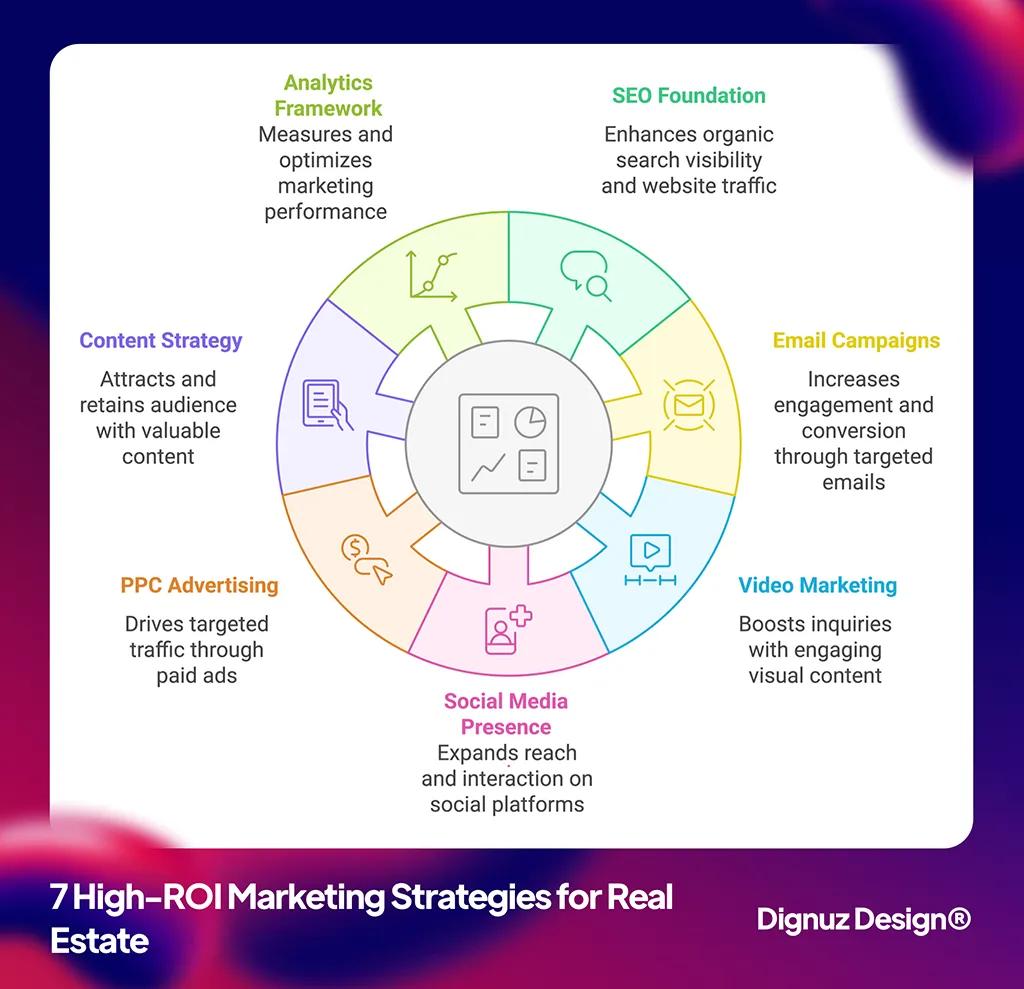
This reframes where the budget should go. The channels that influence the silent comparison are the ones worth funding heavily. The channels that talk to people who have already decided are the ones to fund last. Most agency budgets get this backward, which is why social and PPC tend to absorb money that would have done more on listing photography, site speed, and search visibility.
Listings are the product, everything else is plumbing
The single most underfunded part of estate agency marketing is the listing itself. NAR's research is consistent year on year that photos are the most valued piece of website content for buyers, followed by detailed property information and floor plans. The Zillow research adds that 78% of sellers say they are more likely to hire an agent who offers high-resolution photography. The buyer cares about photos, the seller chooses you partly based on photos, and yet listing photography is the line item that gets cut first when budgets tighten.
I have seen agencies spend four-figure monthly retainers on Facebook campaigns pointing to listings that contained six phone photos taken on a cloudy afternoon. The campaign delivered clicks. The clicks bounced. Then the same agency renewed the Facebook contract and cut the photography budget because "we are not getting enough from photography." The diagnostic question was never asked. The photography spend did not fail. The campaign was paying to push traffic into a landing page that destroyed its own conversion rate.
The fix is not exotic. Better natural light, wider lenses, edited exposure, and floor plans that match the room flow. Real estate photography fundamentals are well covered and the gear cost is recoverable inside a single instruction. The harder discipline is treating each listing page as the conversion event that everything else is paying to deliver, not as a database record. Listing page design is where the entire funnel either holds or collapses, and almost every other marketing decision should be evaluated against whether it improves the listing or merely points more traffic at a poor one.
The website is the only marketing asset you actually own
Portals, paid platforms, and social networks are rented attention. The terms change, the algorithms change, the cost per lead drifts upward every year, and the audience belongs to the platform. Your website is the only asset whose audience, traffic, and data you actually control. The implication is structural: under-investing in the website while over-investing in rented channels is a strategic mistake that compounds quietly over time.
Two technical realities determine whether a website actually earns its keep as a marketing asset. The first is speed. Mobile-first indexing, Core Web Vitals, and basic human patience all converge on the same threshold: a property site that takes more than two seconds to render usable content on a mid-range phone is losing visitors before the listings even paint. I rebuilt a developer's site last year on Astro with images served through Cloudflare, and the largest contentful paint dropped from over four seconds to under nine hundred milliseconds. The bounce rate on the listings index fell by roughly a third inside the first month, with no other changes to the marketing mix. Speed optimization for property websites is not a vanity engineering project; it is the precondition for any other channel to convert.
The second reality is search visibility. Property search is intent-rich in a way few other commercial searches are. Someone typing "two-bedroom flat for sale [neighbourhood]" is not browsing, they are deciding. A site that ranks for the right area-and-property-type queries gets a steady stream of high-intent traffic that costs nothing per click and does not stop when the campaign ends. The portals capture most of these queries today, which is a real constraint, but local long-tail queries, area guides, school catchment information, and property type pages remain genuinely winnable. Web design for real estate companies covers the structural choices that make a site SEO-capable rather than SEO-resistant from the outset.
The point worth making is that website investment is not a one-off rebuild every five years. It is the highest-leverage line in the marketing budget because every other channel feeds into it, and every weakness in it taxes every other spend.
Search before social, almost always
The order in which an estate agency should fund channels is one of the most contested questions in this category and one of the simplest to answer when you look at intent. Search captures people who have already decided to buy or sell and are now looking for the agent or the listing. Social captures people who are scrolling, occasionally noticing property content. The two audiences are not at the same stage of the funnel, and treating them as interchangeable is what produces the lopsided budgets I described at the top of this article.
Google's own framework on the customer decision journey, which it described originally as the collection of micro-moments where people make decisions, applies to property search with unusual clarity. People go to search engines when they are ready to act. They go to social feeds when they are ready to be distracted. An estate agent paying to interrupt distraction is paying a higher price for a less qualified contact than an estate agent showing up in the search that the buyer started themselves.
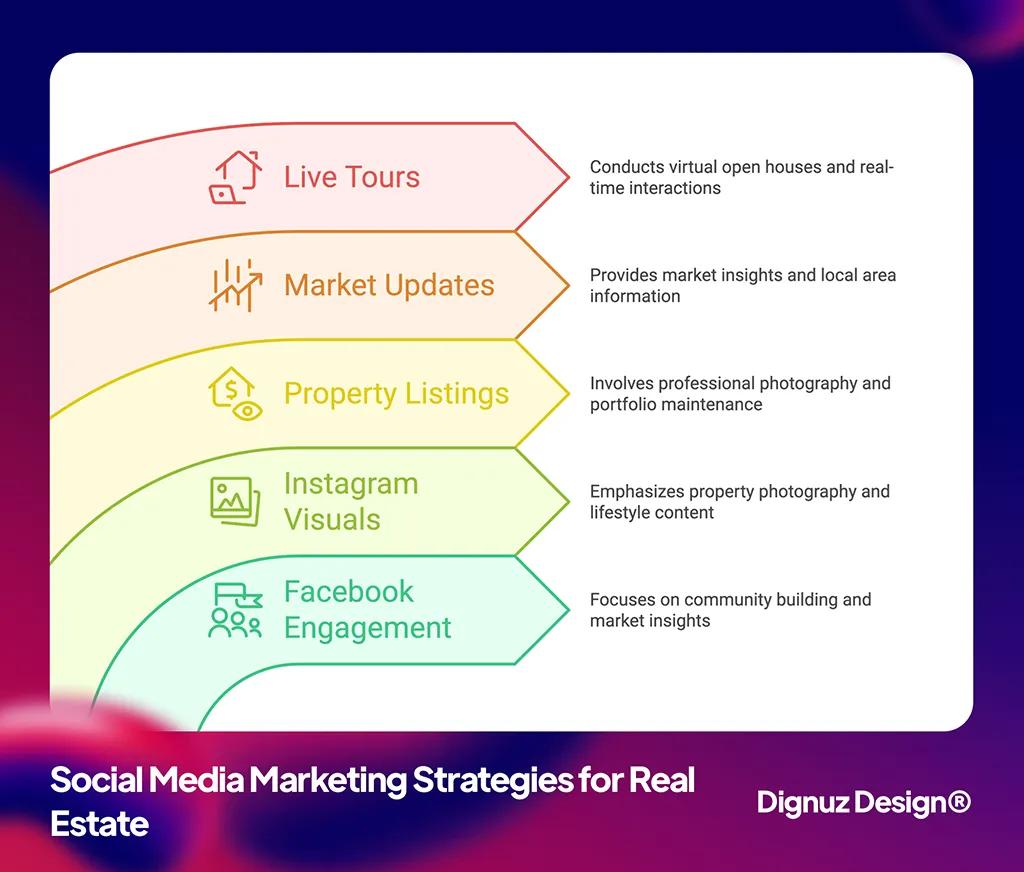
This is not an argument against social. Social plays a role, particularly for brand building, agent visibility, and remarketing to people who have already visited the site. Social media for estate agents earns its place when it follows search rather than substituting for it. The mistake to avoid is funding the social retainer before the website ranks for the agency's own brand name, before the listings carry strong photography, and before the technical SEO is functional. Until those foundations hold, social is a leak.
Video and 3D tours: the highest-ROI visual upgrade and the most wasted budget
Zillow's research is the clearest evidence I have seen on the demand side of virtual tours: 71% of sellers say they are more likely to hire an agent who offers virtual tours or interactive floor plans, and 72% of buyers agree that 3D tours give a better feel for the space than static photos. The supply side has not caught up. Most "virtual tours" in agency listings today are still 360 photo carousels stitched together with a free tool, which is barely a virtual tour at all, just a clickable picture sequence.
The gap between what buyers want and what agencies provide is genuinely commercial. An agency that delivers a proper navigable interior on every premium listing differentiates itself from the local field at almost no incremental cost per listing once the workflow is in place. The hard part is the workflow, not the technology.
This is the intersection where I spend most of my time. AmplyViewer was built as an interactive 3D property viewer that embeds directly into the agency website, with no third-party platform redirect, no external branding, and analytics that flow back into the same dashboard as the rest of the site. Faraday3D handles the equivalent work on the developer side, producing renders and virtual tours of new-build properties that have not been completed yet. On one off-plan scheme last year, the developer sold over half of available units before the structural shell was finished, on the strength of 3D content alone. That is the kind of ROI that virtual tours can deliver when treated as a serious commercial asset rather than a checkbox on the listing template. Immersive 3D experiences in real estate covers the production decisions that determine whether a tour converts or just adds another carousel to ignore.
Video, separately from tours, deserves a clearer-headed assessment than it usually gets. Property walkthrough videos work on YouTube because YouTube is a search engine, and "[area] property tour" is a query buyers run. They work less well on Instagram, where reach is shorter and the attention window is measured in seconds. YouTube for real estate marketing outlines the format-by-platform difference, and the principle to take from it is that video assets need to be cut differently for the channel they are running on, not produced once and posted everywhere.
Email is the underrated workhorse
Email is the channel almost every estate agency under-runs. Two structural reasons make it particularly valuable in property. The first is that the buyer or vendor decision cycle is long, typically three to nine months from first inquiry to transaction, and email is the only channel that can stay present across that timeline without being intrusive. The second is that the underlying data, name and email and area of interest, is already in the agency's CRM, and the marginal cost of using it well is genuinely small.
The reason email under-performs in most agencies is not that the medium has weakened. It is that the content quality is poor. A monthly market update written in templated copy with a generic "the market is moving" line at the top produces almost no engagement. A monthly digest that names specific properties just listed, explains why a particular street is moving fast, and includes one practical observation from the agent who works that postcode performs differently. The content has to read like it was written by someone who actually knows the area.
This is the same principle that drives AmplyDigest, the AI-summarized morning digest service I built for newsletters and content I want to keep up with. The reason it works is that it earns space by being curated and specific, not by being frequent. The same logic applies to agency email: send less, say more, and segment the list by buyer profile and search area so each email is genuinely about a property they would consider. Marketing automation for real estate covers the segmentation and nurture sequencing in more depth.
Paid search and retargeting belong on top of organic foundations
Pay-per-click works in property, but it works best as a top-up on a site that already ranks organically and converts well. PPC on top of a weak site amplifies the weakness. The traffic is paid for whether or not the listings hold up to scrutiny, and the cost per qualified viewing tends to rise quietly over time because the campaign is doing work that the site should be doing.
The exception worth funding even on imperfect sites is retargeting. Visitors who reached a listing detail page and left without enquiring are a high-value audience, and the cost per impression to reach them again is genuinely low. A simple retargeting setup that follows them with the property they viewed, plus one or two comparable listings, recovers a meaningful share of inquiries that would otherwise have leaked. This is the one paid channel I would set up before the website is fully optimized, because it works against an audience you have already paid to acquire.
Branded search PPC, where the agency bids on its own name, is the other defensive line worth holding. It is cheap, it protects against competitor agencies bidding on your brand, and it captures buyers who already heard of you from a sign or a vendor referral and are now Googling to find you.
What to measure, and what to stop measuring
Most estate agency dashboards measure things that look like marketing performance and miss the things that decide whether the marketing actually paid back. Pageviews go up. Reach goes up. Engagement rate fluctuates. Meanwhile the only numbers that matter are these.
- Qualified inquiries per channel, defined as contact form submissions or phone calls that resulted in an actual viewing booking, not raw form fills. A channel that produces a hundred form fills and three viewings is performing worse than one that produces twenty form fills and twelve viewings, regardless of what the click numbers say.
- Cost per qualified viewing, summing all spend on a channel divided by the bookings it produced. This is the number that lets you compare spend across channels honestly, and the number that reveals which channels are quietly draining the budget.
- Time-to-instruction or time-to-offer by lead source, which surfaces something dashboards usually miss: some channels produce faster-closing inquiries than others. A lead from organic search tends to close faster than a lead from a cold social campaign, because the organic visitor self-selected by searching.
The discipline required to track these is not technical. The CRM and the website analytics can connect, with reasonable effort, and most agencies already have the data flowing somewhere. The discipline is to stop reporting on vanity metrics in the weekly meeting and start reporting on the three numbers above. Once that becomes the standing question, budget reallocations follow naturally because the underperforming channels become impossible to defend.
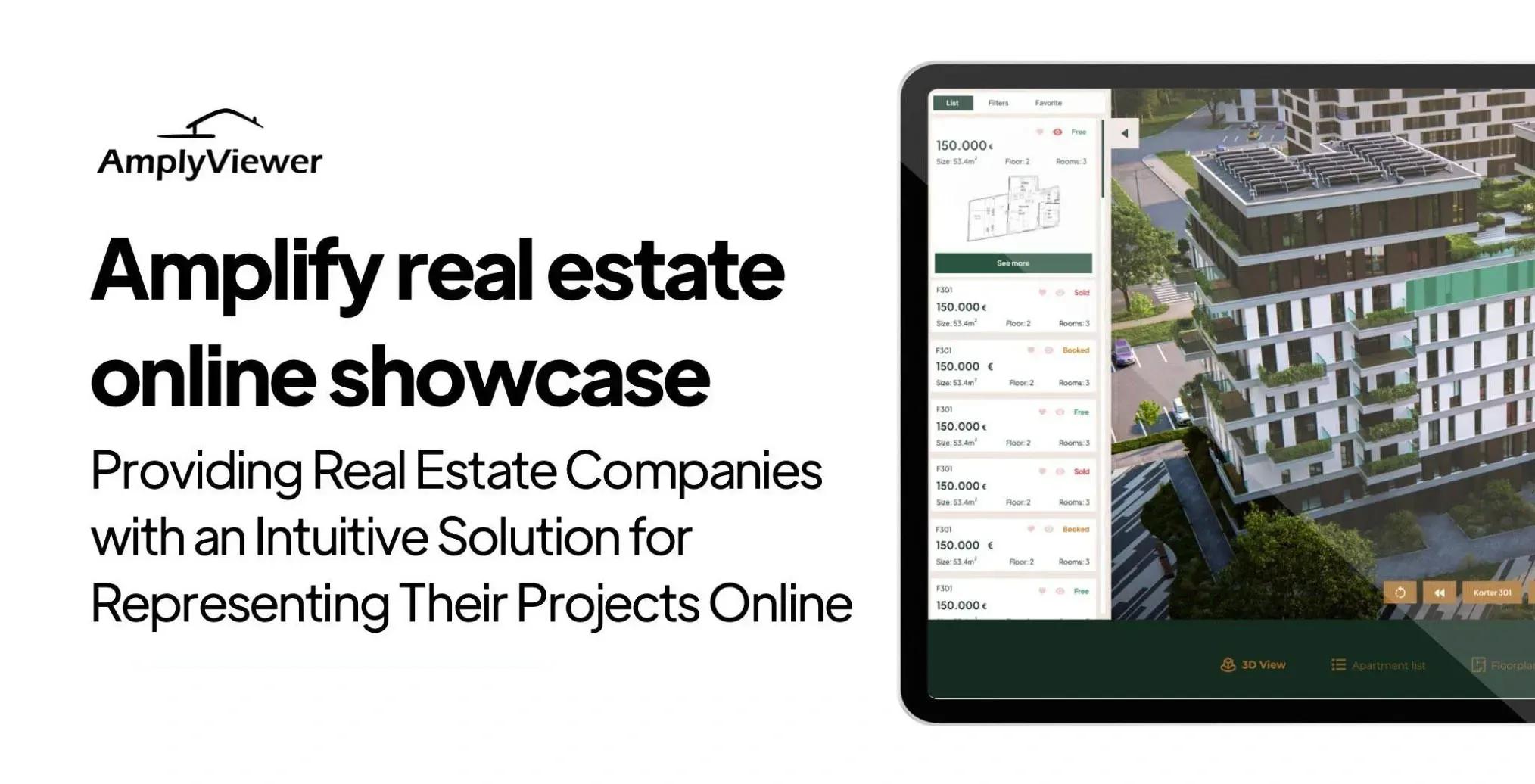
💻 Let us help you create a stunning online showcase for your projects that works seamlessly across all devices. Ready to amplify your real estate business? 👉 Explore AmplyViewer now
Frequently asked questions
How much of an estate agent's marketing budget should be digital?
For most independent and mid-sized agencies, digital should account for the majority of the marketing budget at this point, often in the seventy to ninety per cent range, with the remainder held back for selective print, signage, and local sponsorships that have known returns. The exact split depends on the local market, but the question worth asking is not what percentage to allocate to digital, it is which digital channels deserve the spend. Putting eighty per cent into digital and then spreading it thinly across every available channel is no better than the traditional mix it replaced.
Which digital channel should an estate agent invest in first?
The website itself, before any campaign channel. The reason is that every other channel sends traffic to the website, and weaknesses in speed, listing presentation, and search visibility tax every campaign downstream. After the site, the next investment is listing photography and ideally a 3D tour capability that can ship on premium instructions. Only after those two are in place does paid search or social start paying back at acceptable cost per qualified viewing.
How long does SEO take to deliver leads for an estate agency?
Local SEO for property searches tends to show meaningful movement within three to six months once the technical foundation is in place, with consistent inquiry flow building over the following six to twelve months. The compounding effect, where each ranked page reinforces the others, takes around eighteen months to become structurally noticeable. The mistake to avoid is treating SEO as a switch that turns on; it is closer to a flywheel that needs sustained content publishing and ongoing technical hygiene to keep accelerating.
Do virtual tours actually increase listing inquiries?
Yes, and the effect is largest on listings priced above the local median, where the buyer pool is smaller and the qualification cost per inquiry is higher. A serious virtual tour, meaning a navigable interior with proper measurements and embedded floor plan, reduces wasted physical viewings because it lets uncommitted buyers self-deselect before booking. The remaining viewings are higher-intent, which is what raises the conversion rate from inquiry to offer. The poor-quality 360 carousels that get labelled "virtual tours" do not produce this effect because they do not give the buyer enough information to self-qualify.
Should an estate agency build its own website or use a template platform?
The answer depends on the size of the agency and the depth of its listing data. A single agent or a brand-new agency is usually better served by a fast template platform until the volume justifies more. A mid-sized agency with hundreds of listings, area-specific content, custom search filters, and integrated CRM, almost always pays back a custom build within eighteen to twenty-four months through faster pages, better organic rankings, and a conversion rate that does not depend on the template provider's roadmap. The break point is roughly when the agency's listings and content outgrow what the template can present cleanly.
Where to start tomorrow
If the question is what to do on Monday morning to improve the return on your marketing spend, the answer is to audit the website before you change any campaign. Run the live site through a real-device speed test. Click into three random listings and ask whether the photos would lose to the same property listed by a competing agency on the same portal. Check whether your agency ranks for its own brand name in the local search and whether the listings indexed by Google represent properties currently for sale or properties sold six months ago. These checks take an afternoon and produce a list of fixes that almost always outranks any new campaign you might launch instead.
The bigger principle is that estate agent digital marketing rewards depth over breadth. A small number of channels run seriously, on top of a website that holds up under scrutiny, will outperform a wide spread of channels run shallowly. The agencies winning their local markets are not the ones doing the most marketing. They are the ones whose listings, site, and follow-up read as if someone actually cares about the work. Spending in that direction is what pays back.