Real Estate Marketing Automation: What Actually Works

Every agency I work with eventually arrives at the same question. We have a CRM, we send email blasts, we run paid ads, we post on Instagram. Where is the automation in all of this, and why does it still feel like we are doing everything by hand? The answer is usually that the tools are in place but the wiring between them is not, and the parts that have been automated are the wrong parts.
I run DignuzDesign, a studio building custom websites for property developers, agents, and architects. A lot of that work is the unglamorous plumbing between the website and whatever marketing stack the client already has, which is where automation either earns its keep or quietly bleeds money. This article is about the patterns I see working and the ones that consistently fail, written for owners and marketing managers who have to make the calls about where to spend money next.
Why most real estate marketing automation under-delivers
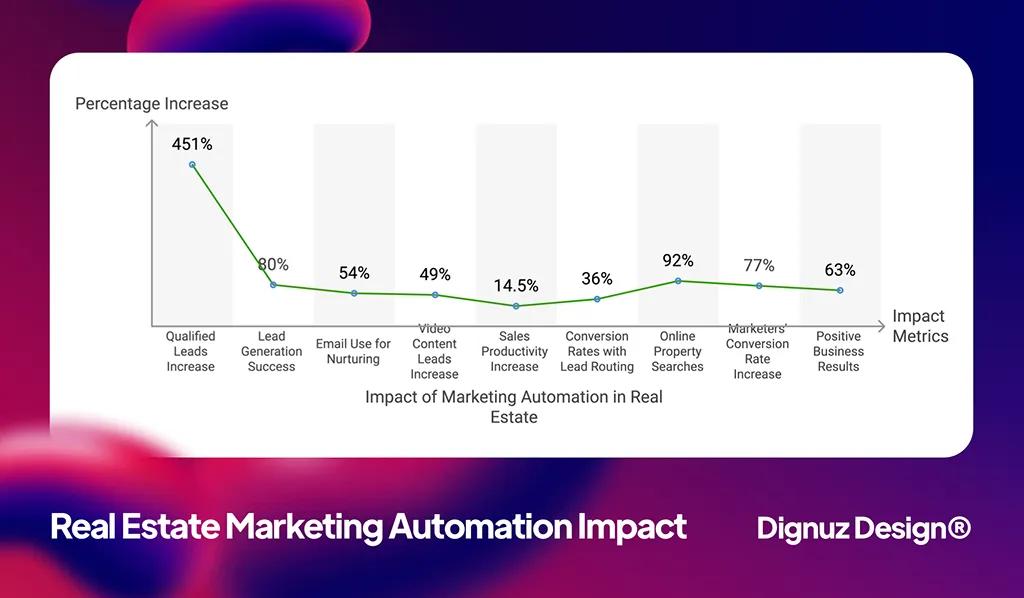
The headline statistics that circulate around marketing automation are wildly oversold. You will see numbers like "451% increase in qualified leads" repeated in vendor blog posts without a primary source. Most of these figures originate in case studies of single companies in unrelated industries, then get laundered through enough secondary articles that they read as universal truths. Real estate has its own dynamics, and the actual lift from automation depends on which step you are automating and what the prior baseline was.
The honest version is this. Automation in property marketing has three jobs. It buys you speed at the moment a lead arrives. It buys you consistency in follow-up over weeks and months when human attention drifts. And it buys you measurement, because manual processes do not leave behind the data trails you need to improve anything. Each of those jobs is worth investing in, but they have different costs and different failure modes. Treating them as one undifferentiated "automation strategy" is how teams end up paying for tools they barely use.
The structural failure I see most often is this. An agency buys a CRM, plugs in a generic drip campaign template, wires the website contact form to the CRM, and then declares automation complete. Six months later the open rates on the drip emails are at three percent, the CRM is half full of duplicate records, and nobody trusts the lead scoring. Nothing in that stack is broken. The work to make it useful was never done.
Speed to lead is still the only metric that actually moves the number
If you take one thing away from this article, take this. The single highest-leverage automation in property marketing is the one that gets a real human into contact with a new lead within five minutes of inquiry.
The research behind this is unusually clean. The MIT-led Lead Response Management Study, published in collaboration with InsideSales.com, analyzed several years of data covering thousands of inbound leads. The headline finding from that study is that the odds of qualifying a lead drop by a factor of 21 when the response window stretches from five minutes to thirty minutes, and the odds of contacting the lead at all drop by a factor of 100. Harvard Business Review republished a summary of the same dataset, and the finding has held up across replications.
For property specifically, this matters more than in most industries. A prospective buyer who fills in a contact form on your listing site has almost certainly opened the same listing on three or four portals and competitor sites in the same browsing session. The first agency that lands in their inbox or on the phone holds the conversation. The second agency, even fifteen minutes later, is talking to someone who already has another viewing booked.
The automation that delivers this is not glamorous. It is an inbound webhook from the contact form, a routing rule that pages the right person on the right channel based on property type and price band, and a fallback escalation if that person does not acknowledge within a defined window. The complexity is in the routing rules, not the messaging. A first-touch SMS or auto-reply that buys the human agent four minutes of credibility is fine. A fully automated chatbot pretending to be a human is not, and prospects detect it quickly.
I cover the broader case for why response infrastructure has to be designed into the site itself, not bolted on, in the post on real estate page design for conversion. The contact form is not the end of the funnel. It is the start of an operational process that has to be measured in seconds.
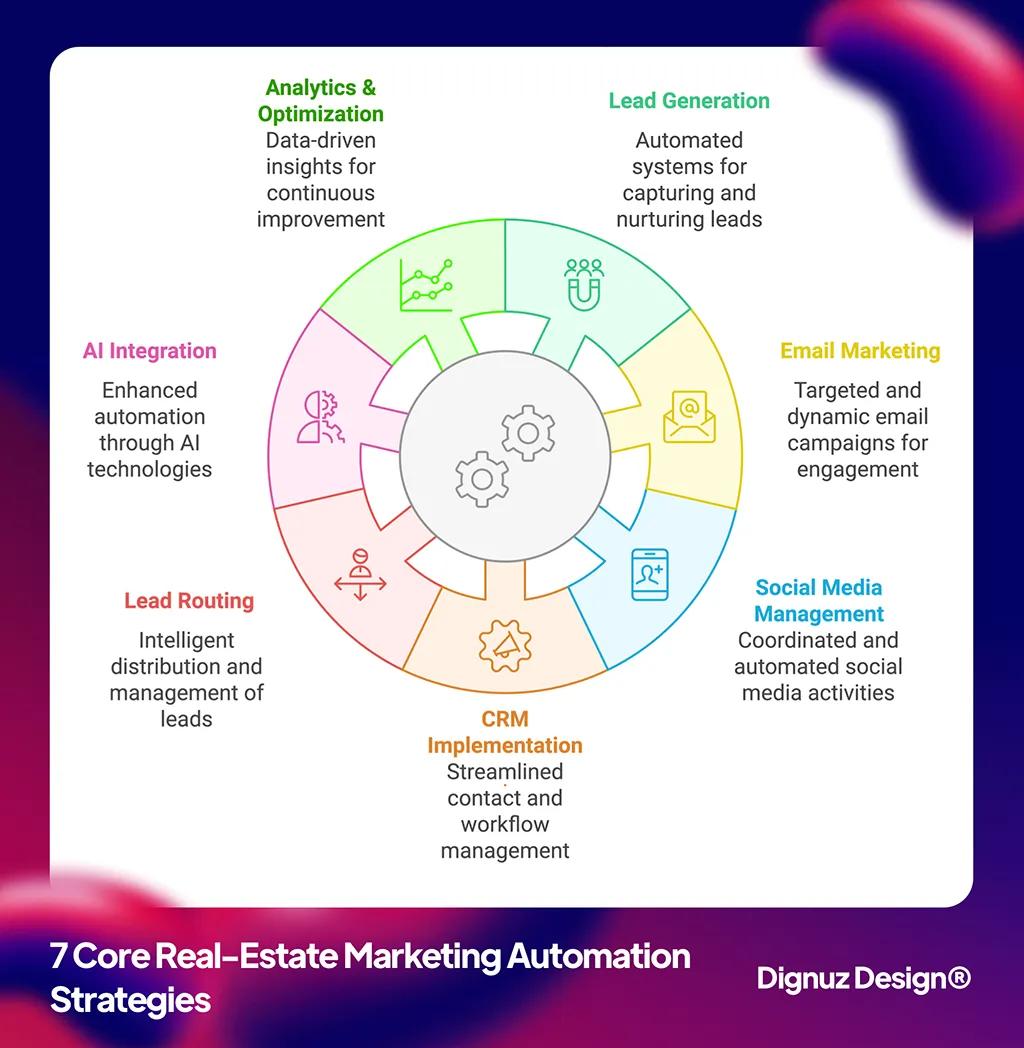
The CRM is a database, not a strategy
The largest category of wasted spend I see in property marketing automation is around the CRM. Agencies buy the platform, fill it up over a year of activity, and then discover that the contact records are full of duplicates, the property preferences are stale, the last-touch dates are missing, and the segmentation they wanted to do is impossible because the data was never structured for it.
The lesson is that the CRM is only as useful as the discipline of the data going into it. Automation does not fix bad data. It accelerates the consequences of bad data. An automated drip campaign keyed to a "downsizer" segment will happily email a hundred records that were tagged downsizer two years ago and have since bought a family home elsewhere. The automation worked perfectly. The result is still that you annoyed a hundred former prospects.
What works in practice is to define a small number of fields that have to be filled in correctly for any record, then enforce that at the point of capture. Source of lead, property type interest, price band, intent timeline. Four fields, validated on entry, are worth more than forty optional fields filled in inconsistently. The 2025 NAR Technology Survey places CRM among the top three lead-generating technologies that Realtors use, behind only social media and the local MLS. That ranking is real, but it is conditional on the CRM being maintained. Most of the CRMs I audit are not.
The other CRM trap is the assumption that the platform you choose has to do everything. The market has consolidated around a few large players, each of which markets itself as an end-to-end system. In practice, a smaller, well-integrated CRM that exposes a clean API and connects cleanly to your website, email tool, and reporting layer will outperform a heavyweight all-in-one that nobody on the team has the patience to configure. The choice is operational, not feature-driven.
Email automation that does not feel like email automation
Drip campaigns are the most over-templated part of property marketing automation. The default templates that ship with most platforms are aimed at e-commerce or general lead nurture, and they sound like it. A property prospect who receives a sequence of seven generic "tips for first-time buyers" emails will mark them as marketing and move on.
The drip sequences that actually perform in property marketing share a few characteristics. They are short. They are tied to specific listings or specific neighborhood activity, not to abstract advice. They acknowledge what the prospect actually did, not what the system assumed. A buyer who registered interest in a two-bedroom flat in a defined area should hear from you when comparable units list, when prices in that area move, and when a development they were looking at announces a launch. Not when your content calendar produces another "how to negotiate" email.
This is where the integration between the website and the email platform earns its keep. If your site is built so that listings can be tagged by buyer-relevant attributes, and those tags flow into the CRM, then drip sequences can trigger off new inventory rather than off calendar dates. That is the difference between a campaign that gets opened and one that gets ignored. The work to make this happen is mostly on the website side, which is one reason I tend to push for a Jamstack-style architecture for property developer sites. A site that is built with structured content and clean APIs feeds the rest of the marketing stack. A site that is a closed CMS does not.
There is one piece of email automation that works without any of this complexity, and that is the transactional layer. Booking confirmations for viewings, document requests, reminders before a scheduled call, follow-ups the morning after a viewing. These are short, expected, and almost universally welcomed. They are also the lowest-risk place to start automating, because nobody will unsubscribe over a viewing confirmation that arrived on time.
Social and paid ads: a smaller win than the vendors claim
Automation around social media in property marketing is a more limited win than the marketing industry tends to admit. Scheduling tools save time on the publishing step. They do not replace the work of producing content that performs in the first place, and that production cost dominates the cycle.
The scheduling and cross-posting layer is worth the small monthly fee. Beyond that, every claim of automated social media management I have seen tested falls down on the same point. The platforms reward content that fits their current native format and penalize content that looks like it was bulk-produced. A scheduling tool that posts the same listing to Instagram, Facebook, and LinkedIn in the same template will see substantially worse reach on at least two of those platforms than the same content adapted natively. For agencies running their own social, the realistic role of automation is queueing and analytics, not generation.
On paid ads, the automation question is sharper. The major ad platforms now run most of their optimization through their own machine-learning systems, which means the practical work is in feeding them clean signals and high-quality creative. Automated rules around budget, audience, and bid management have a real place, but they sit inside the platform rather than across platforms. The error I see is agencies trying to build an external automation layer over Meta and Google ads, when the actual leverage is in giving the platforms enough conversion volume and accurate event tracking to optimize on their own. The site-level instrumentation matters more than the automation rules. I unpacked the platform-specific tactics for Facebook in real estate marketing in a separate article if that is the live channel.
AI and predictive tools: where they help, where they hallucinate
AI is the part of this conversation that has changed most over the past two years. The NAR survey now reports that 68 percent of Realtors have adopted AI tools in some form, while only 17 percent of those report a significant positive business impact. That gap between adoption and impact is worth taking seriously. It is not because AI tools are useless. It is because the obvious applications are over-applied and the useful ones require more setup.
The obvious applications are listing description generation, social caption writing, and chatbot-style first responses to inbound inquiries. These all work in a narrow sense. They produce text that looks fine. The problem is that prospects in a high-stakes purchase decision can tell the difference between a generic AI-generated description and one written by someone who has actually walked the property, and the agencies leaning hardest on AI for this layer are the ones reporting the lowest impact. The first-touch chatbot is the most fragile of all, because every prospect who recognizes it as a bot loses some trust in the agency before a human ever speaks to them.
The applications where AI is quietly delivering value tend to be internal. Summarizing long property documents so an agent can prepare for a viewing without reading thirty pages. Drafting first-pass responses to standard inquiries that the agent then edits in thirty seconds instead of writing from scratch. Sorting and clustering thousands of historical leads to identify which segments actually closed and which did not. This is the kind of work that AmplyDigest was built around in a different domain, distilling long input streams into short useful outputs. AmplyDigest turns email newsletters and YouTube subscriptions into a single morning summary, which sounds unrelated to real estate but illustrates the pattern. AI is most useful where it compresses long inputs into short ones for a human to act on, not where it produces customer-facing content end to end.
On the predictive analytics side, the honest reading is that price prediction models and lead-scoring algorithms are useful when they are trained on enough of your own historical data to be calibrated. Off-the-shelf scoring that runs on a generic model is rarely accurate enough to drive routing decisions, which means the routing rules end up being overridden manually, which means the automation is not really automated. If you are going to invest in predictive tooling, invest in the data pipeline that feeds it first.
The pipeline leak nobody talks about: data quality and integration
Every audit I run on an underperforming marketing automation stack ends up at the same root cause, and it is almost never the choice of tool. It is the integration between tools and the quality of the data flowing through them. The classic patterns to look for are these.
- The website contact form posts to the CRM, but only some of the fields map across, so the CRM record is missing the property the visitor was looking at when they inquired. The first email the prospect receives makes no reference to that property, and the prospect concludes that nobody is paying attention.
- The CRM is the source of truth for some records, the email platform for others, and the ad platforms for a third set, with no reconciliation. The same person ends up in three lists with three different consent statuses, which is also a compliance problem under most data protection regimes.
- Lead source data is captured at the moment of inquiry but lost on subsequent touches, so the reporting layer cannot tell you which channel actually produced the deal six months later. The agency keeps spending on whichever channel feels most active, rather than the one that converts.
- Property data on the site updates faster than the CRM property tags, so drip campaigns reference units that have been sold or withdrawn. Recipients lose trust in the relevance of what you send.
- Analytics events fire inconsistently across browsers and devices, so attribution models silently underweight mobile traffic, which in property is often more than half the inbound volume.
None of these are sexy problems. They are also the ones that determine whether your automation investment compounds or stagnates. The fix in each case is the same: define what data has to flow where, instrument it cleanly, and audit it on a schedule. The work is closer to engineering than to marketing, which is why most marketing teams underinvest in it.
What to automate first, in practical order
If you are sitting on a budget for marketing automation and trying to decide what to do first, the order I recommend after running this work for years with property businesses is the following. Start with response-time infrastructure. Get the first-touch acknowledgment to a new lead inside five minutes, every time, with a human in the loop within fifteen. This is the single highest-impact change you can make and it does not require buying a heavy automation suite.
Second, fix the website-to-CRM data flow. Make sure every inquiry carries with it the listing context, the source channel, and a clean set of preference fields. Audit the resulting records monthly for a quarter to confirm the data is actually clean.
Third, build the transactional email layer. Booking confirmations, viewing follow-ups, document reminders. These are the lowest-risk automated emails and they pay for themselves in time saved by the team.
Fourth, layer in segmented nurture sequences for the long tail of prospects who are six to twenty-four months out from buying. This is where most agencies start and where almost all of them fail, because the prior three layers were not in place. If they are, segmented nurture works and starts producing recovered deals from your existing database, which is the closest thing to free revenue in this business. The same logic shows up in the wider treatment I wrote on digital marketing strategies that produce real ROI for estate agents, where the recovery of cold pipeline is consistently the most underrated channel.
Fifth, only once the first four are working, add the visual marketing automation layer. Listing imagery, 3D content, and interactive tours that flow into your social and ad pipelines. This is where products like AmplyViewer earn their place, because an interactive 3D viewer that lives natively inside your own site lets the same asset feed your listing pages, your email campaigns, and your paid ad creative without ever leaving your domain. The asset is created once and reused across the stack, which is the right kind of automation to invest in.
What not to automate
The shorter list, but the more important one. Do not automate the first substantive conversation with a serious prospect. Do not automate the writing of property descriptions that the prospect will compare line-by-line against the actual unit. Do not automate the handling of complaints or post-sale support, even partially. And do not automate the analytics review itself. A weekly dashboard that nobody actually looks at is not analytics. It is decoration.
The general principle is that automation should free up human attention for the moments where human judgment compounds, and should not be used to remove humans from those moments. Property is a high-trust, high-value transaction. Buyers and sellers detect when they are being processed rather than served, and they pull back. The agencies that grow steadily over time are the ones whose automation pushes the routine work out of the way so the team can be present for the parts that matter.

💻 Let us help you create a stunning online showcase for your projects that works seamlessly across all devices. Ready to amplify your real estate business? 👉 Explore AmplyViewer now
Frequently asked questions
How long does it take to see results from marketing automation in real estate?
The response-time automation pays back immediately, often within the first month, because the very next inquiry that gets handled within five minutes converts at a rate the previous baseline did not. The segmentation and nurture layer takes longer, typically three to six months, because it depends on the database reaching a useful size and on cycles of buyers coming back into the active phase. Predictive and AI layers take longer still, because they need calibrated training data. Anyone promising compounding results inside a few weeks is selling the wrong product.
What is the minimum tool stack for a small property business to start with?
For an agency with one to five agents, a clean stack is a property-oriented CRM with an open API, an email platform that connects cleanly to that CRM, a website built so that forms post structured data to both, and a single dashboarding tool that pulls from all of them. The names matter less than the integrations between them. I generally advise against the all-in-one platforms that promise to replace the stack, because the lock-in costs catch up faster than the time savings.
Can a developer or agency do this without a technical hire?
Partially. The selection and configuration of tools is within reach for a non-technical marketing manager. The integration work, the data audits, and the website instrumentation are usually not, and trying to do them without technical support is where most projects fall over. The pragmatic path is to bring in a developer or studio for the integration phase and the first six months of audits, then maintain the running stack internally. That is how most of the projects I work on are structured.
How does automation handle compliance with data protection rules?
Badly, if you do not design it in from the start. Every automated touch needs a clear basis under the applicable rules, whether that is consent, legitimate interest, or contract. The CRM is the right place to track consent status, and every automated channel needs to read from that field before sending. The most common compliance failure I see is consent captured at the website but not propagated to every downstream system, which is also a data-integration problem dressed up as a legal one.
What is the most overlooked automation in property marketing?
Re-engagement of the cold database. Most property agencies have years of past inquiries sitting in the CRM that were never followed up properly after the first three months. A well-designed re-engagement sequence that surfaces relevant new listings, market updates, or events to that cold database routinely recovers a measurable percentage of those contacts into active conversations. The work is essentially free, because the contacts are already in the system. Almost nobody runs it.
Closing
Marketing automation in real estate is not a product you buy. It is a way of organizing the operational layer of your business so that the team can spend its attention where attention compounds. The agencies that get this right tend to do unglamorous things well: they answer leads in minutes, their CRM is clean, their email tells prospects something they could not have read on a portal, and their reporting tells them honestly which channel is working.
The rest of the stack, the AI assistants, the predictive scores, the dashboards, all of it sits on top of those fundamentals. Skip the fundamentals and the rest of it is noise. Build the fundamentals and the rest of it starts to compound.