Real Estate Marketing on Facebook: What Actually Works

The brief I get from estate agents about Facebook is consistent enough that I can almost predict the email. They have a page with a few thousand followers, they boost the occasional listing, the engagement looks fine on paper, and the leads are thin. Sometimes they have run paid campaigns with a freelancer or an agency, and the cost per inquiry has crept up over time without anyone being able to explain why. What they want to know is whether Facebook is still worth the effort, or whether the budget should move to Instagram, TikTok, or somewhere newer.
The honest answer is that Facebook is still where the buyer audience for most price brackets actually sits, but the platform is a different beast for real estate than it is for almost anything else you might advertise. Meta has wrapped property advertising in restrictions that other industries do not face, the feed mechanics punish content produced for other channels, and the things that work require thinking about the platform as it is now rather than as the generic real estate marketing posts describe it.
I run DignuzDesign, a studio building custom property websites for developers and agents, and I work daily with the content pipeline that feeds those sites into channels like Facebook. The view here is from the practitioner side: what gets built, what gets shipped, and what actually moves on the platform.
Why Facebook still matters for real estate, and where the numbers actually come from
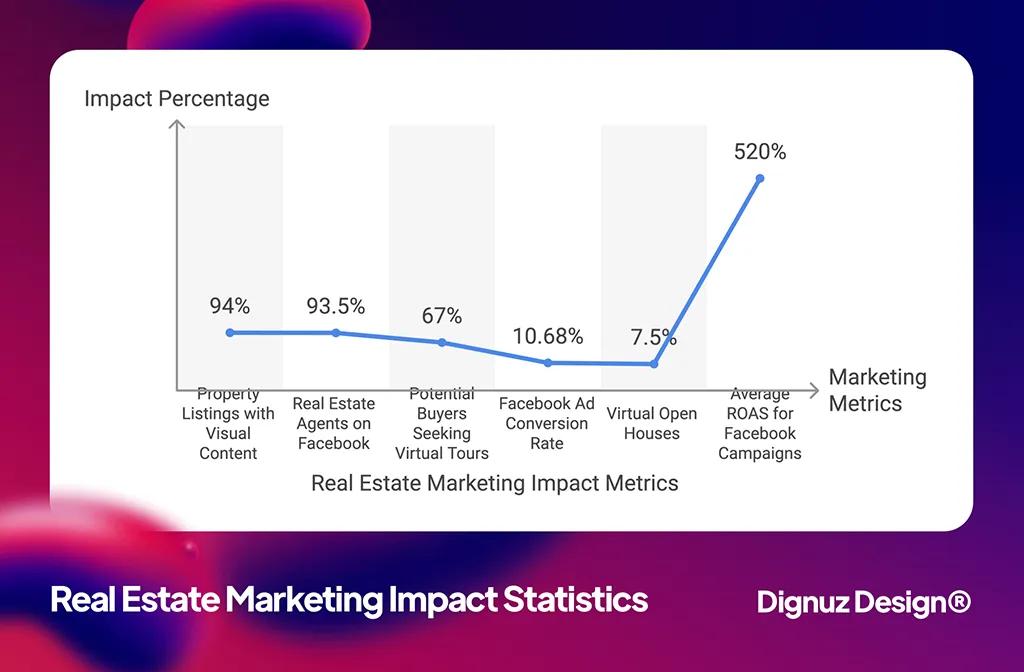
Almost every marketing article on this topic opens with a statistic about how many agents use Facebook. Most of those numbers float around the internet without a primary source. The figure that does hold up is from NAR's annual technology survey. The 2025 REALTOR Technology Survey reports that 87% of agents use Facebook, well ahead of Instagram at 62% and LinkedIn at 48%. Social media is also the single biggest reported source of lead generation in the same survey, ahead of CRM systems and the MLS itself.
That is the supply side. The demand side is more important and more often skipped. Most home buyers under 60 have a Facebook account and check it weekly. They may not actively follow agents, but they see content from neighbours, local groups, and Marketplace listings. This is the asymmetry worth understanding. Facebook is not where buyers go to search for property. It is where they encounter property they were not actively searching for, while doing something else. That changes what the platform can do for an agent or developer.
Treat Facebook as a discovery channel and a remarketing surface, not a search engine. The buyer who hits your listing on Rightmove, Zillow, or your own site is in active search mode. The buyer who scrolls past your reel on Facebook is six months earlier in the journey. The job of your content there is to be memorable enough that when they do start searching, your name surfaces.
The Special Ad Category rule that shapes every real estate campaign
The single most important fact about Facebook real estate advertising is one the generic playbooks rarely mention. Every housing-related ad on Meta has to be declared in the Housing Special Ad Category. This is not optional. It is enforced after a 2022 settlement between Meta and the US Department of Housing and Urban Development, which had alleged that Meta's earlier targeting tools enabled discrimination in housing advertising under the Fair Housing Act.
What that means in practice is that the targeting options you can use for property ads are dramatically narrower than for almost any other category on the platform. You cannot target by age, gender, ZIP code, or many interest-based affinities. The location radius for US campaigns has a 15-mile minimum, which means you cannot show ads only to people in one neighbourhood. Lookalike audiences and Custom Audiences are restricted. Detailed interest targeting is largely stripped out.
The agents who get the most out of Facebook accept this constraint and work with it. The ones who burn budget try to work around it, often by misclassifying their ads as general business promotion rather than housing. Meta's enforcement on this has become aggressive over the past few years. Misclassified ads get rejected, accounts get flagged, and the cost of recovery is high. The right reading is that you cannot win on Facebook by out-targeting your competitors. You have to win on creative, offer, and the funnel that catches the click.
For a deeper view on how this constraint reshapes the broader marketing mix beyond Facebook, the piece on estate agent digital marketing with high ROI covers where to allocate budget when paid social cannot carry the campaign alone.
How the feed actually delivers your content
The next thing the generic articles miss is how Facebook's feed mechanics interact with property content. Three behaviours decide whether your post or ad gets seen, and all three reward production choices that the average property video ignores.
First, video autoplays without sound by default. A walkthrough that opens with an estate agent talking to camera, no captions, no immediate visual hook, gets scrolled past in under a second. Most listing videos I see are produced for YouTube or for the agent's website where the viewer is expected to choose to play with sound. On Facebook, those same videos die in the feed.
Second, the first three seconds determine whether the algorithm gives the post wider distribution. If watch time at second three is short, the post is suppressed before it reaches a meaningful audience. The implication is brutal for property content. A slow opening drone reveal of a coastal estate may be cinematic, but if it loses its audience before the building appears, it never gets reach.
Third, vertical or square framing outperforms horizontal at roughly two to one in feed time, because mobile users see more of a vertical post per scroll. The drone footage your videographer shipped at 16:9 was edited for a different platform.
The practical translation: every piece of property video that lives on Facebook needs a Facebook-specific cut, not the same MP4 you put on YouTube. Square or vertical framing. Captions burned in. A hook in the first second, not a slow build. Music or sound design assumed to be muted. The hero shot of the property visible immediately. This sounds obvious until you audit a typical agent's content schedule and find that all eight posts last month were horizontal videos with no captions.
Where 3D content earns its place on Facebook, and where it does not
Most articles about real estate on Facebook now include something about virtual tours and 3D experiences, because both are now table stakes in serious listings. The relevant question for an agent or developer is which 3D content works on the platform itself, versus which works as a follow-up after the platform has done its job.
NAR has published research showing that 94% of listings still do not include a virtual tour even though most buyers want one. The gap is closing but slowly. The independent research is more careful about the size of the effect. The 2024 NBER working paper on virtual tours, which analyzed roughly 75,000 home sales, found that virtual tours increase sale price by an average of about 1% and the effect is strongest in competitive markets and for less experienced agents. It is a real effect, repeatable, but smaller than the inflated 31% faster sale figure that circulates in marketing posts without a primary source.
What does that mean for Facebook specifically? The fully interactive 3D experience does not live on Facebook. The platform's video and image formats cannot host a navigable model that the viewer controls with a mouse or finger. What lives on Facebook is the trailer for that experience. A six-second clip of the camera flying through a kitchen and into a living room is something the feed will deliver. A click then takes the user off Facebook and onto the agent or developer's own site, where the full interactive experience runs.
The architectural decision worth making early is to keep the navigable 3D viewer on a domain you control, with metrics you can measure. This is why I built AmplyViewer as an embedded interactive viewer that sits inside the studio or developer's own site rather than on a third-party platform. The clip on Facebook drives the click; the click lands on your domain; the engagement is measured in your analytics, not in Matterport's or Zillow's. The full pipeline is what closes the loop. If the destination is somebody else's platform, you have paid Facebook for traffic and handed the engagement signal to a competitor.
Faraday3D, the visualization studio I run alongside DignuzDesign, produces a lot of the underlying 3D content that feeds this pipeline for developer clients. The production decision that matters here, more than any single rendering tool, is that the same 3D model has to ship in multiple formats: a navigable viewer for the site, a 15-second vertical clip for Facebook and Instagram reels, a 60-second horizontal cut for YouTube, and a handful of stills that work in carousel ads. A 3D producer who delivers only the 4K cinematic file is delivering one variant of an asset that should yield five.
Ad formats that work for property and the ones that disappoint
Within Facebook's ad system, the formats that consistently outperform for property fall into a narrower set than the platform's documentation suggests.
Carousel ads, where each card shows a different room or angle of the same property, have a structural advantage. They give the viewer a reason to swipe, and swipes are the engagement signal Meta uses to decide who else sees the ad. They also let one ad show the full visual story of a listing rather than just a single hero image. The honest caveat is that carousel ads only work if the images themselves are good. Five mediocre interior photos in a row do worse than one strong one, because each weak card resets the viewer's expectations.
Video ads, when produced to the Facebook-specific constraints discussed above, are the format that scales best for developer clients with a launch budget. The reach is broader than carousel, the cost per thousand impressions is competitive, and the format suits the discovery-stage audience that Facebook actually delivers. The cost per qualified lead from video tends to be higher than from search, but the audience reached is people who were not yet searching, which is the point.
Lead Ad forms, which let the user submit interest without leaving Facebook, have a deceptive quality. The cost per lead looks excellent because the friction is so low, but the lead quality is correspondingly weak. Many of those submissions come from users who tapped reflexively because the form was pre-filled. For low-engagement campaigns this is fine. For high-intent property inquiries it is usually a worse outcome than driving traffic to a properly designed listing page on your own site. The principles for what such a page should look like are covered in the post on property listing design best practices.
Marketplace listings, distinct from feed ads, deserve a separate mention. For rental and lower-priced sale stock in markets where Marketplace is active, organic Marketplace listings produce real inbound inquiries at zero ad cost. The trade-off is that the conversation lives in Messenger and the lead does not enter your CRM unless you forward it. For developers running multiple units, the friction usually outweighs the benefit. For individual agents listing one or two properties, it is the most underused free channel on the platform.
Virtual open houses, live broadcasts, and the events that actually work
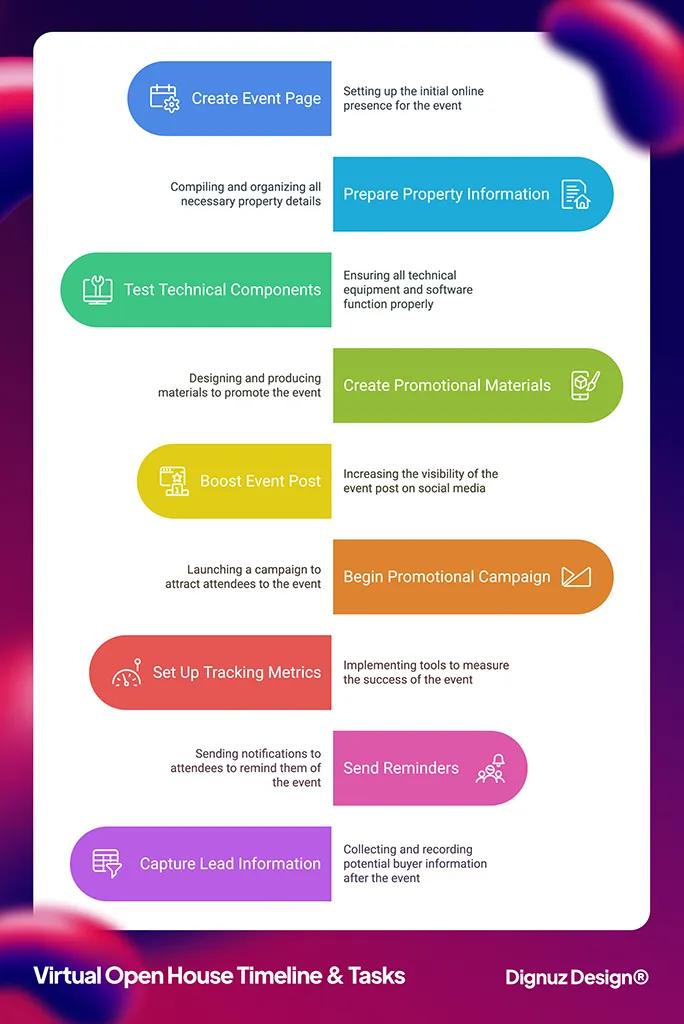
Facebook Live for property events sits in a strange middle ground. The original article on this topic implied that virtual open houses were a clear win, but the reality is more nuanced. Live broadcasts have huge organic reach when they perform, and almost no reach when they do not. The deciding factor is whether the audience knew the broadcast was coming.
An open house event that is announced four hours before it goes live, with no email follow-up to existing prospects and no paid promotion of the event itself, will get six viewers, three of whom are the agent's colleagues. The same broadcast preceded by a week of feed posts, a Messenger broadcast to interested past inquiries, and a small ad spend boosting the event listing itself, will get several hundred. The difference is not in the broadcast quality. It is in the pre-event distribution.
The other quiet truth about virtual open houses is that the watch-time distribution is heavily skewed. A few viewers stay for the full broadcast and become qualified inquiries. Most drop after a few minutes. The right way to use Live is therefore to record it, edit a clean three-minute highlight, and re-distribute that as the long-tail asset across feed, reels, and email for the following two weeks. The live event is the production opportunity. The edited cut is the marketing asset.
For agents and developers thinking about how to systematize this kind of event-led content, the piece on real estate marketing automation strategies covers the follow-up flow that turns one event into many months of touchpoints.
Tracking, attribution, and what to do about iOS 14.5 and beyond
Anyone running Facebook ads for real estate after 2021 has to come to terms with the fact that the attribution data is no longer what it was. Apple's privacy framework, combined with growing user opt-out rates across platforms, means that Meta's reported conversion numbers are model-estimated rather than directly observed for a significant slice of users. The reported cost per lead in Ads Manager is best treated as a rough indicator, not a precise number.
The practical adjustment is to triangulate. Take Meta's reported conversion numbers, your website analytics from GA4 or your preferred tool, and your CRM's lead-source data. None of the three are complete, but the intersection tells you the truth. Inquiries that match a Facebook click in the same hour are almost certainly Facebook-sourced. Inquiries with no traceable origin are increasingly common and tend to skew toward the channels with the worst attribution, which is exactly Facebook.
The bigger structural fix is to use a server-side tracking implementation (Meta's Conversions API or its equivalent through your tag manager) instead of relying only on the browser pixel. This restores a meaningful share of the measurement that pixel-only setups lose. For developer clients running multi-month campaigns, the server-side setup is the single technical investment that improves campaign quality more than any creative change. The cost is real but bounded, and the payback is in the optimization signal that lets Meta's algorithm find the audience that actually converts.
The other prerequisite for any of this to work is a fast, well-built destination page. Half the Facebook campaigns I audit are running to listing pages that take six seconds to load on a mid-range Android phone, which is where most of the audience actually sits. The ad spend buys the click, the slow page loses it. This is not a Facebook problem; it is a website problem that compounds with every paid channel. The patterns that fix it are covered in the post on real estate website speed optimization.
Production decisions that compound across Facebook and the rest of the marketing stack
The single most useful framing I can offer agents and developers thinking about Facebook is that the platform rewards a specific kind of content production discipline. If your visual content is good enough to perform on Facebook's silent, vertical, mobile feed, it is almost certainly good enough to perform everywhere else. The reverse is not true. Content optimized for your website's hero section, for a Rightmove listing, or for a printed brochure routinely fails on Facebook.
This is why I push developer clients to think of their 3D and photography pipeline as a multi-format production from the start. The hero render exists. The vertical clip cut from the same model exists. The carousel-friendly set of square stills exists. The interactive viewer for the website exists. None of these are afterthoughts; all four are deliverables specified at the start of the project. Producing them together is a fraction of the cost of producing them sequentially when each channel's manager asks for their format six weeks later. The deeper logic of why this matters is laid out in the comparison of 2D versus 3D design treatments for property work.
For my own information diet, this is also where a tool like AmplyDigest earns its place. Following the right architecture, real estate, and marketing newsletters and getting a single curated digest in the morning is what has let me notice when the platform changes faster than the marketing blogs do. Most of the actually relevant updates on Meta's housing policy in the last few years did not surface in real estate marketing publications. They surfaced in legal and policy circles months earlier.
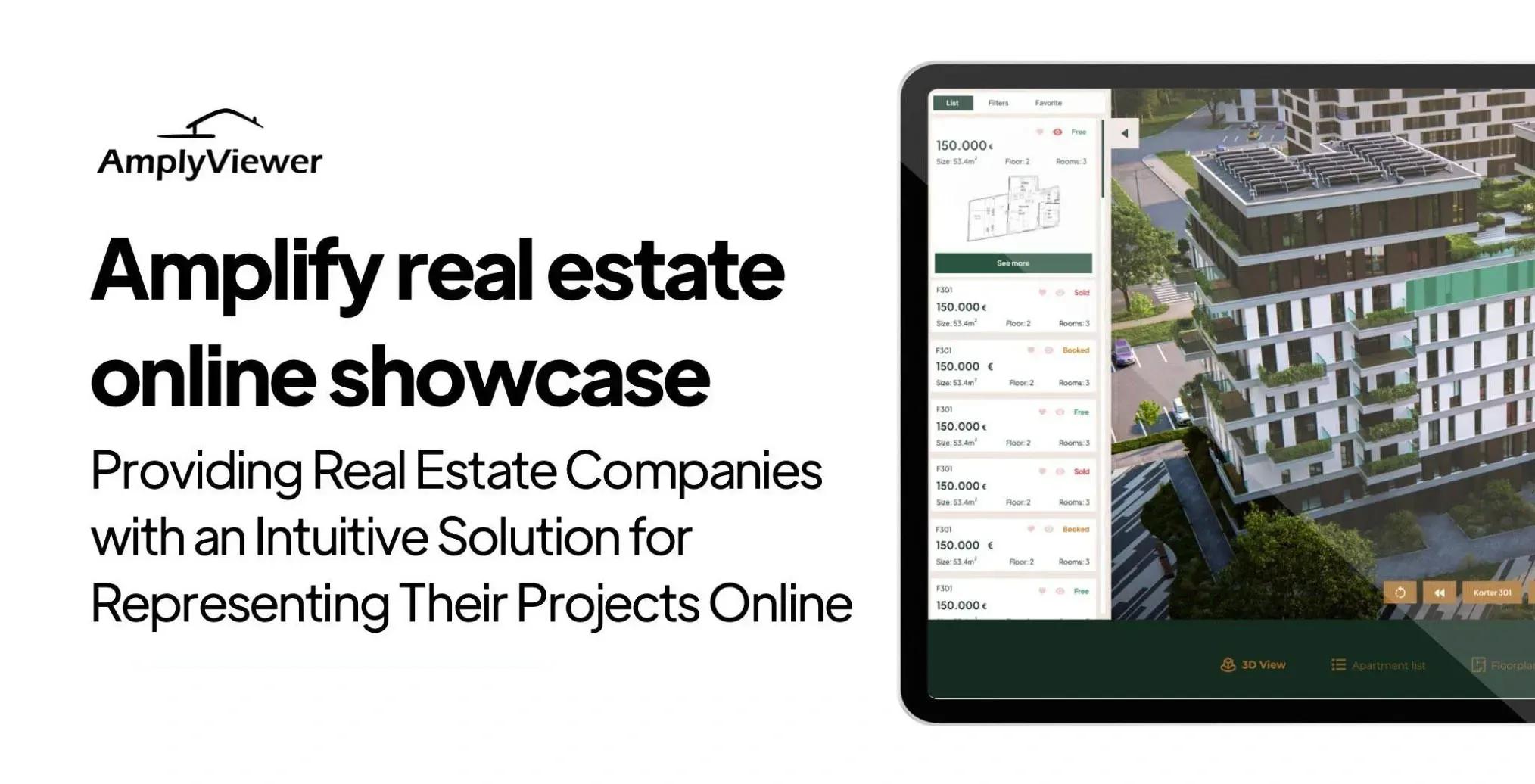
💻 Let us help you create a stunning online showcase for your projects that works seamlessly across all devices. Ready to amplify your real estate business? 👉 Explore AmplyViewer now
The honest bottom line for agents and developers
Facebook real estate marketing is not dead and not magic. It is a discovery and remarketing channel with strict targeting rules, particular content demands, and degraded attribution. Treated as such, it produces inquiries at a cost per lead competitive with most paid alternatives and well below traditional channels. Treated as a generic social media platform that you can run search-intent campaigns on, it disappoints.
The agents and developers who do well on it tend to share four habits. They accept the Special Ad Category constraints and stop trying to outsmart them. They produce content specifically for Facebook's feed mechanics, not repurpose YouTube or website assets. They send paid traffic to fast, well-instrumented pages on their own domain. And they measure outcomes against CRM data rather than against the platform's self-reported numbers.
The broader pattern that holds across most channels we work with for property clients - that the production discipline is what compounds, not the channel itself - is covered in more detail in the companion piece on real estate social media marketing and the longer treatment of how immersive 3D real estate experiences contribute to sales.
Frequently asked questions about real estate marketing on Facebook
How much should a real estate agent budget for Facebook ads per month?
For an individual agent running their own listings, a realistic floor is around the cost of a small monthly retainer for a freelancer who can manage campaigns, plus a creative budget for new visual assets. The ad spend itself is secondary to those two costs in the first six months. Anything under that floor produces too little data for Meta's algorithm to optimize, and any underperformance is more likely a creative or destination-page problem than a budget problem. Developer clients with a new launch typically spend an order of magnitude more, scaled to the size of the release.
Is it worth running Facebook ads for a single high-value luxury property?
Sometimes, but the Special Ad Category constraints make it harder than for mid-market stock. You cannot target by income, occupation, or interest in luxury goods. The 15-mile radius restriction means you cannot show ads only to specific affluent postcodes. For genuinely high-value listings, the better Facebook strategy is usually organic reach through the agent's own audience and developer's owned channels, combined with paid distribution of editorial-style content that is not classified as a housing ad. The luxury market in particular benefits from the editorial routes covered separately.
What kind of content gets the highest engagement on a real estate Facebook page?
Short vertical video of a single property feature, paired with a price and a location, consistently outperforms full property tours, market commentary, or agent personal-brand content. Specifically, content that answers a viewer's first question (what is the property, where is it, what does it cost) in the first three seconds tends to retain audience to the end. Personal-brand posts about the agent's lifestyle work for audience warmth but rarely produce inquiries directly.
Can I use Facebook Marketplace to list properties for sale?
Yes for rentals and lower-priced sale stock in most active markets, but the lead handling lives in Messenger rather than in any CRM. For one or two properties this is manageable. For a developer running thirty units it produces operational drag. The pragmatic split is to use Marketplace for rentals and individual resale listings while keeping new-build development marketing in the paid ad system where you can route inquiries through a normal funnel.
How do I measure whether my Facebook ads are actually working?
Triangulate three sources rather than trusting any single one. Meta Ads Manager gives you a campaign-level view that is model-estimated and slightly optimistic. Your website analytics tool gives you a session-level view that loses traffic from users who opted out of tracking. Your CRM gives you the eventual outcome with a known source for each inquiry. The truth is in the intersection. If all three agree a campaign produced thirty leads in a month, it produced thirty leads. If only Meta says so, you have a measurement gap, not a result.
Do I need a 3D virtual tour to advertise property on Facebook?
You do not need one to run the ads, but you increasingly need one for the destination page the ads send traffic to. The independent research on virtual tour effectiveness in the NBER paper is clear that the lift is real, repeatable, and bigger in competitive markets. A Facebook click that lands on a listing page with only flat photography sees lower conversion than the same click landing on a page with an embedded interactive viewer. The 3D content does not perform on Facebook itself; it performs after Facebook has done its work.