Custom vs Template Real Estate Websites: What Actually Breaks

The phrase "custom real estate website" has been so abused by marketing copy that it has lost almost all meaning. Every agency calls their work custom. Every template is sold as "fully customizable". The owner of a property business reads a hundred pages of identical copy promising the same vague advantages, then makes a decision based on price, because nothing else in the conversation distinguishes the options.
I run DignuzDesign, a small studio that builds property developer, architect, and estate agency websites on Astro, Webflow, and Cloudflare. A lot of my work is rescue work. Someone bought a template, layered three plugins on top, called it custom, and eighteen months later cannot edit a listing without breaking the layout. I write this article from inside that experience, not from a position paper. The honest comparison between custom and template real estate websites is not the one most agencies sell. It is narrower, more specific, and a lot less flattering to the custom side than the marketing makes it sound.
The dishonest framing nobody pushes back on
Most articles on this topic line up two columns. Custom on the left, template on the right. Every cell on the custom side is green. Every cell on the template side is yellow or red. The conclusion is foregone. Custom wins on speed, SEO, security, branding, conversions, and ROI. The reader closes the article slightly more confused than when they opened it, because no actual property business performs across every one of those axes simultaneously.
The honest framing is narrower. A template real estate website is a defensible choice for a single-agent business with under twenty listings, a static portfolio, and no need to differentiate visually from competitors. A custom build is the right choice the moment any of those three conditions stops holding. The day you need to show twelve developments with distinct identities, the day you need a 3D viewer on a flagship property, the day your branding has to feel like a luxury home rather than a stock CMS, the template stops earning its place.
The interesting question is not "which is better in the abstract". It is "which one fails first at the scale my business is heading toward". That is the question almost nobody answers, so I will try to answer it honestly here.
Where buyers actually spend their attention
According to the NAR Profile of Home Buyers and Sellers, more than half of buyers find their home online, and roughly seventy percent of property searches happen on a mobile or tablet device. That second number is the one most agency proposals quietly ignore. A property website is a mobile product first and a desktop product second. Every design decision should be sanity-checked against that fact, and most are not.
Template builders give you a responsive design, technically. The home page rearranges. The navigation collapses into a hamburger menu. The hero image scales down. What templates do not give you is a listing detail page designed from the ground up for the way buyers actually behave on phones. The buyer who is about to inquire on a $900,000 apartment is on a phone, on a sofa, swiping between three or four listings on different sites at once. The listing page that loads in under two seconds, shows the right photo as the hero, and puts the contact form a thumb-flick away wins that comparison. The one held together by a builder plugin loses it. I cover the specifics in property listing design best practices, but the short version is that this is where every template build I have audited has been weakest, and where every custom build I have shipped has done the bulk of its job.
The plugin tax: where template economics actually live
The thing nobody warns you about when buying a template based real estate site is that the sticker price is the smallest cost on the invoice. The real cost lives in the dependency tree underneath. A typical WordPress property template ships with a parent theme, a child theme, a page builder, a custom post type plugin for listings, a search and filter plugin, an MLS importer if you need one, a forms plugin, a caching plugin, and an SEO plugin. Each of those is a separately maintained piece of software, by a separate vendor, with its own update schedule, its own breaking changes, and its own opportunity to abandon the product.
What this means in practice is that the template build is not one product. It is eight or nine products held together by configuration, and the property business owner is the integration tester. A plugin pushes a major version. The page builder stops talking to the theme. A custom field disappears from the listing template. The owner calls the original developer who left the freelance market two years ago. The owner then calls me, and the rescue starts.
The cost of that rescue is reliably higher than the cost of building correctly from scratch. The original $4,000 to $7,000 quote turns into a $12,000 to $18,000 rebuild within two years. I have written about how to build an affordable custom site without paying for it twice, and the math behind that article is drawn from somewhere between thirty and forty rescue jobs in the last few years. The dishonest part of the template pitch is not the upfront price. It is the way the ongoing dependency cost is hidden.
Why speed kills property templates specifically
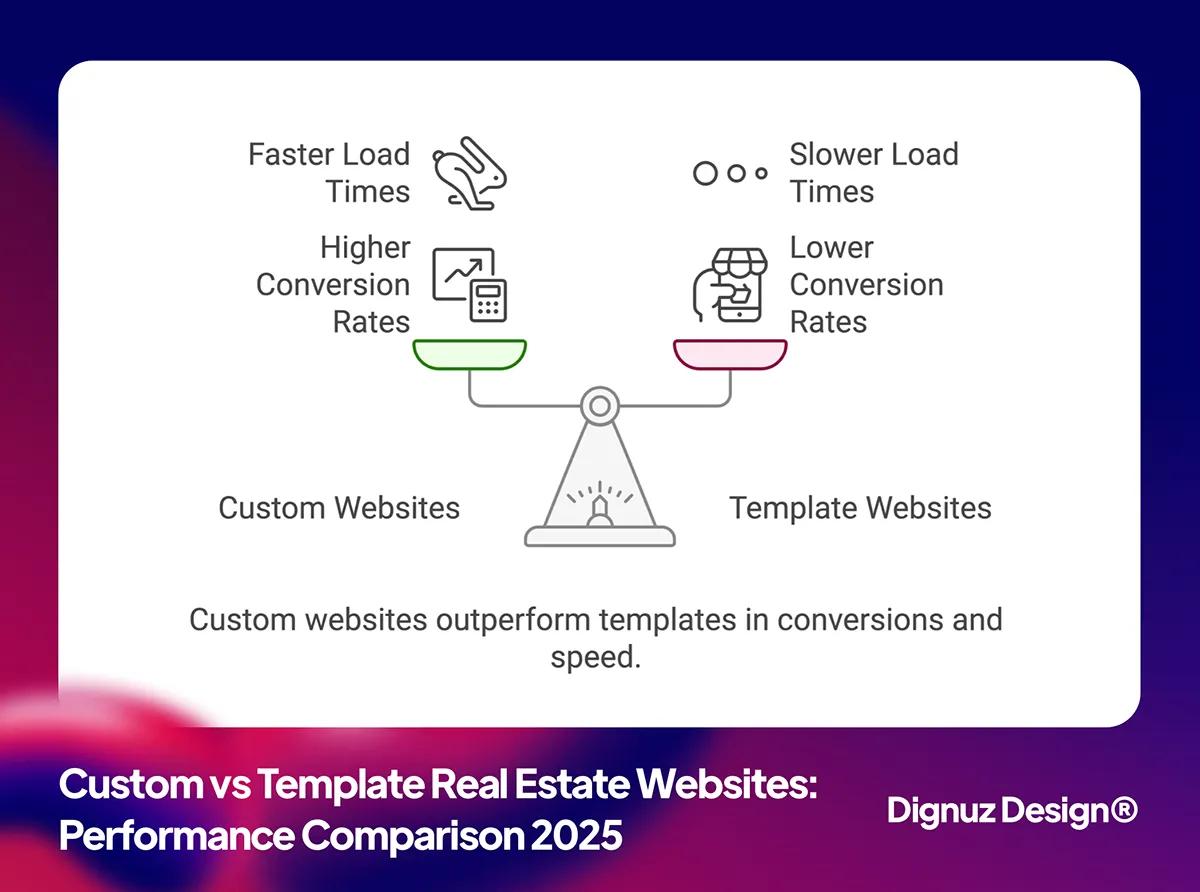
Speed matters on every website. It matters disproportionately on property websites because the buyer is comparing across multiple tabs simultaneously, and the slow tab loses by default. Google's own Search Central documentation on Core Web Vitals confirms that page experience metrics are used as ranking signals. This is not a marketing claim. It is published Google policy.
Template real estate sites are slow for structural reasons, not lazy reasons. The page builder loads its own framework on every page. The theme loads jQuery and a sliders library and a lightbox library because three of its components need them. The MLS plugin queries the database on every page load. The SEO plugin injects its own scripts. The end result is a homepage that ships eight megabytes of compressed assets to a mobile user on a 4G connection in a basement. None of this is a single developer being lazy. It is the architecture doing what it was designed to do.
A modern static build skips the entire stack. Astro renders the HTML at build time. Cloudflare serves it from an edge near the buyer. Images are converted to AVIF and served at the size the device needs. The page is interactive in under a second on the same mobile connection that took the template eight to load. I wrote in detail about this in real estate website speed optimization, and the specifics there are not theoretical. They are what I do every week on production builds.
The reason this matters commercially is straightforward. Slower pages convert worse, and they rank worse. Both effects compound. A property site that drops to page two of search results for a competitive local term loses roughly four fifths of its organic traffic. A property site that adds two seconds to its listing detail page load time loses inquiries silently, because nobody emails to tell you they bounced. Speed is the most boring axis in this debate and the one with the largest revenue impact.
The mobile reality buyers expect now
The Zillow Consumer Housing Trends Report tracks how property consumers actually use websites, and the trend that most affects this decision is the steady climb of mobile-first behavior. Renters and buyers expect digital features as standard, with the majority describing photos, floor plans, and clean mobile presentation as essential rather than nice to have. That expectation does not flex around what your site happens to support. If your floor plan is a pinch-to-zoom JPEG inside a third-party gallery widget that loads after two seconds of empty space, the buyer is on a competitor tab before your site has rendered.
This is where I see template sites fail in a way that does not show up in any agency proposal. The desktop view passes a casual review. The mobile listing page is broken in the way that nobody quite catches because the agency reviewed on a 15-inch laptop in good Wi-Fi. The owner approves the launch. The buyer never inquires. Nobody connects the dots.
What custom actually buys you that templates cannot
Stripping the marketing copy out, custom buys you four things that templates structurally cannot deliver. None of them are abstract.
The first is ownership. The site is your code, on infrastructure you control, with no theme author who can disappear and no plugin license that can expire. Two years from now, if your relationship with me ends, the build is portable to another developer in a week. Most template builds are not portable. They are tied to the specific theme and plugin combination that built them, and changing developers means rebuilding from scratch.
The second is a listing page tuned to your inventory. Templates give you a generic listing layout. Custom gives you a layout that reflects what you sell. A luxury new build developer needs a hero gallery, a floor plan that opens to full screen, a price band that includes monthly mortgage estimates, and a virtual tour embed. An off-plan developer needs a completion timeline, a payment schedule, and a 3D unit explorer. An estate agency needs a fast filter and a saved search. The same template cannot serve all three, and serving any of them well requires actual design work on the listing page, not on the home page.
The third is visual identity. Templates make every site look like every other site running the same template. For most agencies in a competitive local market, that is fine. For developers and architects whose entire pitch is the quality of their work, it is corrosive. The site is the first sample of work the buyer sees. If it looks like a stock template, the assumption is that everything else does too. I covered this angle in detail in luxury real estate website design, but the principle holds at every price point. The site is part of the product. It either signals care or it signals corners cut.
The fourth, and most underrated, is the ability to plug specialised tooling in cleanly. My own product, AmplyViewer, is an interactive 3D property viewer that embeds inside a listing page so buyers can explore a unit before booking a visit. It is built specifically for property sites and slots into a custom build in a few hours. On a template site, the same integration becomes a wrestling match with a page builder, a custom post type, and a caching plugin that all want to do something different with the embed. That work I do at Faraday3D on the 3D side feeds directly into what AmplyViewer can show, which is a level of integration no template stack accommodates cleanly.
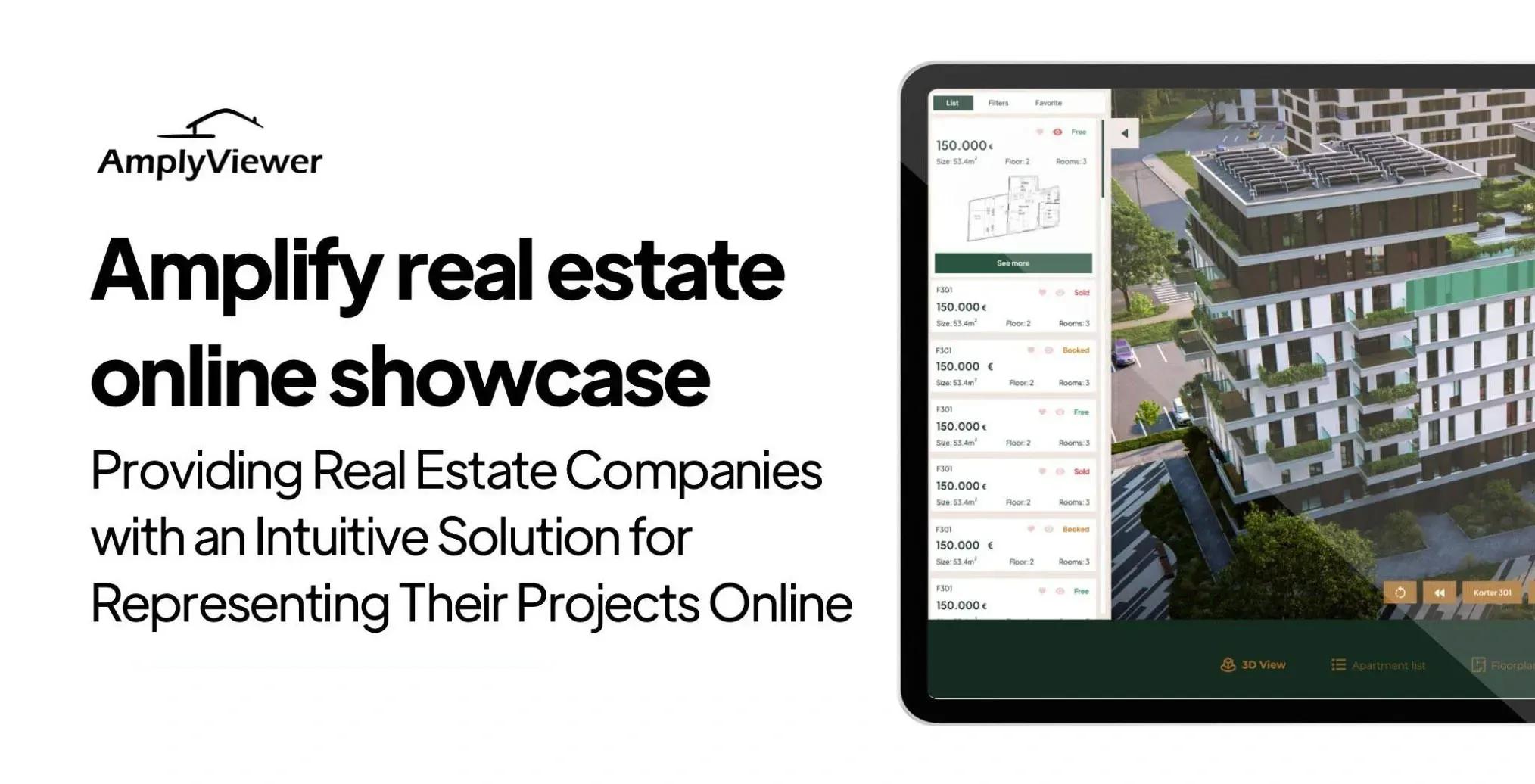
💻 Let us help you create a stunning online showcase for your projects that works seamlessly across all devices. Ready to amplify your real estate business? 👉 Explore AmplyViewer now
Where the line actually sits
Here is the part nobody in my industry will say out loud. Not every property business needs a custom site. A solo estate agent with five listings, a referral-based pipeline, and no growth ambition is overspending if they pay for a custom build. A polished theme on a clean CMS, set up properly the first time, will serve them for years. The honest advice for that business is to buy a good template, hire a developer for one day of setup, and stop thinking about the site.
The line shifts the moment one of three things is true. The first is that the business has more than fifteen or twenty active listings, because at that point search, filtering, and content management start to fight the template. The second is that the brand needs to look distinctive, because in luxury, off-plan, and architect markets the site is part of the sales conversation. The third is that any specialised feature is on the roadmap, including 3D viewers, virtual tours, integrated CRM hooks, or off-plan payment schedule tooling. Any one of those three pushes the calculation across the line into custom.
If you are unsure which side you fall on, the question to ask is not "do I want a custom site". It is "will my business look the same in three years as it does today". If the answer is yes, a template will serve. If the answer is no, the template will become a constraint long before the three years are up, and you will pay for a rebuild on top of the original spend.
The cost picture has actually changed
The other thing missing from most custom-versus-template articles is that the cost gap has closed dramatically in the last few years. The old quote ranges still cited by older agencies, where custom meant $25,000 minimum and templates meant $2,000 maximum, are based on tooling from a different era. Static site generators, edge hosting, and Webflow's CMS have collapsed the labour cost of a custom build. I covered the new economics in Jamstack for property developer sites, and the short version is this: a small studio shipping on a modern stack can deliver a genuinely custom property site for somewhere between $5,000 and $12,000, with maintenance costs lower than a comparable WordPress build.
That number is not what most agencies will quote you, because most agencies have not modernised their workflow. When you read a quote, the question to ask is whether the price reflects current tools or 2019 tools. A developer pricing from current tools will give you a sharper number. A developer pricing from old tools will sell you old labour at the old price. If you want to test this, ask the developer what static site generator or headless CMS they default to, and listen to whether the answer is concrete or vague. The piece on how to choose a web design agency and the one on hiring a real estate website developer both walk through the right diligence questions.
Security is the quietest difference
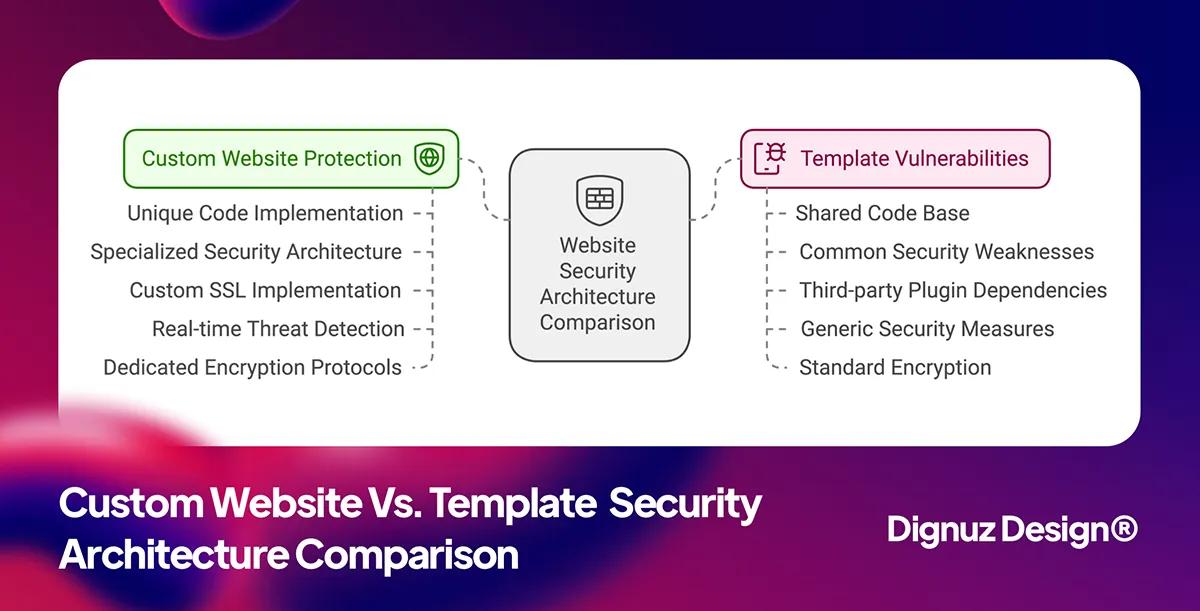
Template real estate sites are not less secure because the developers are careless. They are less secure because the attack surface is larger. Every plugin is a separate codebase that can ship a vulnerability. Every active plugin needs to be patched within days of disclosure, or the site becomes part of the next botnet. A WordPress site with eight plugins inherits the security posture of all eight vendors, and the owner is rarely told this.
A static site with no database and no admin login has almost no attack surface. There is no admin panel to brute force. There is no PHP runtime to exploit. The site is a folder of HTML files served from an edge network. This is not theoretical security. It is the default behaviour of the architecture. For a property business handling buyer inquiries and sometimes payment intent data, the architectural difference is meaningful. It does not eliminate the need for sensible practice, but it removes the standing vulnerability that template-based sites carry by design.
Frequently asked questions
Is a custom real estate website always worth the extra cost?
No. A solo agent with a handful of listings and a referral-driven pipeline is overspending on custom. A property developer, a multi-agent agency, or a business that needs to look distinctive in a competitive market almost always recovers the spend in higher conversion on the listing page and lower long-term maintenance cost. The honest dividing line is not budget. It is whether the business needs visual identity, scale, or specialised features the template cannot deliver.
How long does a custom real estate website take to build?
A focused property developer or estate agency site on a modern stack takes six to nine weeks from kickoff to launch, assuming the client provides content and photography on time. The pieces that stretch the timeline are usually content gathering, brand decisions, and listing data migration, not the build itself. Older agencies quoting twelve to sixteen weeks are usually pricing in slack for an outdated workflow.
Can I move from a template to a custom site without losing my SEO?
Yes, if the migration is done with care. The non-negotiables are preserving the URL structure of every page that has any inbound link or organic traffic, setting up 301 redirects for any URL that has to change, keeping page titles and meta descriptions close to the originals on launch, and submitting the new sitemap immediately. Skipping any of these is the most common reason a redesign loses organic traffic for months. A competent developer will treat this as standard practice, not a special service.
Will a custom site rank better than a template site?
A custom site with clean code, fast load times, and a sensible structure will outrank a template site that ships bloated assets and slow page experience, all else being equal. The ranking advantage comes from technical execution, not from being custom in the abstract. A poorly built custom site is no better than a well-configured template, and there are plenty of both. Treat "custom equals better SEO" as a half-truth. It depends entirely on who builds it.
What is the biggest mistake property businesses make when choosing a template?
Buying based on the demo home page rather than the listing detail page. The demo is the showroom. The listing page is the production line, and that is where the buyer actually decides whether to inquire. Most templates have a beautiful home page and a generic listing template that breaks the moment you add real photos and real prices. Always preview the listing detail page on a phone with realistic content before buying.
What does an honest custom real estate website cost today?
On a modern stack with a small studio, somewhere between five and twelve thousand dollars for a single-brand site with up to a few hundred listings, depending on complexity, integrations, and whether 3D or virtual tour tooling is part of the scope. Quotes significantly higher than that often reflect agency overhead rather than additional value. Quotes significantly lower than that often reflect a template build relabelled as custom.
The honest takeaway
Custom real estate websites do not outperform template solutions because custom is a magic word. They outperform template solutions when the property business has outgrown what a template can structurally deliver, when the listing page actually gets the attention buyers give it, and when the build is done on current tools rather than old ones. In every other case, the comparison is either marketing or self-justification.
If you are sitting with two quotes and trying to choose, do not pick on the comparison table. Pick on the listing detail page. Open it on your phone. Time how long it takes to load. Look at where the inquiry form sits. Look at whether the photographs feel like the price band the property is at. That single page tells you more about which build will earn back its cost than any list of features ever will.