Real Estate Social Media Marketing That Actually Sells

I spend most of my week sitting between three things: the websites I build for property developers and agencies, the 3D renders and virtual tours my visualization studio produces, and the marketing material my clients post on Instagram, Facebook, YouTube, and LinkedIn. That position is unusual, and it has made one thing painfully clear. The reason most real estate social media never produces a real lead is not the algorithm. It is that the feed, the website, and the property experience are designed as if they belong to three different companies.
An agent posts a carousel of photos. A buyer taps through, gets curious, clicks the link in bio, lands on a slow listing page with thumbnail photos and a PDF brochure, and leaves. The post performed beautifully. Nothing sold. This is the gap nobody writes about, and it is the only thing that actually matters once you understand the basics of which platform to post on and how often.
This article is about what works for property professionals in practice. I am Dimitri, owner of DignuzDesign, a web studio building custom sites for real estate companies, architects, and property developers. I will use real numbers from real industry research, not bullet lists of "tips" recycled across a hundred marketing blogs. By the end you should know what to post, where to post it, what the post needs to point to, and how to measure whether any of it is making you money.
The platforms property buyers actually use
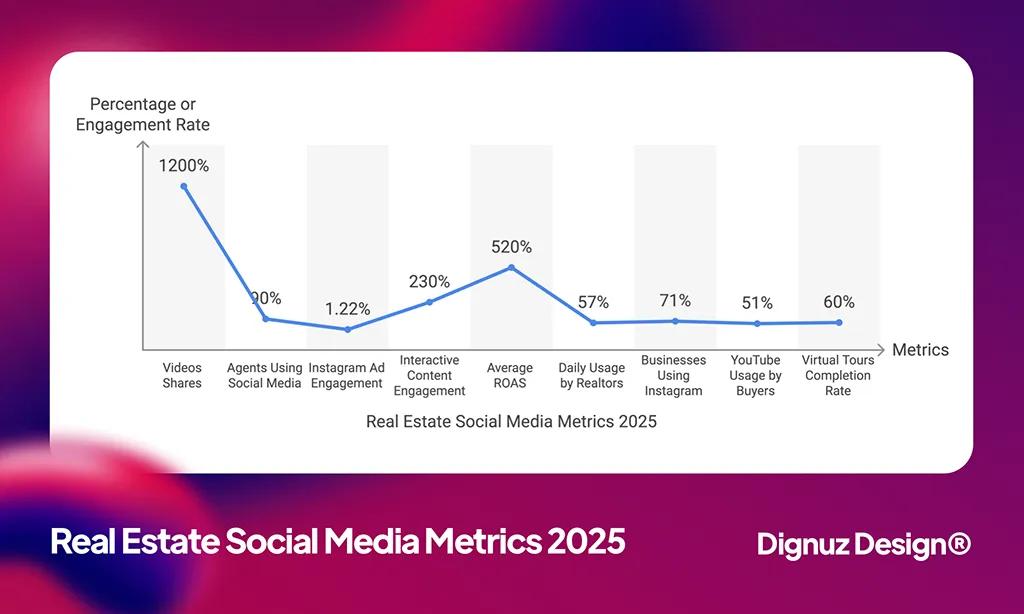
Before strategy, reality. The National Association of Realtors found in its 2025 Technology Survey that 75 percent of agents now use social media for business, and that social media produces the highest share of quality leads of any source, ahead of CRM databases, MLS, and paid ads. That number sits at 39 percent of agents naming social as their best lead source. The methodology and the rest of the survey is published by NAR directly, and it is worth reading because it cuts through the inflated claims floating around.
The platforms behind that lead share are not what most marketing blogs tell you. According to Pew Research Center's 2025 data on U.S. adult social media use, 84 percent of adults use YouTube and 71 percent use Facebook. Instagram sits at 50 percent. TikTok is heavily concentrated in adults under 30. That distribution matters enormously for property work because the median home buyer in the latest Zillow Consumer Housing Trends Report is in their early forties. Your buyer is not on TikTok. Your buyer is on YouTube watching neighborhood walkthroughs and on Facebook seeing what their friends shared.
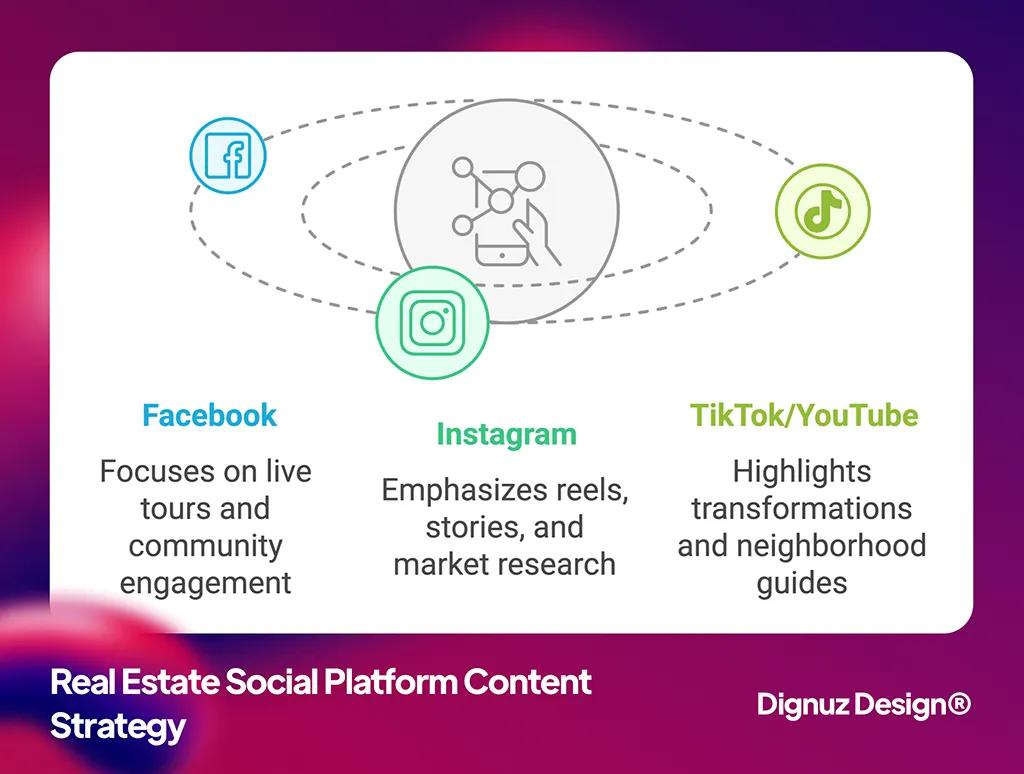
This single fact reorders the whole playbook. Most real estate accounts spend their effort on Instagram because Instagram is what the marketing industry talks about. The platform that actually produces buyer intent at scale is YouTube, and the platform that actually produces shareable local trust signals is Facebook. Instagram is the portfolio, the aesthetic proof, the gateway. None of the three is optional. The mistake is treating them as interchangeable.
YouTube is the search engine you keep ignoring
I have watched listing videos do nothing for two years and then start sending three serious inquiries a week after a single change: the agent finally treated YouTube as a search engine instead of a video gallery. Title the video with the actual neighborhood and the price band ("Two-bedroom apartments in Sant Antoni, Barcelona, around 450k"). Write a real description. Add chapter markers so the buyer can skip to the kitchen. Upload a thumbnail that does not look like every other thumbnail. YouTube is the second largest search engine on the internet, and it indexes every word of your description. Property buyers searching for an area will find a four-month-old listing video before they find a Facebook reel from yesterday.
I cover the production side and the search-discoverability side in more depth in our guide to real estate marketing on YouTube, but the structural point is what changes results: YouTube content compounds. Instagram content evaporates within forty-eight hours. Allocate your time accordingly.
Facebook is your local trust engine
Facebook is where someone's cousin tags them on a listing. It is where a sold-property post collects fifteen comments from neighbors. It is where local groups discuss schools, parking, building works, and which agent is responsive. None of this is glamorous. All of it produces conversations that turn into business. The agencies I work with that take Facebook seriously have a single rule: every listing post is written as if a neighbor will read it, not as if a buyer will. The neighbor is the one who shares it.
The format itself rewards specificity. Long captions outperform short ones for property posts because people read property captions the way they read news about their own street. The specifics of Facebook for real estate deserve their own treatment, but the headline takeaway is to write for the local audience even when the buyer is from elsewhere.
Instagram is the portfolio, not the funnel
Instagram is where someone decides whether you look like a serious operator. It is rarely where they first find you and almost never where they contact you. Treat it that way. Curate ruthlessly. A feed of fourteen identical "Just listed" graphics tells the same story as a real estate website built from a 2014 template. Your Instagram is interview clothes, not the interview itself.
What property buyers actually save and share
Across every project I have worked on, three formats outperform everything else for property: long-form video walkthroughs, before-and-after renderings, and floor plan reveals. Not lifestyle reels. Not motivational quotes over sunsets. Not "five tips for first-time buyers" carousels.
The reason is simple. Real estate is the only purchase most people make where the product is invisible until you visit. Anything that closes that gap - a real walkthrough, a 3D model of an unbuilt apartment, an honest floor plan with measurements - is doing the actual job of marketing. Everything else is decoration.
This is where my second studio comes in. Faraday3D produces architectural renders, virtual tours, and visualizations for property developers, and the patterns are very consistent. A render of an unbuilt apartment with the morning light streaming through the kitchen window outperforms a photo of a finished apartment in flat afternoon light. A walkthrough video with the agent narrating what they noticed when they first walked in outperforms a silent drone flyover. The buyer wants to project themselves into the space. Your job on social is to make that projection easy.
I would go further. For new developments, a still image of a render is the weakest possible use of the asset. The render's value is in motion - a slow camera move through the living room, a sun-path animation showing what the balcony looks like at different times of day. These are not luxury extras. They are what produces saves and shares, and saves and shares are what the algorithm uses to decide whether to keep showing your post to anyone.
The handoff problem nobody talks about
Here is the part most articles skip. A successful social post on its own does nothing. It has to hand the buyer off to something. That something is almost always a website, and the quality of the handoff is what decides whether the post produced a lead or just produced a metric.
The most common failure I see is this. Strong post on Instagram. The link in bio goes to a Linktree. The Linktree goes to a property page hosted on a generic CRM. The property page loads in five seconds, shows eight low-resolution photos, and has a contact form at the bottom. The buyer is gone. The agent looks at the post analytics, sees high reach and high engagement, and concludes that "social media works." It worked. The website killed it.
Every social campaign needs a landing experience that matches the polish of the post. For a single listing this can be one well-built page with a hero image, a virtual tour, a floor plan, neighborhood context, and a single clear contact action. For a development, it should be a project page with a 3D viewer, renderings, available units, and a calendar booking widget. For an agent's personal brand, it can be a fast, well-designed agent page that reflects the same aesthetic as the feed. We cover the principles of this kind of landing build in our piece on real estate web page design for conversion.
For developments specifically, the gap between social content and the experience on the destination page is the single largest cause of dropped buyer interest I see. This is what AmplyViewer was built for. Our interactive 3D property viewer sits inside the project website and lets a buyer who arrived from a social post explore the building, pick a unit, see the view from that specific floor, and book a viewing. The reason it moves the needle is not the technology. It is that the buyer who tapped a story on Instagram now has something to do on the website other than scroll past photos.
The content discipline behind the accounts that produce leads
The real estate accounts that actually produce inquiries are not the ones with the best individual posts. They are the ones with the most consistent presence. This is the part of social media that is not glamorous and not discussed enough. The agencies winning in 2026 are not winning because of one viral reel. They are winning because they have posted three times a week, every week, for three years, in the same voice, about the same neighborhoods.
That kind of consistency does not happen by inspiration. It happens because someone has built a system. The system is usually some version of the following: a single recording day every fortnight where the agent films five short walkthrough clips, two market-update talking-head clips, and a few transitions. The footage goes into a folder. A part-time editor or a freelancer cuts the clips into posts and schedules them across the platforms. Captions are written from a template that is then customized for each post. Analytics get reviewed monthly, not daily.
If you want to actually do this rather than read about it, I wrote a longer piece on automation strategies for real estate marketing that walks through the scheduling tools and workflow. The tools matter less than the rhythm. An agent posting twice a week from a calendar will beat an agent posting six times a week when they feel inspired.
One useful self-imposed rule: every post needs to answer a question a real buyer asked you that week. Not a hypothetical question, not a "thought leadership" insight. A real question. "How much do service charges run in this building?" "Is the metro extension actually happening?" "What floor gets the morning sun?" These produce content that buyers in the area will recognize as authentic, because it is. The accounts that try to manufacture topics always sound like accounts that are trying to manufacture topics.
Measuring what actually matters
Engagement rate is the most overrated metric in real estate social media. Followers are second. Reach is third. None of these correlate strongly with inquiries, viewings, or sales. The metrics that do correlate are saves, shares, profile visits, and link clicks - in roughly that order for property content.
The reason saves matter so much is specific to this industry. People save listings the way they used to bookmark them in a browser. A save is intent. It is someone telling the algorithm, and themselves, that this property or this agent is worth coming back to. An account producing twenty saves a week is producing meaningful business pipeline even if the follower count is flat. An account producing fifty thousand views and three saves is producing entertainment.
The second metric to watch is profile visits per follower. If you have a thousand followers and four hundred of them visit your profile each week, you have an engaged audience that will eventually convert. If you have ten thousand followers and twenty profile visits, you have decorative numbers. The platforms make this data available in their analytics. Most agents never look.
The third, and the one that actually closes the loop, is attribution at the inquiry. Every contact form should have one extra field: "How did you find us?" with five options including a free text. Without this, you will spend three years guessing which platform is producing money. The agents I work with who track this consistently usually discover that two of their four platforms produce ninety percent of the business. They then stop wasting time on the other two.
💻 Let us help you create a stunning online showcase for your projects that works seamlessly across all devices. Ready to amplify your real estate business? 👉 Explore AmplyViewer now
A note on luxury and high-end property social
Luxury real estate is a separate game on social, and the differences matter. The principles above all apply, but the volume of content is lower and the production value of each piece is much higher. A luxury account that posts five immaculate pieces a month outperforms one that posts twenty rushed ones. The audience is smaller, the buyer is more discerning, and a single sloppy photo can do more brand damage than a missed week. We get into the specifics in our piece on luxury real estate marketing for high-end buyers, but the headline rule is: in luxury, restraint outperforms volume, and the website those posts point to has to look like it costs what the homes cost.
The professional rules most agents break
Social media for real estate exists in a regulated industry and most people forget that constantly. Fair housing language matters. So does disclosure of representation when promoting listings. So does removing a post the day a property goes off market. These are not optional. A single screenshot of a careless post can become a complaint, and a single complaint can cost a license. I have written more on the practical rules in our piece on social media dos and don'ts for realtors. The short version: have a written policy, even if it is just for yourself, and follow it.
Where this leaves you
Real estate social media works when it is treated as the front of a funnel that includes a strong website, real visual content, and a system for consistent posting. It fails when it is treated as a billboard. The platforms with the most reach for property buyers are YouTube and Facebook, with Instagram serving as portfolio and proof. The content that produces saves and shares is video walkthroughs, renderings, and floor plans, not lifestyle content. And the metric that decides whether any of it is working is not engagement rate, it is whether the inquiries are landing in your inbox.
If you want a single place to start, do this. Pick one platform. Commit to two posts a week for ninety days. Make sure every post links to a fast, well-designed page on your own site. Add one question to your contact form asking how the buyer found you. After ninety days you will know more about your actual marketing than most agents in your market.
Frequently asked questions
How often should a real estate agent post on social media?
For most agents, two to four posts a week per platform is the sustainable rhythm. The exact number matters far less than the consistency. An agent posting twice a week for a year will outperform one posting daily for three weeks and then disappearing for a month. The platforms favor accounts with a steady cadence because their algorithms read inconsistency as low signal.
Which social media platform is best for real estate agents?
It depends on what you are selling. For mass-market residential, YouTube and Facebook produce the most buyer intent because that is where your median buyer actually spends time. For luxury and design-driven properties, Instagram drives more engagement among aesthetically motivated buyers. LinkedIn matters mostly for commercial property and investor relationships. Most working agents need a real presence on at least Facebook and one of YouTube or Instagram.
Do I need video to do real estate social media well?
Yes, in the practical sense that no still-photo-only account in 2026 is competitive with accounts producing even basic walkthrough video. You do not need cinematic production. You need consistent, watchable video that gives a buyer a sense of moving through the space. A phone on a gimbal, a clip-on microphone, and decent natural light is enough to start. The agents I work with who tried to wait until they could afford a full production setup lost two years of compound audience growth before realizing the bar was much lower than they thought.
How do I get real estate leads from Instagram?
Instagram rarely produces leads directly. It produces profile visits, and profile visits produce link clicks, and link clicks produce leads if the landing page is built properly. The single highest-leverage change for most agents is improving what sits behind the link in bio. A purpose-built landing page with a clear contact action, an embedded virtual tour, and a single phone number will convert vastly better than a Linktree pointing to a generic listings portal.
How long does it take to see results from real estate social media?
Three to six months for the first inquiries from a cold start, and twelve to eighteen months before social becomes a meaningful share of your business. The agents who quit at month four are the majority. The ones who stay through month nine, when the algorithm finally has enough data to surface their content to the right audience, are the ones who later say social media "just suddenly took off." It did not suddenly take off. It compounded.
Should I run paid ads or focus on organic posts?
For agents starting out, organic almost always comes first. Paid ads amplify whatever is already working organically. Running paid ads on weak posts wastes money. Once you have three or four organic posts that consistently produce inquiries, boosting those exact posts with a small budget is one of the highest-ROI moves in the playbook. Running cold paid ads to people who have never heard of you, with creative built from a template, almost always loses money for individual agents.