Real Estate Visual Identity That Attracts Premium Clients

Premium buyers do not reward prettiness. They reward signal. The noise floor in luxury property marketing is high, and most of the "brand guidelines" documents I get sent, from independent agents and nine-figure developers alike, read like they were filled in from the same Notion template: navy for trust, gold for luxury, two fonts maximum, a photography style that is "warm and timeless." This is cosplay branding. It is also why premium clients keep skipping past it.
I run DignuzDesign, a web studio that builds sites for real estate companies, architects and developers, and Faraday3D, a 3D visualization studio that produces the renders those sites often rely on. Most weeks I am working across a brand system, a property listing template and a 3D viewer at the same time, which is the angle this article is written from. The goal is not to give you a pretty deck. It is to tell you what visual identity actually does in a premium property sale, and where the generic advice breaks.
What "Premium" Actually Means in a Visual System
Premium is not a palette. It is a pattern of restraint. When I look at the work of serious luxury operators, across brokerages, developers and hotel groups, the common thread is almost never a specific color or typeface. It is an unusual density of decisions: fewer fonts, fewer weights, fewer images per screen, longer captions, tighter cropping rules. The brand reads as confident because nothing is fighting for attention.
The failure mode in most "luxury real estate" branding is the opposite: an attempt to look expensive by piling on signifiers. Gold accents. Serif display fonts. Aerial drone b-roll. A website that opens with a seven-second muted video loop. Each element, on its own, is fine. Stacked together they read as someone trying to convince you, which is the least premium thing a visual system can do.
Here is a test I use when I review a client's existing identity: can a cold prospect tell, within the first three screens of the website, that this operator only works with properties above a certain tier? If the answer is no, the identity is decorative rather than positioning. It is producing noise, not signal. Generic advice like "use deep navy to convey trust" is how every mid-tier agent ends up looking like every other mid-tier agent, because the advice treats branding as decoration layered on top of a business rather than a system for communicating what the business actually is.
The Three Layers Most Real Estate Operators Collapse Into One
A real estate visual identity is not one object. It is three, and most agents, even ones with expensive brand books, blur them together. Pulling them apart is the single highest-leverage move I see clients make.

Brand identity: the pieces that never change
This is the fixed layer. Logo, wordmark, type system, core palette, tone of voice, the style of the "For Sale" sign on the front lawn. It should be defined tightly enough that a new hire can apply it without asking permission, and narrow enough that it is visible as a signature even when the logo is not on screen. I have designed and redesigned this layer for property developers in three countries over the last two years, and the most common fixable mistake is palette sprawl. A primary color, a surface color, a text color, one accent. That is the whole budget. If your brand book lists eight "secondary" colors, you do not have a brand, you have a mood board.
The other fixable mistake is assuming serif equals luxury. It does not. Knight Frank uses a clean sans-serif. Christie's International Real Estate leads with a custom serif but pairs it with extremely restrained sans-serif body copy. What reads as premium is the discipline of the pairing, not the family. If you want a deeper treatment of this specifically for developers, we wrote it up in our property developer brand identity guide.
Property identity: the rules that govern each listing
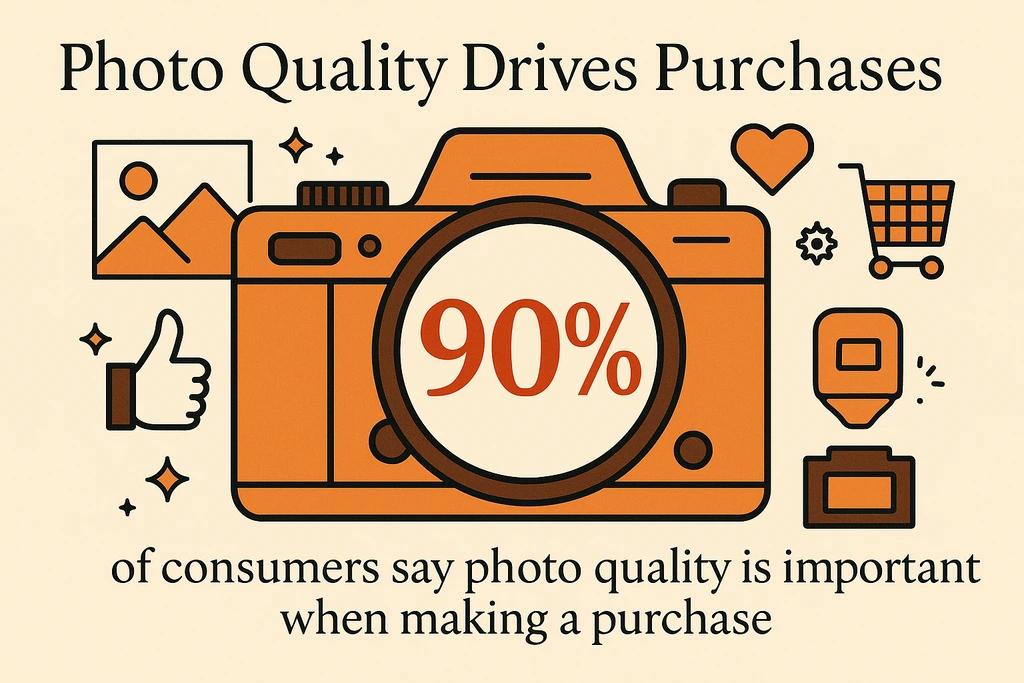
This is the layer almost nobody writes down, and it is where premium positioning is actually won or lost. Property identity is the visual grammar that every individual listing has to obey: how a property is photographed, what lens range you commit to, whether interiors are shot with natural light or staged, how floor plans are drawn, what happens to the photo on the tile, the PDF and the social post.
Redfin's study of professionally photographed listings is worth quoting not for the headline but for the shape of the finding. In the price bands they analyzed, homes shot with professional cameras sold between $3,400 and $11,200 closer to or above list price, and for homes in the $400,000 range, closed about three weeks faster than those shot on phones. The National Association of Realtors has published similar findings on photography and sale price. The useful takeaway is not "hire a photographer." It is that visual consistency across listings compounds: a buyer scrolling your portfolio is unconsciously measuring whether the properties feel curated by the same hand, and that signal is doing more work than any individual image.
The agents I see get this right treat photography as a spec, not an expense. Same photographer or at least same color calibration. Same crop ratio on the hero tile across every listing. The kitchen shot always taken from the same angle relative to the range. A consistent approach to floor plans, whether 2D or isometric. When you scroll a well-run luxury agent's listings, the properties look like members of the same family. When you scroll a generic one, each listing looks like it was marketed by a different person. Buyers notice, even when they cannot articulate what they are noticing.
Presentation identity: how properties move and how buyers explore them
This is the newest layer and the one most underinvested. Video walkthroughs, 3D tours, interactive floor plans, renders of unbuilt stock. The same rules of consistency apply. A site with a Matterport tour on one listing, a drone reel on another, and a set of still photos on a third communicates that you are experimenting, not curating. Either commit to a presentation layer across the portfolio or do not do it at all.
Matterport's own figures, which I read skeptically because they are selling the tool, claim that listings with 3D tours engage buyers meaningfully longer and sell up to 31% faster. The directional signal, not the exact percentage, matches what I see in analytics on developer sites we have built: when a 3D viewer or a Faraday3D render is embedded above the fold on a project page, time-on-page roughly doubles, and the inquiries that come in are qualitatively different. Fewer "is it still available" messages, more questions about orientation, finishes and floor selection. That is the signature of a buyer who has already walked the property in their head.

Why the Generic Color Psychology Advice Fails in Luxury
"Navy equals trust. Gold equals exclusivity. Black and white equals timeless." You have read this sentence fifty times. It is primary-school branding. Real luxury operators routinely break every one of those rules. Aman uses deep olive and a near-stone neutral. Christie's leans on a saturated red that would get rejected by any "luxury color psychology" blog post. Savills, in many markets, runs nearly monochrome with one warm accent. What they share is not a palette; it is internal consistency and a color system that is rare relative to their local competition.
That last point is the one the generic advice misses. Visual identity is positional. Your palette's job is not to feel premium in the abstract. It is to be recognizable in your specific market, against your specific competitors. I had a developer client in the Baltics whose proposed brand palette was a deep navy with gold accents. It looked fine until we pulled up the three closest competitors' websites, and two of them had landed on almost the same palette. We pivoted the client to a warm charcoal and a muted terracotta. Not because it is inherently more luxurious, but because it was the only brand on the local search results page a buyer would remember the next morning. Our luxury real estate marketing guide goes deeper on this positional approach to design choices.
The Website Is Where Visual Identity Lives or Dies
Premium buyers do not visit your business card. They visit your website, usually on a phone, usually at the end of their day, usually while they are half-distracted. Everything in the brand book gets compressed into the first four seconds on a 390-pixel-wide screen. This is where most "luxury" brands collapse, because the identity was designed in Figma at 1440 pixels and never stress-tested on a real device.
Three things I check on every premium real estate site we audit. First, typography at small sizes. A lot of luxury sites specify an elegant display typeface that turns into an illegible mess under 18 pixels. Premium buyers read specs, square footage, price, neighborhood. If the body text looks amateurish on a phone, the brand looks amateurish on a phone, regardless of how the logo lockup renders on a billboard. Second, loading speed. Under four seconds is the absolute ceiling for a luxury site; under two is where you want to be. Speed is a luxury signal. Large hero images, ungrouped scripts and uncompressed video are the three things slowing most of them down, and the technical side of speed optimization is boring work that every generic "luxury" agency skips. Third, image treatment. Consistent crop ratios across the portfolio. A defined color grading pass, even a simple one. Progressive loading for the hero, so the page does not jank on a mid-tier 4G connection.
The site is also where the identity has to do work for conversion, not just aesthetics. A premium buyer is not going to fill out a twenty-field form, but they will send a message if the primary action is confident and visible. Our real estate page design conversion guide breaks this down in more detail, and our luxury real estate website design piece covers the structural patterns we use for the high-end segment specifically.
Where 3D and Interactive Tools Earn Their Place (and Where They Do Not)
I want to be honest here because this is my commercial area and the temptation to oversell it is real. 3D tours, renders and interactive viewers are not a universal upgrade. They are a fit-for-purpose tool. They work when the property is either complex enough that photography genuinely misses the spatial story, or when the property does not yet exist. For a two-bedroom apartment in a standard layout, a Matterport tour is probably overkill and can actually make the listing feel like it is trying too hard. For a five-level villa with a subterranean wine cellar and a lap pool, or for a 120-unit off-plan development, it is borderline non-negotiable at the luxury tier.
The off-plan case is the one that matters most commercially. If you are a developer selling units that will not exist for eighteen months, your visual identity has to compensate for the absence of a physical product. Renders carry that weight. This is where our work at Faraday3D sits, and where I see the biggest gap between what buyers expect in 2026 and what most developers are shipping. Static renders are table stakes now. Interactive exploration, where a buyer can pick a floor, toggle a kitchen finish, change the time of day, is the next tier, and it is where something like AmplyViewer earns its place, because masterplans and multi-unit developments are where buyers genuinely need to compare and self-select before any sales call. For the broader business case on this, the immersive 3D experiences and sales write-up has the numbers we track.
Cross-Channel Consistency Without Becoming Boring
The most common misreading of "brand consistency" I see is "use the same hero image everywhere." That is not consistency, it is repetition, and premium buyers read it as a lack of material to show. The right mental model is closer to how a design system works in software: consistent structural rules, variable content. The Instagram grid, the listing tile, the brochure cover, the site hero, all follow the same crop ratio, the same type scale, the same treatment of the property name and the price. But the content rotates freely. A buyer scrolling across three different surfaces feels a single hand at work, even though nothing is literally repeated.
Apply this thinking to every touchpoint. Email signatures. PDFs. The "For Sale" sign stuck in the ground. Vehicle livery if you have it. Business cards. The buyer's first tangible interaction might be any of these, in any order. If you treat them as one object presented in different materials, the brand scales. If you treat them as separate projects, each gets a little worse each time, until the identity is only coherent on the website. For brokerages working across commercial and residential, our commercial real estate branding notes have specific guidance on how the two segments can share a system without blurring.

How to Know If Your Visual Identity Is Actually Working
Most measurement advice in this area is useless because it tracks vanity metrics. Likes on Instagram. "Brand awareness." Impressions. None of these tell you whether the visual identity is doing its job, which is to pre-qualify serious buyers and disqualify the wrong ones before they waste your time.
Better questions to ask of your analytics: does direct traffic, meaning people who typed in your domain or came via a saved link, convert to inquiry at a higher rate than paid traffic? If yes, the brand is doing real work because direct traffic is largely people who already decided they wanted to see what you have. Do inbound inquiries reference the portfolio as a whole, or just a specific listing? References to the portfolio feel is a sign the identity is registering as a signature, not a generic marketplace. Do you close against competitors who are visibly cheaper on commission or contract terms? That is the cleanest test. If premium clients pick you over a discounter, they are paying for a signal the discounter cannot credibly produce, and that signal is mostly your visual identity and the confidence it projects.
The Knight Frank Wealth Report 2025 is worth reading for context here. It documents continued growth in the global population of buyers with meaningful net worth and a continued tilt toward lifestyle-driven property decisions. Those buyers are not price-shopping. They are signal-shopping, and your visual identity is the signal.
The Fastest Mistakes to Fix This Week
If you cannot commission a full rebrand, there are a handful of things that take a day or two and move the identity disproportionately. Remove every piece of stock photography from your site, even if it means less content for a month. Stock photography is the single clearest tell of a non-premium operator and premium buyers spot it instantly. Cut your type system down to one workhorse typeface and one accent, at most, and delete every other font file from the brand folder so it cannot sneak back in. Recommission your headshot, properly, with the same photographer who shoots your listings. Rebuild your listing tile template so every property on your site crops, captions and prices identically. Audit your brand colors against your three closest local competitors and change yours if there is overlap.
None of this requires a creative director. It requires honesty about what the current identity is signaling and a willingness to cut rather than add.
FAQ
How is visual identity for luxury real estate different from other luxury branding?
Luxury real estate is unusual because the product is illiquid, hyper-local and often requires a physical visit. The identity has to carry confidence across three surfaces at once: the listing, the portfolio and the operator. Most luxury sectors only need to handle one of those, so the consistency demands are higher. Palette and typography matter less than whether every individual listing within a portfolio reads as curated by the same hand.
Do I need a professional photographer if my properties already have MLS-quality photos?
MLS-standard photos are a baseline that removes disqualifiers. They are not, on their own, a visual identity. The question is whether the same photographer, or at least the same color calibration and framing rules, are used across your portfolio. A portfolio of competent-but-stylistically-different listings reads as a directory. A portfolio of listings with a shared visual language reads as curation, which is what premium buyers are paying for when they choose you.
How much should I budget for a visual identity refresh?
A focused refresh, meaning logo system, type, palette and a listing template, sits between roughly 4,000 and 15,000 euros depending on the scope and the market. A full identity system with photography direction, a rebuilt website and a 3D presentation layer for off-plan stock is a different conversation, usually starting around 20,000 euros for a single-project developer and rising from there. Anything below 2,000 euros is a logo refresh, not an identity refresh, and will not solve the signaling problem discussed above.
When is a 3D tour worth the cost for a listing?
A 3D tour earns its keep when the property has spatial complexity that still photography cannot capture, when the property is off-plan and physically inaccessible, or when your buyers are primarily remote and international. For straightforward layouts in strong photography light, a 3D tour can actually dilute the listing by making it feel over-produced. As a rough heuristic: above a certain price threshold for your market, or for any off-plan development, it is the default; below that threshold, it is a case-by-case decision.
How long does it take to see results from a brand refresh?
Plan for six months before the refresh starts moving inbound quality in a measurable way. The first month is consistent application across touchpoints, which is the invisible part. Months two and three are the organic and paid traffic catching up. Months four to six are when direct traffic and referral inquiries start reflecting the new identity. If you expect a spike in the first thirty days, you will be disappointed and probably revert changes prematurely.
Should my visual identity change for different property segments?
For most operators, no. One identity with rules for how it adapts is stronger than separate identities for residential, commercial and off-plan. The exception is when a single brand is trying to serve genuinely different buyer populations, for example a developer running both mid-market and ultra-luxury stock. In that case, sub-brands are cleaner than forcing one identity to stretch. The test is whether a buyer in either segment would feel the other segment is beneath or above them; if yes, separate the identities.