Real Estate Marketing Trends That Actually Move Property
Every year a fresh wave of "real estate marketing trends" lists arrives, and most of them say roughly the same thing in roughly the same order. AI is coming. Virtual tours are important. Sustainability matters. Personalize everything. They are not exactly wrong, but they are not exactly useful either, because they treat every trend as if it carries equal weight and equal evidence behind it.
I run DignuzDesign, a web studio that builds custom websites for real estate developers, architects, and agents, and Faraday3D, a 3D architectural visualization studio that produces renders and virtual tours for property launches. Between those two seats I see the same marketing decisions get made over and over, by very different sized firms, on very different sized budgets. Some trends consistently earn their keep. Some are bought because they sound modern. The gap between those two groups is where most of the marketing budget on a property project is wasted.
This is the version of the trends conversation I wish more developers and agents had access to before they signed off on a budget. It is opinionated on purpose.
The shift that underlies every other trend
Before talking about specific channels and formats, there is one shift that explains why so much of property marketing has changed: the actual property search now happens before anyone speaks to anyone.
The National Association of Realtors reports that around 52% of buyers find the home they end up buying online, and roughly 70% search using a mobile or tablet device at some point in the process. Almost all home buyers, across all generations, use the internet during their search. The implication for marketing is not subtle. By the time a buyer fills in an enquiry form or walks into an open house, they have already filtered out most of the market on their phone. The early funnel is now almost entirely digital and visual, and the rest of the funnel is increasingly relational.
That is the lens I would put on every trend that follows. The question is never "is this trend interesting." The question is "does this trend help a property win the phone-screen comparison."
3D tours and immersive visuals: the trend with the cleanest evidence
Of all the property marketing trends people talk about, this is the one where the data is most defensible. Zillow Research found that listings with a 3D Home Tour were viewed roughly 65% more and favorited roughly 75% more than listings without one, with the largest gap appearing in the first two weeks on market, which is exactly the window when listings have the most leverage on price.
That is not the same as saying "every property needs a virtual tour." It is saying that when buyers are comparing listings on their phone, listings that let them walk through win attention faster, and attention in those first two weeks is what protects asking price. The signal is strongest for properties where the layout, light, or proportions are hard to read from photos alone, which in practice means most properties above the median price point and almost everything off-plan.
For off-plan and pre-construction work the case is different again, because there is nothing to photograph. Renders and interactive viewers are not a marketing nicety there, they are the product brochure. This is where the line between web development and 3D work blurs, and it is the reason we built AmplyViewer: an interactive 3D viewer that developers embed directly into their websites so buyers can explore a building, switch units, and look at views before any salesperson opens a brochure. The honest version of the "virtual tour trend" is that some properties need a full immersive viewer, some need a single Matterport scan, and some need neither. Conflating those three is how budgets get wasted.
If you are weighing whether 3D fits a specific project, the longer treatment in immersive 3D real estate experiences and sales goes through where the format earns its cost and where it does not.
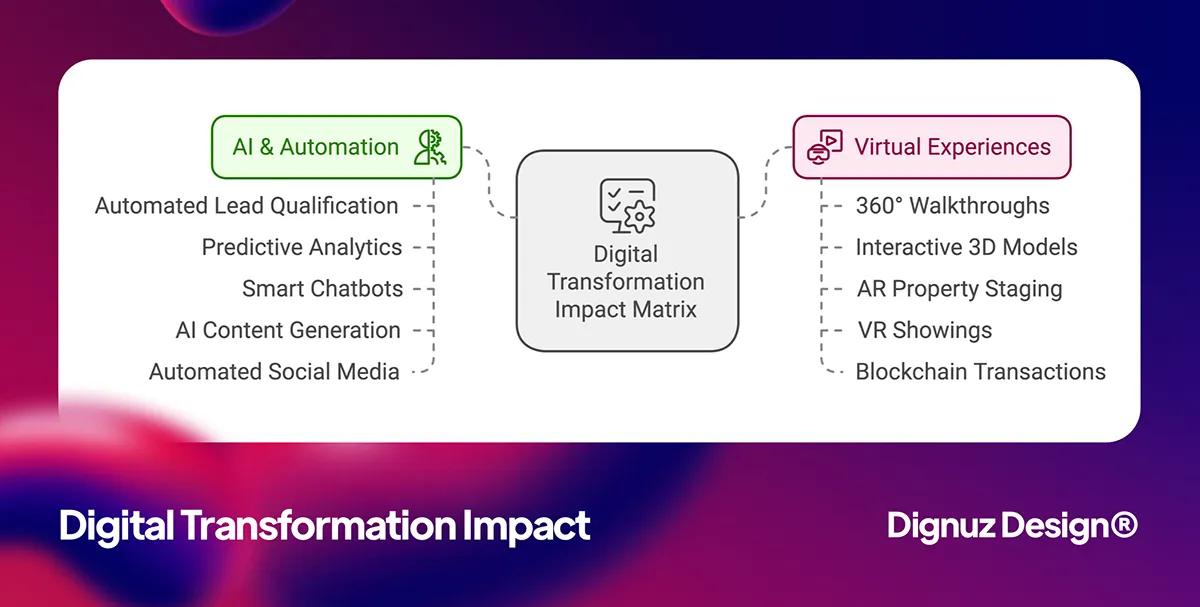
AI and automation: where it earns its keep, where it wastes your time
The AI trend in property marketing is the messiest one to write about, because the term gets used to mean three different things at once. There is AI that does the work nobody wants to do (categorising leads, drafting first-pass listing copy, summarising inbound enquiries). There is AI that does work badly (auto-generated property descriptions that sound like every other listing, auto-replies that buyers can sniff out in two messages). And there is AI that is sold as a feature but functions as a buzzword in the deck.
The pattern I see across the developer and agent sites I work on is that automation pays off in the boring places. Lead routing that stops enquiries from sitting in an inbox over a weekend. Follow-up sequences that send the right floor plan to the right enquiry instead of a generic brochure. CRM enrichment that lets an agent walk into a viewing already knowing whether the buyer has been to two similar properties this month. None of that is glamorous, and almost all of it shortens the time from first click to first conversation, which is the metric that actually moves sales.
Where AI gets oversold is at the top of the funnel. Auto-written property descriptions and AI-generated social posts are technically faster, but they accelerate the production of content that nobody wanted to read in the first place. Buyers comparing three listings on their phone can tell within ten seconds which one was written by someone who has actually been inside the property. The trend worth following is not "AI everywhere," it is "AI on the operational layer, humans on the storytelling layer." A practical breakdown of where automation pays off in property pipelines lives in real estate marketing automation strategies.
One side note. I run a small product called AmplyDigest that uses AI to summarise newsletters and videos into a single daily email. Building it taught me how thin AI-generated summaries get when there is no editorial taste behind them. The same is true of property copy. Speed without taste produces volume, not engagement.
Sustainability is now a price signal, but only when the claims are real
The "sustainability in property marketing" trend has been on every list for years, usually with no actual numbers attached. The numbers worth knowing come from the RICS Sustainability Report, which shows that close to half of surveyed professionals globally observe a price premium for green-certified buildings, with the majority of that group estimating the premium at up to roughly 10%, alongside a parallel "brown discount" for energy-inefficient buildings.
What that means for marketing is the opposite of what most agencies do with it. The trend is not "add a leaf icon to the brochure and mention sustainability in the listing." The trend is that energy performance is becoming part of the price negotiation, which means marketing has to treat it the same way it treats square footage: as a verifiable fact, supported by certificates, ratings, and where possible by actual running-cost figures from comparable units. Buyers and their lenders are starting to read those numbers seriously, particularly in commercial and high-end residential.
The practical implication for a developer or agent is that the listing page, the brochure, and the website all need to have somewhere genuine to put the EPC rating, the certification badge, the smart-home spec, and the projected running costs. A leaf icon in the header is not marketing, it is decoration. A clearly designed energy section on the listing page, with the same visual weight as the floor plan, is marketing.
Social media is a lead engine, but the format matters more than the platform
According to the NAR REALTOR Technology Survey, social media has been the single most cited lead-generating technology for agents, well ahead of CRM and MLS in the same survey, for several years running. That fact by itself is not a strategy. It just confirms that distribution still happens where attention sits.
The more useful observation, from looking at what actually performs on developer and agent accounts, is that the platform matters less than the format-platform fit. A 90-second walking tour with natural voiceover works on Instagram Reels, on TikTok, on YouTube Shorts, and on LinkedIn for commercial properties. The same 90 seconds chopped into still images with a caption block performs poorly on every platform. The asset is the same, the format is what moves it.
Two patterns I would call out specifically:
- Vertical, narrated, single-take property walks outperform stylised drone-and-cinematic edits for almost every audience below the trophy-asset price point. Buyers want to see what they are buying, not a director's reel. The cinematic version still has a place at the top of a luxury development page on the website, but as a social hook it converts worse than a phone-shot walkthrough by the listing agent.
- Platform-specific content beats cross-posted content by a wide margin, which sounds obvious and almost no one actually does. LinkedIn rewards investor-angle commentary on a property, Instagram rewards a clean room-by-room walk, YouTube rewards a longer neighbourhood and property combo. The same three minutes of footage, recut three ways, beats one general edit posted everywhere.
The longer version of how to structure this across channels is in real estate social media marketing, and for agents specifically there is a more focused breakdown in estate agent digital marketing.
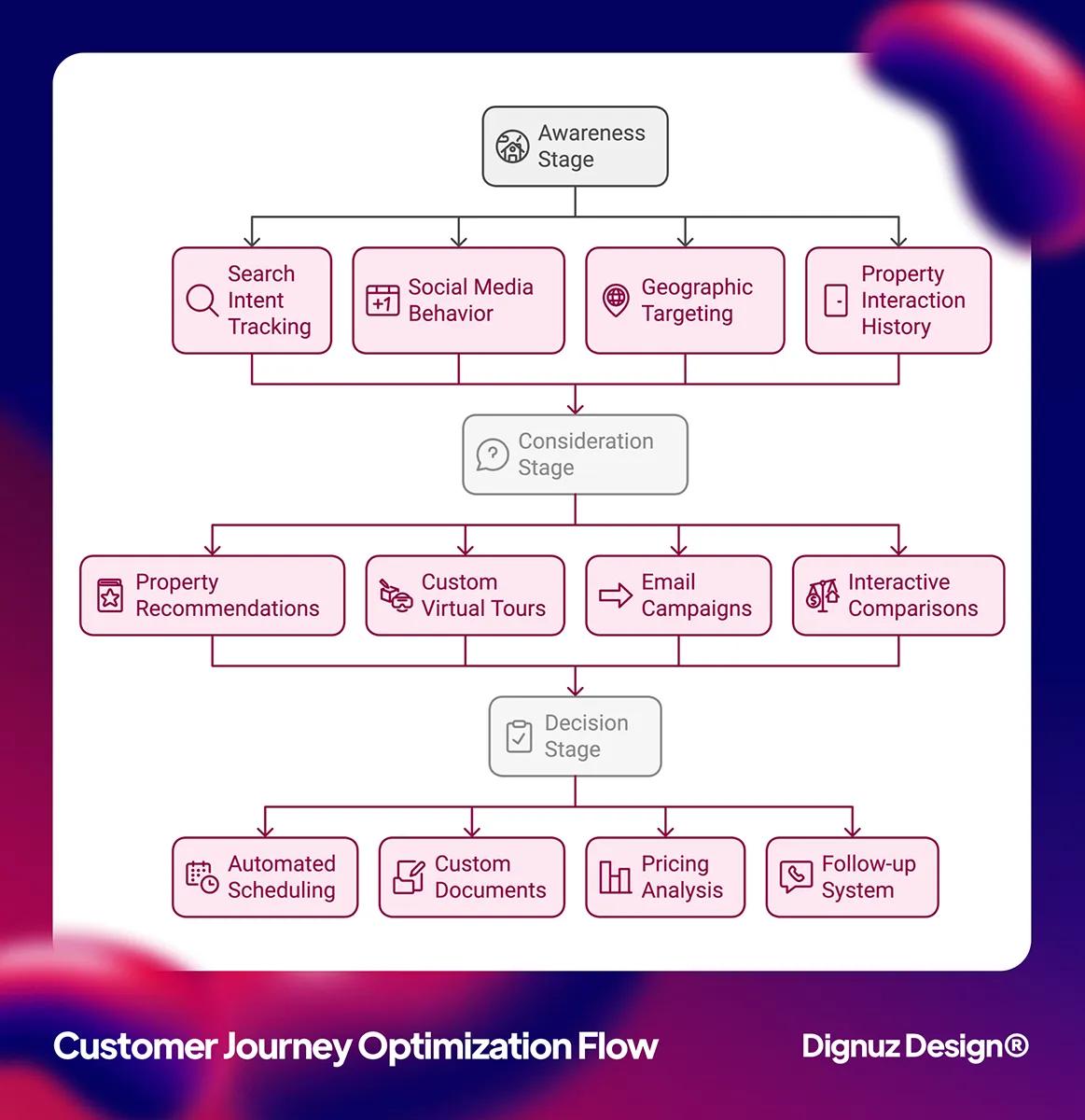
Personalisation is just "know who you are writing for"
Personalisation is the trend that has been talked about the longest and implemented the least convincingly. In most property marketing decks it means a CRM with merge tags. In practice the personalisation that moves a buyer is much more boring. It is the listing page showing a buyer who came from a "two-bed apartment Lisbon" search a comparable shortlist of two-bed apartments, not the developer's full inventory. It is the email after a viewing that references the specific concerns that came up in person, not a generic "thanks for visiting" template.
The technology to do this well has existed for a long time. What is changing is that buyers now expect it, because every other category of online shopping does it. A property website that treats a returning visitor exactly the same as a first-time one is starting to feel as dated as a property website with no mobile layout. The trend is less "AI personalisation" and more "stop wasting the data you already have."
This is also where the website itself stops being a brochure and starts being a tool, which is the part of the trends conversation almost everyone underestimates.
The trend that quietly beats most of the others: a website that actually works
If I had to pick one marketing investment that gave the biggest return on the developer projects I have worked on, it would not be 3D, AI, or social. It would be the website itself behaving the way a buyer expects a serious product page to behave: fast, mobile-first, with clear inventory, clear pricing where appropriate, real photography, real renders, and a route to a human in fewer than two clicks.
This is not a new trend, but it is the one that quietly defeats the others. A development with the best 3D tour in the country loses to a development with a website that loads on a 4G connection in a parking lot, every time. The data on this is unambiguous. Mobile-first search dominates the early funnel. A site that takes five seconds to render the hero image on a phone has already lost half its visitors before the first property card appears.
The trend within this trend, on the technical side, is the move away from heavy CMS templates towards static and Jamstack-style builds for the marketing layer. The reason is mundane and mechanical: properties have launches, launches have traffic spikes, and a slow site at the moment of peak attention costs more than the rest of the marketing budget combined. We build most of ours on Astro and Cloudflare for exactly that reason. A more detailed look at why this matters specifically for property pages is in real estate website speed optimization, and the broader case for not using a generic template is in why custom real estate websites outperform template solutions.
What to actually do with all this
If you strip the noise out, the picture for most developers, agents, and architects looks like this. The phone is where listings get filtered. 3D and immersive content materially help the listings that need them, and waste money on the ones that do not. Sustainability is no longer decorative, it is part of the price story. Social distributes attention, but only when the format respects the platform. AI is useful in the back office and dangerous in the front-of-house copy. And underneath everything, the website is still doing most of the work.
The version of this conversation that gets talked about least is also the most important: trends compound. A serious 3D viewer on a slow website fails. A great website with a generic listing page and no energy data fails to land the higher-end buyer. A social channel pushing cinematic edits to a buyer who just wants to see the kitchen fails. Marketing in property is mostly about removing those mismatches, not adding more channels. The studios and agents who win the next few years are not the ones with the longest tech stack, they are the ones whose listings, websites, and content tell the same coherent story across every touchpoint a buyer uses.
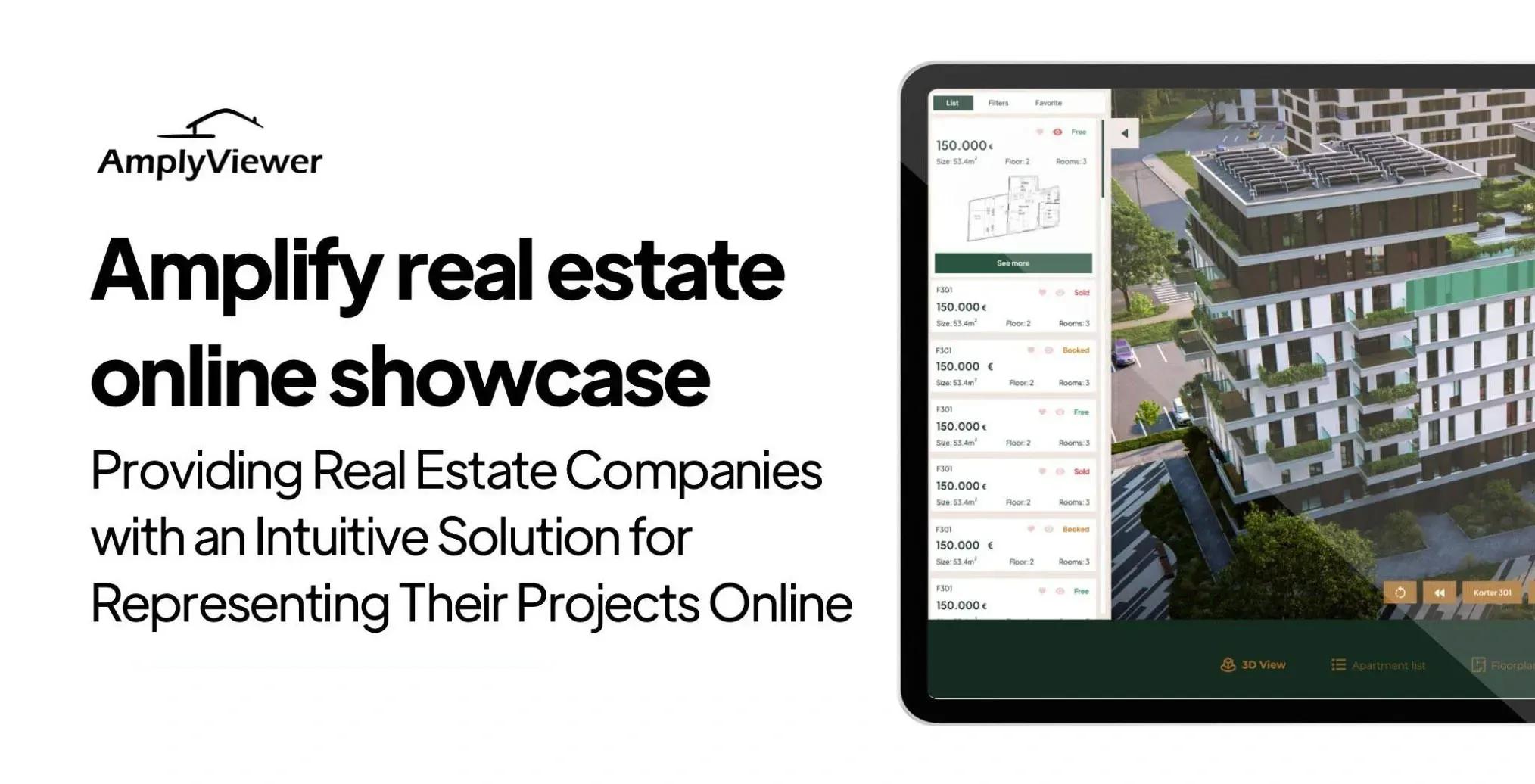
💻 Let us help you create a stunning online showcase for your projects that works seamlessly across all devices. Ready to amplify your real estate business? 👉 Explore AmplyViewer now
FAQ
Which real estate marketing channel gives the best return for a small agency?
For a small agency without the budget for a full 3D and content stack, the highest-return combination is usually a fast, custom-built website with strong individual listing pages, plus a disciplined social presence on one or two platforms where the agent is genuinely comfortable on camera. The most expensive mistake small agencies make is spreading thin across six platforms and underinvesting in the listing page that all of those platforms ultimately link back to.
Are virtual tours and 3D viewers worth the cost on lower-priced properties?
Often not. The Zillow Research data on 3D tours shows the biggest performance gap in the first two weeks on market, and that gap is most valuable when there is meaningful price leverage to defend. For lower-priced properties with simple, easily photographed layouts, a strong photo set and a short walkthrough video usually outperforms a full 3D scan on a cost-adjusted basis. The format starts to pay off clearly on higher price points, off-plan units, and properties with unusual layouts.
How important is sustainability data in property marketing now?
It is moving from "nice to mention" to "expected to disclose," particularly in markets with stricter energy regulation and in commercial real estate. RICS data shows a measurable green premium on certified buildings and a parallel brown discount on inefficient ones. In practical marketing terms, that means EPC ratings, certifications, and projected running costs deserve a real section on the listing page, not a bullet point at the bottom.
What is the best way to use AI in real estate marketing without it sounding generic?
Keep AI on the operational side and humans on the storytelling side. Use it for lead routing, enrichment, scheduling, drafting first-pass internal documents, and summarising inbound enquiries. Avoid using it to write public-facing property descriptions and social captions verbatim, because buyers comparing listings can detect generic copy quickly, and generic copy is the fastest way to lose a price-sensitive buyer's attention.
Do property developers still need a custom website, or is a portal listing enough?
Portal listings are necessary for distribution but insufficient for positioning. They flatten every development into the same template, which makes it almost impossible to communicate brand, architectural intent, or unit-level differences. For any development above a basic price point, a custom website is what makes the rest of the marketing stack (3D, social, paid, brochure) work as a system instead of as five disconnected channels. The case is laid out in more detail in the comparison between custom and template real estate sites linked above.
How often should a real estate marketing strategy be reviewed?
The headline strategy (positioning, brand, target buyer profile, channel mix) is worth reviewing once or twice a year. The execution layer (listing performance, ad creative, social formats, lead-response times) is worth reviewing monthly. Most underperforming property marketing programmes I see are not strategically wrong, they are operationally stale. The trend metric that matters most for any individual property is not "are we using AI" but "how long does it take us, on average, to get a real human reply to a fresh enquiry on our best listing."