Interactive Ways to Showcase Properties That Sell

Interactive property showcases sell well as a pitch. The agent walks in with a Matterport demo, the developer sees a flashy 3D configurator at MIPIM, the brokerage commissions a VR experience for a flagship listing, and everyone agrees the future has arrived. Six months later, the analytics tell a quieter story. The interactive feature got a polite spike of visits in the first week and then dropped to a fraction of the photo gallery's traffic. The agent who paid for the tour cannot tell whether it produced a single qualified lead.
I run DignuzDesign, a web studio that builds property developer and estate agent websites, and Faraday3D, the 3D visualization studio that produces the renders and interactive 3D models those websites display. That overlap forces me to be honest with clients. I see which interactive showcases generate qualified enquiries and which ones generate compliments at the launch event. The two are not the same audience, and the choice of format almost always matters more than the production budget.
This is a practical look at the showcase formats available to a property team, when each one earns its place, and what consistently goes wrong in execution.
The Adoption Gap Nobody Talks About
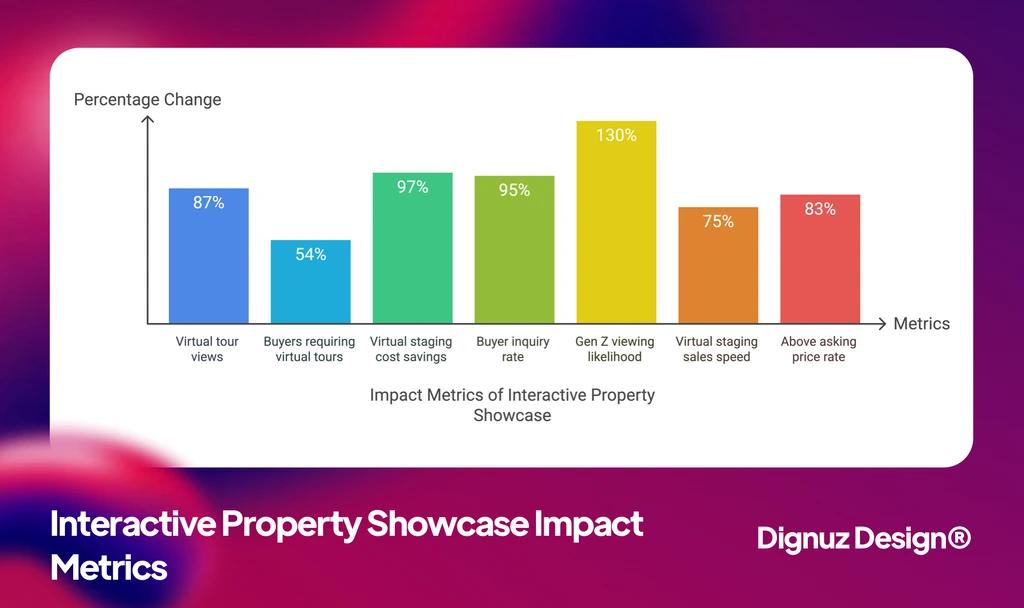
Before discussing formats, it helps to know where the market actually sits. According to a National Association of Realtors review of MLS data, roughly 94% of residential listings still ship without a virtual tour of any kind. At the same time, Zillow's own engagement research shows that listings with a 3D Home tour collect 68% more views and are saved by buyers 36% more often than listings without one.
Read those two numbers together. The demand exists. The supply does not. The interactive showcase, framed properly, is one of the few areas in real estate marketing where an agent or developer can still differentiate without competing on price or commission. The mistake is treating the format itself as the differentiator. The differentiator is whether the buyer can answer their own questions faster than they can on the competing listing.
Most "interactive" features fail not because the technology is bad but because the team installed it without thinking about which buyer question it was meant to answer. A 360 tour of an off-plan unit answers nothing, because the unit does not exist yet. A still render of a finished apartment answers less than three good photos. The format has to fit the property.
Three Tiers of Property Visualization
For a working property team, almost every interactive showcase decision falls into one of three tiers. Choosing the right tier for the listing in front of you is more important than upgrading the production quality within a tier.
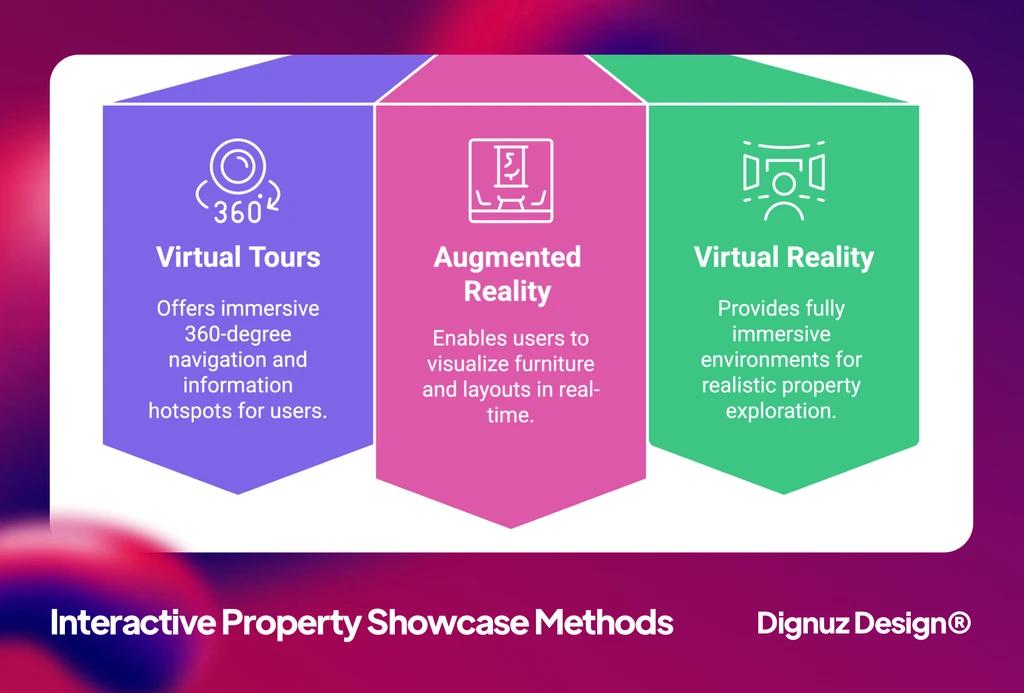
Tier one: lightweight 360 and dollhouse views for existing stock
This is the Matterport, Zillow 3D Home, CloudPano category. A capture device sweeps the property, and the platform stitches the panoramas into a navigable space with a top-down floor plan. Production takes a few hours, the cost on a typical residential unit lands in low three figures, and the output is usable on any device with a browser.
This tier is the right answer for existing residential stock between mid-market and upper-mid-market price points. The buyer wants to verify that the photos are not lying, walk the floor plan in their head, and decide whether the property is worth a physical viewing. That is the complete job to be done, and the platforms in this tier do it well. Anything more elaborate is overproduction for that buyer's actual decision.
The trap in this tier is treating the tour as a finished deliverable. The tour needs to be embedded directly in the property page, not buried behind a "view virtual tour" button that opens a new tab. It needs to load on the same scroll as the photo gallery. The single largest source of wasted spend I see in this category is a beautifully captured Matterport scan that buyers never reach, because the website hides it three clicks deep.
Tier two: custom interactive 3D for off-plan, configurable, and flagship listings
The tier-one platforms only work when the property physically exists and can be scanned. For off-plan developments, master-planned communities, and listings where the buyer will customize finishes, the asset has to be built rather than captured. This is where 3D renders, interactive site plans, and embedded property configurators come in.
This is the category where choosing 3D over 2D stops being a stylistic question and becomes a sales question. A developer launching a fifty-unit residential project has a problem: every buyer wants to understand what their specific unit will feel like, how the view changes with floor and orientation, and how the unit fits into the masterplan. Static brochure renders give one answer per unit, which is to say no answers at all, because the buyer cannot interrogate the model.
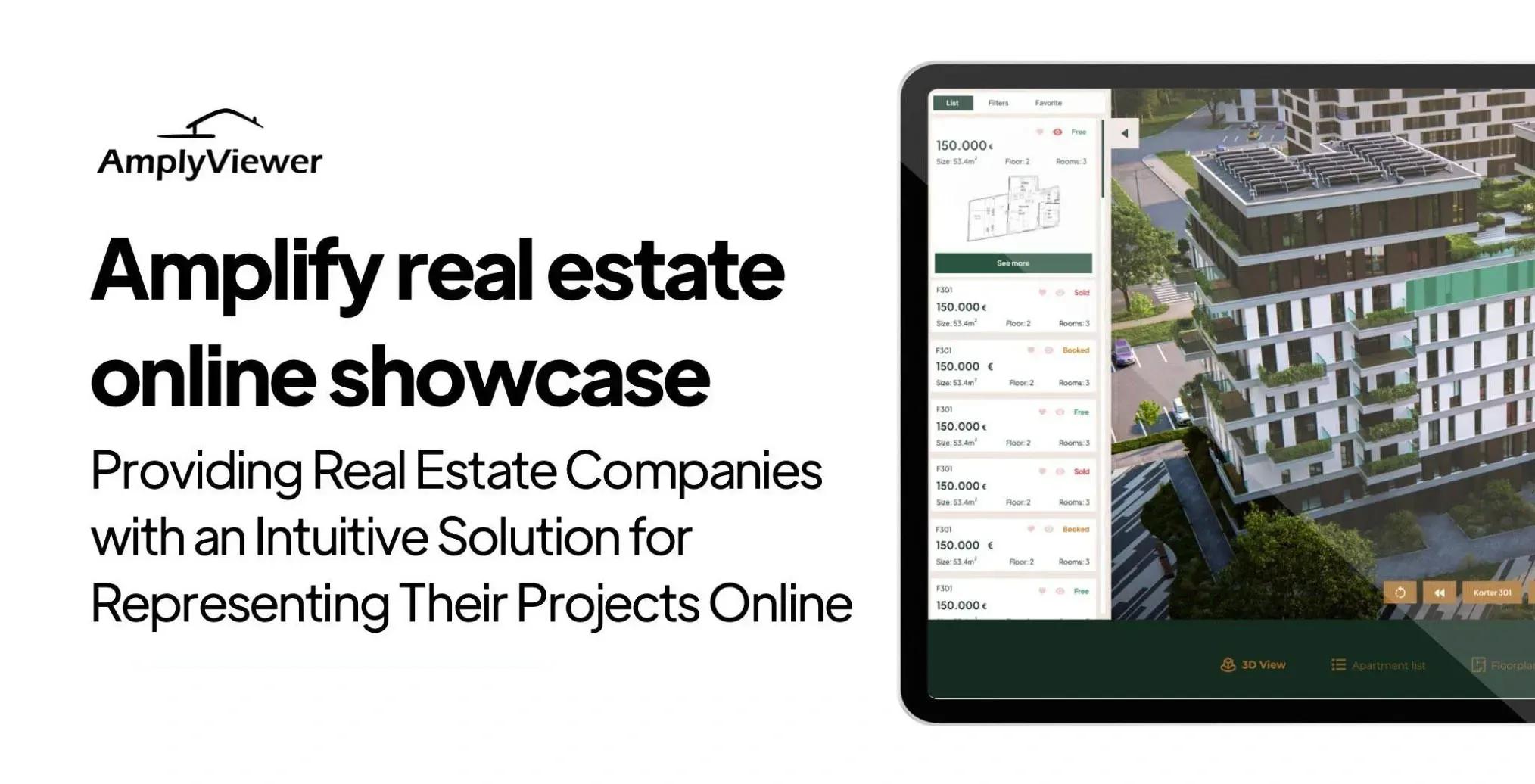
An interactive 3D viewer, embedded into the property page, lets the buyer click into a unit, rotate, see the live view from that floor, and switch between finish packages. This is the gap our own product AmplyViewer was built to close. It is also a category where production discipline matters: the underlying 3D rendering work has to be honest about what the finished property will actually look like, because a buyer who feels deceived at handover does not refer the next buyer.
Tier three: full VR and AR experiences
Then there is the immersive tier: VR headsets, AR overlays that drop a virtual sofa into a real room, and the kind of experience designed for a sales gallery rather than a website visit. Industry survey data from Matterport showed that 55% of buyers said they would consider purchasing a property unseen if a quality 3D tour were available, which suggests genuine appetite, but headset adoption among home buyers remains low enough that headset-first design is the wrong default.
VR and AR earn their place in two scenarios. The first is a permanent sales gallery for a large development, where a headset experience can replace an unbuilt show flat at a fraction of the construction cost. The second is luxury and trophy property, where a buyer is comparing a small number of high-value listings and an immersive walkthrough is an appropriate fit. Outside those two cases, the production budget is usually better spent making the tier-one or tier-two experience faster, cleaner, and easier to reach from the listing page.
What Makes an Interactive Showcase Actually Convert
Once the tier is chosen, the variables that determine whether the showcase moves a buyer are the unglamorous ones. After years of building these into property websites, the same three issues keep appearing.
The first is speed. An interactive showcase that takes eight seconds to load on a buyer's phone gets closed before it loads. Most virtual tour platforms are heavier than agents realize, and the tour vendor's "embed code" frequently drags in scripts that crater Core Web Vitals on the parent page. This is why speed optimization on the host site is not a separate concern from the tour itself. A fast property page with a slow tour is still a slow property page in the eyes of the buyer and the search engine.
The second is information architecture. The interactive view is the buyer's most engaged moment with the listing, which is exactly when they want to ask questions about specific elements: what is the floor material, what brand is the kitchen, what does the south balcony look like in afternoon light. Interactive hotspots, when written like a knowledgeable agent answering a real question rather than a property brochure listing features, are the single highest-leverage piece of content in the whole showcase. Most teams underwrite them and lose the moment.
The third is integration. The tour, the gallery, the floor plan, the inquiry form, and the CRM should function as one tool, not five embedded widgets stacked on top of each other. The buyer who clicks a hotspot for "request information about this finish" should arrive at a form that already knows which unit and which finish they were looking at. This is what property listing page design is actually about: the listing is software, not a brochure.
Where AR Genuinely Helps
Augmented reality in property marketing tends to get pitched as "virtual staging at scale", which is the wrong frame. Virtual staging as a flat image-editing task is already mature and inexpensive; AR adds value only when the buyer can change something in real time and see the consequence.
The two cases where I have seen AR earn its production cost are buyer-side furniture placement on existing empty units, and developer-side finish package switching on off-plan units. Both share a structure: the buyer makes a decision, the visualization responds, the buyer's confidence in the decision goes up. That is a behavior change. A static AR demo where the buyer rotates a single piece of furniture for ten seconds is a novelty, not a conversion lift.
For luxury developments, finish-package AR is increasingly the deciding factor in the customization conversation, because it lets the buyer commit to upgrades before the construction window closes. Builders care about that timing because changes after a certain milestone cost an order of magnitude more. The AR experience pays for itself by collapsing the buyer's decision cycle, not by looking impressive in a press release.
Short-Form Video as the Top of the Funnel
Interactive showcases sit at the bottom of the funnel, but the conversation about them is incomplete without the layer that brings buyers to them. Short-form video on Instagram, TikTok, and YouTube Shorts is now the most cost-effective way to push a buyer onto the listing page where the showcase lives.
The mistake is treating short-form as a miniature virtual tour. The platform algorithm does not reward a forty-second walkthrough of a kitchen; it rewards a specific hook, often a contrast or a question, that ends on a reason to visit the full listing. The interactive tour is the payoff, not the content itself. Teams that get this right treat the social clip and the property page as a pair: clip introduces the question, listing answers it. Teams that get it wrong post the same clip everyone else posts and wonder why engagement is flat.
Email is the other channel worth naming here. Buyers who have shown interest in one property are the highest-converting traffic for newly listed inventory, and a well-built email digest still outperforms paid social for that audience. (My side project AmplyDigest grew out of this same observation about the underrated economics of well-curated email.)
Common Rollout Mistakes
One bullet list earns its place in this article: the recurring patterns I see when an interactive showcase rollout disappoints. These are the failure modes worth checking before signing the next production invoice.
- Buying capture before fixing the listing page. A team commissions twenty Matterport scans before the property pages are built to host them properly. The tours land behind buttons, in lightboxes, or on third-party domains, and the engagement data never resembles the vendor's case studies because the implementation undercuts the format.
- Treating the tour as a separate product. The tour is a feature of the listing, not a feature of the website. When it is procured and tracked as a separate line item, it gets versioned, branded, and optimized in isolation, and the integration with the rest of the buyer journey is never anyone's job.
- Overinvesting in flagship listings, underinvesting in volume. The trophy unit gets a custom 3D experience that costs as much as ten tier-one tours. Meanwhile, the volume listings that pay the bills go out with stock photos. The math almost never supports that allocation.
- Skipping the hotspot writing. The tour vendor delivers an empty interactive shell. The agency does not write any hotspot content. The buyer clicks once, finds nothing, and leaves. The unlabeled tour is worse than a labeled photo gallery.
- Measuring views instead of inquiries. Views are an input metric. The output metric is qualified inquiries per listing, and only a small minority of the showcases I see in production are wired to attribute inquiries back to the tour. Without that, every cost discussion is opinion.
The Off-Plan Problem in Particular
Off-plan development is the category where the wrong showcase choice costs the most, because the buyer cannot physically inspect the asset and is being asked to commit on the strength of the visualization alone. The instinct is to commission high-resolution renders and call the marketing done. That works for the brochure but not for the buyer who wants to interrogate the unit.
What converts in off-plan is the same pattern that converts in finished property, just with the asset built rather than scanned. The buyer needs to walk through the unit, switch the view between floors and orientations, change finishes, and see the masterplan context. Each of those is a click-level interaction, not a brochure spread. Immersive 3D for off-plan sales is one of the few cases where production budget on the showcase reliably outperforms equivalent budget on paid media, because the showcase is doing the explanatory work that a finished property does for itself.
Master-planned communities have an additional layer: the buyer is also evaluating the development around the unit. An interactive site plan that lets the buyer click into amenities, see distances, and understand the phasing is often more decisive than the unit interior. Visual marketing strategy at this end of the market has to operate at both scales at once.
Connecting the Showcase to the Decision
The frame that has held up across hundreds of property pages is simple. Every interactive feature should answer a specific buyer question that the standard listing cannot, and it should answer that question in the same moment the buyer asked it. A virtual tour that answers "is the photography honest" earns its place. A configurator that answers "what would my unit feel like with the upgraded kitchen" earns its place. A VR headset experience in the sales gallery that answers "can I imagine living here" earns its place.
Anything that does not map to a real question, in a moment where the buyer is ready to ask it, is decoration. Decoration can be charming, but it does not change a transaction. The teams that win in interactive property marketing are not the teams with the most impressive showreel. They are the teams that have shortened the path between the buyer's question and the answer.
If your website is doing the hard part well, the conversion architecture of the property page matters more than the visual fireworks. If it is not, no amount of interactive content will save the listing.
💻 Let us help you create a stunning online showcase for your projects that works seamlessly across all devices. Ready to amplify your real estate business? 👉 Explore AmplyViewer now
FAQ
What is the difference between a virtual tour and an interactive 3D model of a property?
A virtual tour is built from photographs of a real space, captured with a 360 camera and stitched into a navigable scene. An interactive 3D model is built in modeling software from architectural drawings and exists independently of any physical capture. Virtual tours suit existing stock that can be photographed. Interactive 3D models are the right format for off-plan developments, unbuilt customization options, and any situation where the buyer needs to see something that does not yet physically exist.
How much does an interactive property showcase actually cost?
The honest range is wider than the marketing materials suggest. A platform-based 360 tour of a residential unit typically lands at a few hundred currency units per property when commissioned through a local capture provider. A custom interactive 3D viewer for an off-plan development sits in the low five figures and scales with unit count and finish complexity. A full VR experience for a sales gallery, including hardware and bespoke modeling, lands in the mid five figures and up. The right question is not what the format costs but what the cost per qualified inquiry looks like over the campaign.
Do virtual tours actually sell properties faster?
Research from 3D capture platforms suggests measurable lifts in days-on-market and final sale price when listings include immersive content, particularly in segments where buyers are time-poor or geographically remote. The effect depends heavily on implementation: tours embedded directly into a fast property page produce different numbers than tours hidden behind buttons or hosted on a third-party domain. The lift is real, but it is conditional on the rest of the listing being competently built.
Should every listing have a virtual tour?
No. A modest, well-priced unit in a market with strong demand and short days-on-market does not benefit much from production investment that buyers are not waiting for. Where the tour matters most is in segments with longer decision cycles, higher unit values, more remote buyers, and stronger comparison shopping. The rule of thumb is to add interactive content where buyers spend the longest deliberating, not as a blanket policy.
What about AR for furniture placement in empty units?
This is the AR use case that has consistently produced real engagement in my experience. Empty units are hard for many buyers to read, especially smaller units where scale is genuinely difficult to judge from photos. An AR layer that places furniture at correct scale solves a specific perception problem and gives the buyer something to do during their second visit to the listing. It is also one of the few AR features that buyers will actually open more than once.
How do I know if my interactive showcase is working?
Measure inquiries attributed to listings with the showcase versus listings without it, controlled for price band and time on market. View counts are easy to inflate and tell you very little. The right benchmark is whether the cost per qualified inquiry is lower on showcase-equipped listings than on standard ones. If your analytics cannot answer that question, the first investment is in the measurement, not in more production.