Why Property Developer Websites Belong on JAMstack

There is a pattern I have noticed across years of building websites for property developers. A developer spends months commissioning high-quality 3D renders of their new scheme, budgets for drone photography, invests in professional copywriting - and then launches the whole thing on a WordPress installation running fifteen plugins, hosted on shared infrastructure, loading in four seconds on a phone.
The renders are exceptional. The website buries them.
This gap between the quality of the property marketing material and the technology used to deliver it is not just an aesthetic problem. It is a conversion problem. And it is the main reason I now build almost all property developer websites on JAMstack architecture.
What JAMstack Actually Is, Without the Jargon
JAMstack stands for JavaScript, APIs, and Markup - but that acronym is less useful than what the architecture actually does in practice.
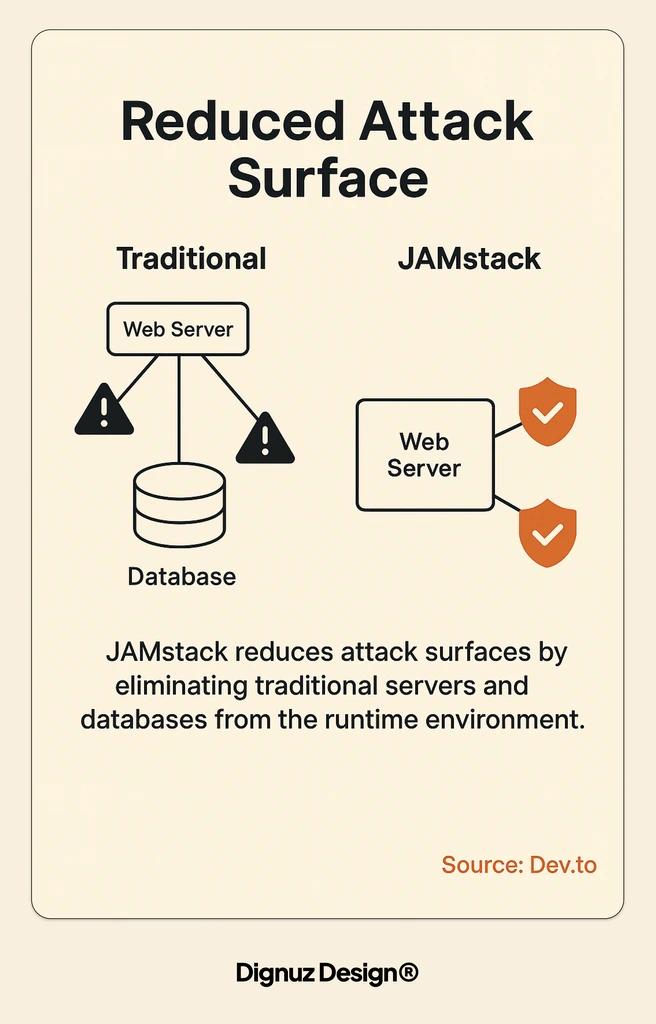
A traditional real estate website built on WordPress works like a restaurant that cooks your meal from scratch every time you order. A user visits a property listing, the server queries the database, assembles the page, and sends it. This happens on every visit, from every user, at the same time. Under traffic load, or when a plugin misbehaves, or when the hosting environment has a bad day, the food arrives cold.
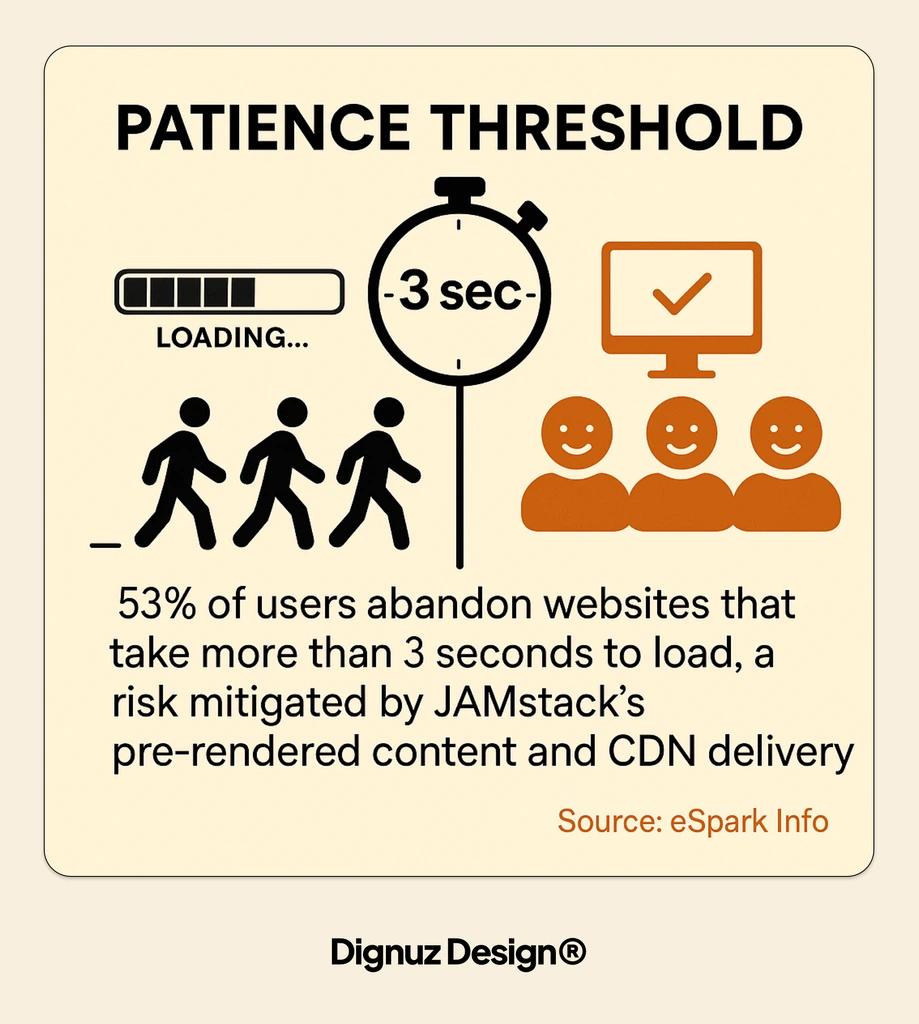
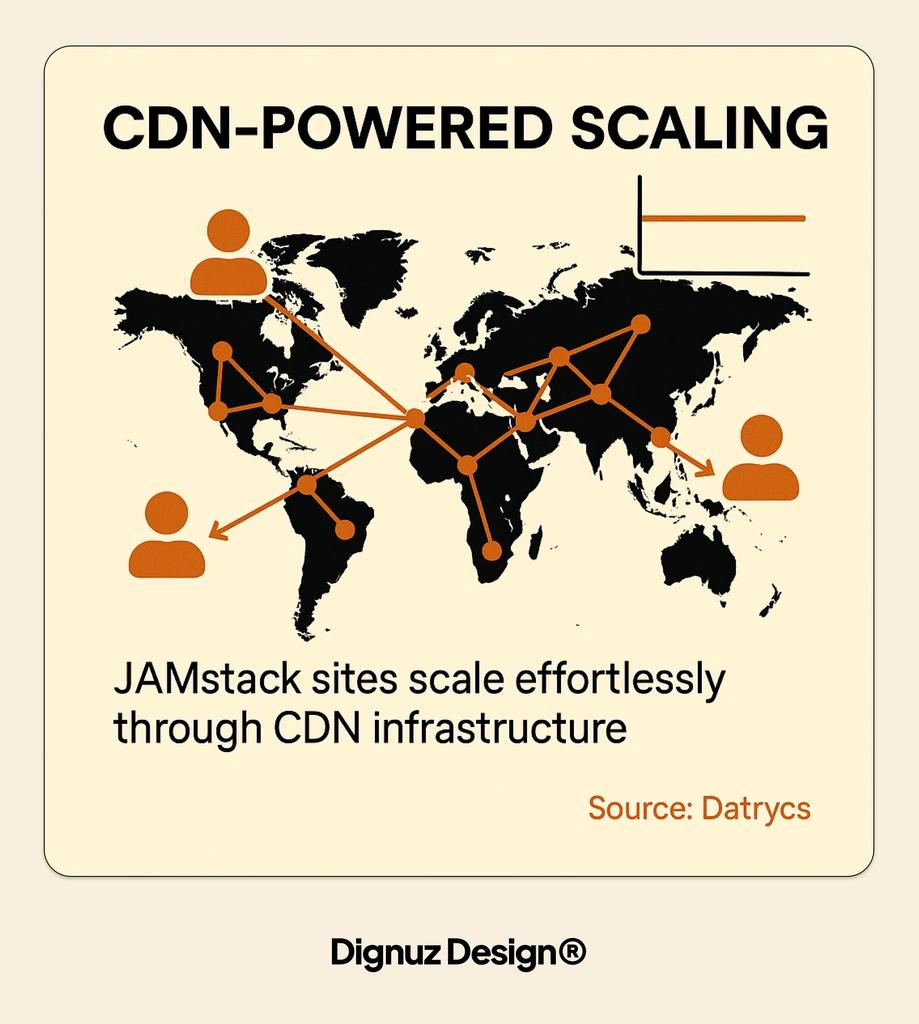
A JAMstack site does something different. Every page is built in advance - rendered as clean, static HTML files during a build process, then pushed to a global content delivery network. When a buyer visits your new development site, they receive a file from a server that is already near them, with no database query, no plugin stack, no server-side processing. The page exists. It just arrives.
For the presentation of property - where you are asking a buyer to form an emotional response to the most expensive purchase decision of their life - the difference between a four-second load and a sub-second load matters more than most developers let on.
The Performance Case Is Not Abstract
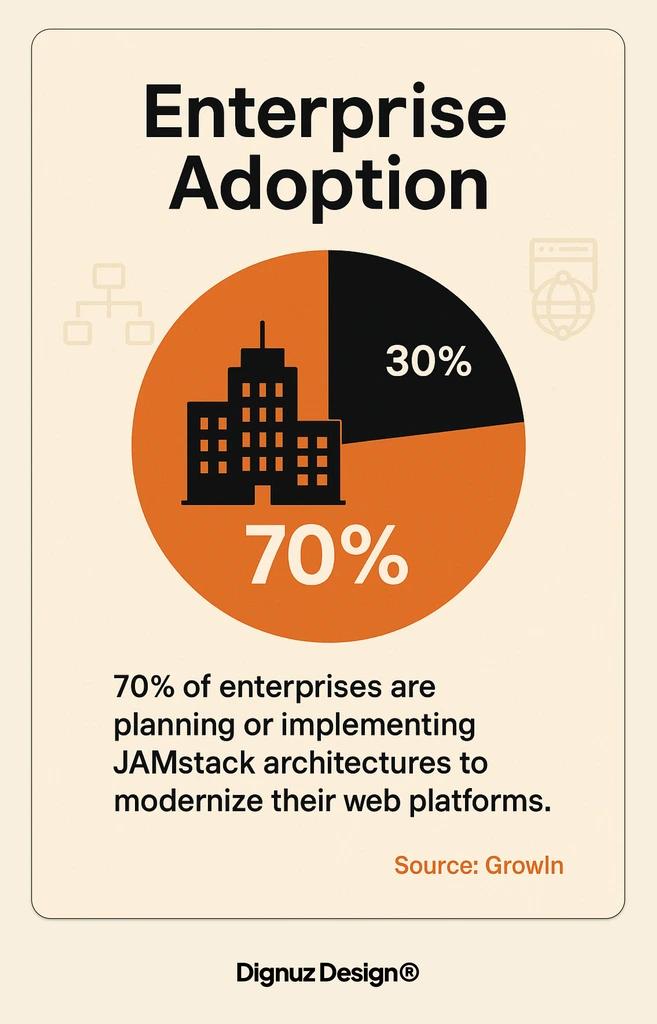
I want to be specific about performance because the numbers in this industry are usually cited without context. In a study commissioned by Google and conducted by Deloitte, analysing over 30 million mobile user sessions across 37 major European and American brand websites, a 0.1-second improvement in mobile load time increased progression rates across the full purchase funnel. The impact on contact page completions - which maps directly to enquiry rates on a property developer site - was 20.6%. On retail product pages moving to basket, 40.1%.
What does that mean for a property developer? Consider a new development site receiving 2,000 qualified visitors per month. If the site is running slowly - three to four seconds on mobile, which is typical for a heavily themed WordPress installation - and you improve that to under a second, you are not talking about a marginal gain. A 20% improvement on contact form completions means roughly 400 additional enquiries from the same traffic volume.
That is the actual business case for JAMstack. Not "faster pages are nicer." Faster pages convert.
This matters even more when you account for how people search for property today. According to NAR's 2024 Profile of Home Buyers and Sellers, every single buyer in the survey used the internet to search for homes, with mobile and tablet being the second most-used information source after the agent themselves. The modern property buyer is not sitting at a desktop clicking through a portal. They are on a phone, during a commute, making a snap judgement about whether a development is worth their time. A slow site on mobile is not a minor technical inconvenience. It is a first impression that ends the relationship.
Why Real Estate Is Especially Demanding
Property developer websites are among the most visually intensive commercial websites in existence. A single project site might carry forty high-resolution renders, a drone video, an interactive floor plan, a site map, and a virtual tour. This is not a blog or a landing page. It is a gallery, a sales brochure, and an enquiry tool rolled into one.
This is where my position at the intersection of web development and architectural visualisation becomes relevant. At Faraday3D, we produce the 3D renders. At DignuzDesign, we build the websites that carry them. And when you are working on both sides of that pipeline, you understand very clearly where the friction is.
The renders that come out of a professional architectural visualisation studio are large files, optimised for print quality. Putting them on a traditional CMS and hoping the platform handles the rest leads to exactly the kind of performance problems I described above. JAMstack changes the pipeline. With a framework like Astro, which is what I use for the majority of property developer builds, images pass through an optimisation layer at build time. They are converted to modern formats, resized to appropriate dimensions for different devices, and served from a CDN edge. The buyer on a phone in poor network conditions gets a compressed image that loads almost instantly. The buyer on a desktop gets the full-resolution render. The server is not making this decision at runtime - it was made once, at build time, and cached everywhere.
This has a direct impact on property listings that rely on visual quality to differentiate. When the renders load instantly rather than painting in progressively over two to three seconds, the emotional impact lands differently. The property looks finished, confident, premium. A slow-loading render communicates exactly the opposite.
The Interactive Visualization Layer
The most demanding scenario for any property website is when you move beyond static renders into interactive visualization - where the buyer can explore a unit selector, rotate a 3D model, or navigate a virtual tour embedded directly in the page.
This is the architecture that AmplyViewer runs on. The interactive 3D property viewer that we embed into development websites - allowing buyers to explore available units, check floor plates, and understand the layout of a scheme before a site visit - is a WebGL application that could theoretically be slow, janky, and destructive to the overall page experience if delivered through the wrong architecture.
JAMstack handles this cleanly. The viewer loads as a JavaScript component, isolated from the rest of the page. The static content - the hero, the project overview, the location section - arrives immediately via CDN. The interactive viewer initialises in the background and is ready by the time the buyer has finished reading the opening paragraph. You can see how this plays out in practice by looking at how immersive 3D tools integrate into the sales process.
The alternative - a monolithic CMS where page load waits for every element to resolve - means buyers encounter a blank canvas while the WebGL context initialises. That friction is measurable and meaningful. On a luxury development where the average buyer spends weeks researching before making an enquiry, every micro-interaction shapes their perception of the developer's attention to detail.
The E-Commerce Question
There is a specific use case for JAMstack in property that gets less attention than it deserves: new development reservation systems.
A growing number of property developers now allow buyers to reserve units directly online, pay a holding deposit, and secure a property before a formal exchange. This is genuine e-commerce - payment processing, inventory management, user authentication, order confirmation - and it sits alongside marketing content that must load instantly and look exceptional.
Traditional e-commerce platforms were not designed for this. Shopify is built for physical goods. WooCommerce comes with the overhead of the full WordPress stack. What JAMstack enables is a clean separation: the marketing site runs as pre-built static pages with excellent performance, and the reservation flow runs as a dedicated application layer, connecting to payment processors and booking APIs through secure API calls. The buyer moves from browsing to reserving without experiencing a jarring change in quality or speed.
This is the composable approach to property e-commerce. Rather than forcing every function through one monolithic platform, you select the right tool for each layer - a headless CMS like Sanity for content, a dedicated booking API for reservations, Stripe for payments - and the JAMstack frontend connects them without exposing any of that complexity to the buyer.
For developers looking to understand how website architecture fits into a broader marketing strategy, this overview of real estate development marketing is worth reading alongside the technical decisions.
The SEO Advantage That Compounds Over Time
One dimension of JAMstack that property developers often underestimate is its effect on search visibility.
Google has confirmed that page experience signals - specifically Core Web Vitals, which measure loading performance, interactivity, and visual stability - are ranking factors. The BBC found they lost 10% of users for every additional second their site took to load, and Vodafone saw an 8% increase in sales after improving their Largest Contentful Paint score by 31%. The relationship between technical performance and organic search performance is now direct and documented.
For a new development launch, where you are competing against national portals for the organic search terms that matter - the name of the development, the location, the property type - a site that consistently scores well on Core Web Vitals has a compounding advantage. It ranks better, loads faster, converts higher, and generates more enquiries from the same spend on photography and renders.
Most property developer websites I encounter before a redesign project fail Core Web Vitals, often significantly. Scores in the 30s and 40s on PageSpeed Insights are common. A properly built JAMstack site - with image optimisation, CDN delivery, and no unnecessary JavaScript - routinely scores in the 90s. This is not marginal. For real estate website speed and its impact on lead generation, the practical gap is significant.
The Practical Tradeoffs
I want to be direct about where JAMstack creates genuine friction, because there are real tradeoffs and ignoring them helps no one.
Content updates require a build process. On a WordPress site, a developer or marketing manager can update a price or swap a render and the change is live in seconds. On a JAMstack site, a content update triggers a rebuild. With modern platforms like Sanity connected to Cloudflare Pages or Vercel, this rebuild takes sixty to ninety seconds for a typical property site. For most developers, this is an acceptable tradeoff. For a developer running a live auction with real-time price changes, it is not.
Large product catalogues - or in property terms, large portfolios with hundreds of units - can slow build times meaningfully. The solutions exist: incremental builds that only rebuild changed pages, on-demand generation for rarely accessed archive content, and distributed build systems. But they require technical setup. This is not the architecture for a developer who wants to deploy and forget.
Search functionality needs a third-party service. A property search with location filtering, bedroom count, price ranges, and availability status cannot run from static files alone. Services like Algolia or MeiliSearch handle this cleanly through JavaScript API calls, but they represent additional integration work and ongoing cost.
These tradeoffs matter most for agencies or developers trying to self-manage. For a project where a developer is working with a specialist studio - where builds are managed, search integration is handled, and CMS training is provided - the friction points largely disappear. The buyer never sees them. What they see is a site that loads in under a second and makes an excellent first impression for a property developer brand that needs to compete visually.

The Technology Stack in Practice
When I build a property developer website today, the stack I use most often is Astro as the frontend framework, Sanity as the headless CMS, and Cloudflare Pages for hosting and CDN delivery.
Astro earns its place specifically because of its approach to JavaScript. Rather than shipping a full reactive framework to the browser by default, Astro renders components to static HTML unless interactivity is explicitly required. On a property site where most pages are marketing content - the hero, the project story, the specification, the location - there is no reason to hydrate a full JavaScript runtime. The page loads as clean HTML and CSS, with JavaScript components like the unit selector or booking form loading on demand.
Cloudflare's edge network means the static assets sit close to buyers regardless of whether they are in Tallinn, London, or Dubai. For developers marketing internationally or selling to foreign buyers - a meaningful segment in the Baltic and Nordic markets - this is not a nice-to-have. It is the reason the site works the same way in every market.
Sanity's structured content model is particularly well-suited to development projects that repeat the same content patterns across multiple schemes. Floor types, unit specifications, amenity descriptions, render galleries - all of these can be modelled once and reused across projects, with the developer's marketing team able to manage updates without touching code. Combined with the kind of visual presentation that custom real estate websites can deliver, this is a genuinely different class of product from a theme-based WordPress deployment.
For developers who want to understand how interactive 3D visualization fits into this architecture, the AmplyViewer page covers how the component integrates into a JAMstack build.
FAQ: JAMstack for Property Developer Websites
Is JAMstack only suitable for large development companies with big budgets?
No. The architecture scales down as well as up. A single property developer launching a boutique scheme of twelve units benefits from the same performance and SEO advantages as a large housebuilder running a multi-scheme portfolio. The setup cost is slightly higher than a template WordPress deployment, but for a developer who is already investing in professional photography and renders, the website architecture is not the place to cut costs.
Can I update my property listings and prices without involving a developer?
Yes, when the project is built with a headless CMS like Sanity. Content editors manage prices, availability, descriptions, and images through a clean editorial interface. A build is triggered automatically when changes are published, and the updated content is live within roughly sixty to ninety seconds. The developer never touches the codebase for routine content updates.
How does JAMstack handle the enquiry and reservation process for off-plan properties?
The enquiry form connects to a form service or backend API - typically a serverless function - that handles submission, validation, and notification without any server running continuously. For reservation flows with payment, a dedicated checkout layer using Stripe or a similar processor handles the transaction, and the JAMstack frontend connects to it via API. The buyer experience is seamless even though the underlying systems are decoupled.
Will my property site rank well on Google if it is built on JAMstack?
Almost always better than a traditional CMS equivalent, assuming the content is properly structured. JAMstack sites consistently achieve high Core Web Vitals scores, which are now direct ranking factors. Pre-rendered HTML is also easier for Google's crawlers to index than JavaScript-rendered content. Clean semantic markup and structured data - which are simple to implement on a JAMstack build - further support real estate conversion-focused web design and search visibility simultaneously.
What happens if I want to add a virtual tour or interactive floor plan to my site?
Interactive tools like WebGL-based viewers, interactive unit selectors, or embedded virtual tours load as JavaScript components that initialise after the main page content has already loaded. This means the page is fast for the majority of visitors who scroll through the project overview, and the interactive tools are fully loaded by the time a buyer wants to engage with them. The architecture specifically supports this pattern, and it is the approach used for AmplyViewer integrations.
How long does it take to build a property developer website on JAMstack?
A typical new development site with project information, a render gallery, unit specifications, a floor plan viewer, and a contact/enquiry system takes between six and ten weeks from design approval to launch. This is comparable to a custom WordPress build of equivalent quality. The timeline is driven more by content preparation - particularly render delivery and copywriting - than by the technical architecture.
A Different Standard for Property Marketing Online
The property industry has accepted mediocre web performance for a long time because it was difficult to separate performance problems from content problems. A website that loads slowly was assumed to need better content or a redesign. What it usually needs is a different technical foundation.
JAMstack does not automatically produce a great property website. The design, the photography, the visualization quality, and the copy all matter as much as they ever did. But it removes the ceiling that traditional CMS architecture places on performance, and in a market where 3D renders and visual presentation are the primary tools of pre-sale marketing, delivering those visuals at full speed and full quality is the baseline a serious developer should expect.
If your current site is taking more than two seconds to load on mobile, your renders are arriving after your buyers have already formed a first impression. JAMstack is the architecture that fixes that - not as a trend, but as a practical choice that a growing number of property developers are making because the results are measurable.