Architect Digital Marketing: 3D Showcases That Win Clients

When an architect sends me a website brief, the request almost always lands on the same point: we need our renders and 3D content to do more for us. The work is usually beautiful. The portfolios are dense with delivered projects. And yet the inbound flow from the site is thin. A contact form that produces three real inquiries a quarter, a portfolio page with no analytics depth, and a folder of unwatched 3D walkthroughs sitting on someone's Vimeo.
The story behind every one of those briefs is the same. The studio has invested in visualization. The investment shows up in the renders and tours. It does not show up in the marketing pipeline. The gap between producing good 3D content and using it to win clients is where most architectural firms leave revenue on the table.
I run DignuzDesign and Faraday3D, one studio building custom property websites and the other producing 3D visualization for developers and architects. Sitting on both sides of that pipeline for years has taught me where 3D content actually converts and where it dies on the way to the audience. This article is about closing that gap.
What buyers and developer clients actually want from architects online
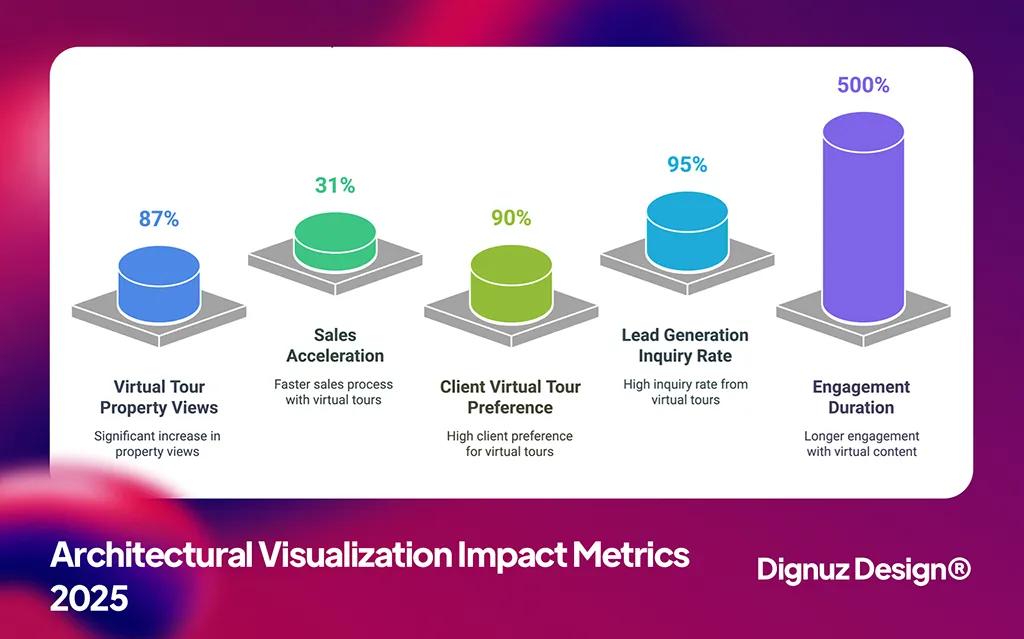
Generic marketing posts about virtual tours quote astonishing engagement numbers. Properties selling 31% faster, listings getting 87% more views. Most of these figures circulate without sources, and most architects rightly distrust them. What does hold up under scrutiny is more modest and more useful.
The National Association of Realtors reviewed listings in mid-pandemic and found that 94% of listings did not include a virtual tour despite 58% of buyers wanting one. That supply-demand gap has narrowed since but has not closed. For architects, the relevant translation is this. When a developer is comparing firms, the studio that can deliver a navigable 3D experience as part of its pitch is still in a minority position, even after several years of 3D becoming widely available.
The engagement evidence is similarly bounded. Zillow's own analysis of its 3D Home tour data shows listings with 3D tours receive substantially more views and saves than equivalent listings without, in the range of 40 to 60% lift depending on the period and market. That is the honest version of "more views." It is not a doubling of traffic, but a meaningful and repeatable engagement increase, and it shows up clearly in the saves and shares metrics on top of view counts.
Here is the practitioner reading. Developers are sitting on land, conducting feasibility studies, briefing architects and contractors, and increasingly using 3D content during their own pitch to investors, planners, and buyers. They are choosing architectural partners partly on whether the firm can produce content that flows into their own marketing stack downstream. A developer who has to commission a separate visualization studio after engaging an architect feels the friction. The architect who can deliver tour-ready, embeddable content as part of the work product reduces friction and earns the next project.
Why most architect digital marketing under-delivers
The diagnostic question I ask before starting any new architect website project is this. Where does the 3D content live today, and how does someone arrive at it? The answers are almost always the same.
The renders live in a portfolio page as flat JPEGs. The walkthroughs live on YouTube, Vimeo, or Matterport behind a click that opens a new tab. The interactive 3D model, if one exists, lives on an external viewer platform that loads slowly on mobile and shows that platform's branding more prominently than the studio's. The contact form does not capture which project the visitor was looking at when they reached out. Analytics on the portfolio is limited to page views.
In practical terms, every step that takes a visitor off the studio's domain or interrupts their flow leaks intent. Most architects know this intuitively for written content. They are slower to see it for 3D content, because 3D feels like a specialist artifact that "belongs" on a specialist platform. It does not. A 3D showcase belongs on the same domain as the rest of the site, loads within the same shell, and connects to the same contact pipeline. Anything else burns the engagement lift you are paying for.
This is the gap AmplyViewer was built to close. It runs as an embedded interactive 3D viewer inside the studio or developer's own site, with no third-party branding and no external redirect, and it ties directly into whatever analytics and form tooling the site already uses. The model is hosted on the same infrastructure as the rest of the site, which means it benefits from the same CDN, the same uptime, and the same domain authority. If you only take one structural point from this article, take that one.
The honest role of 3D in an architectural marketing pipeline
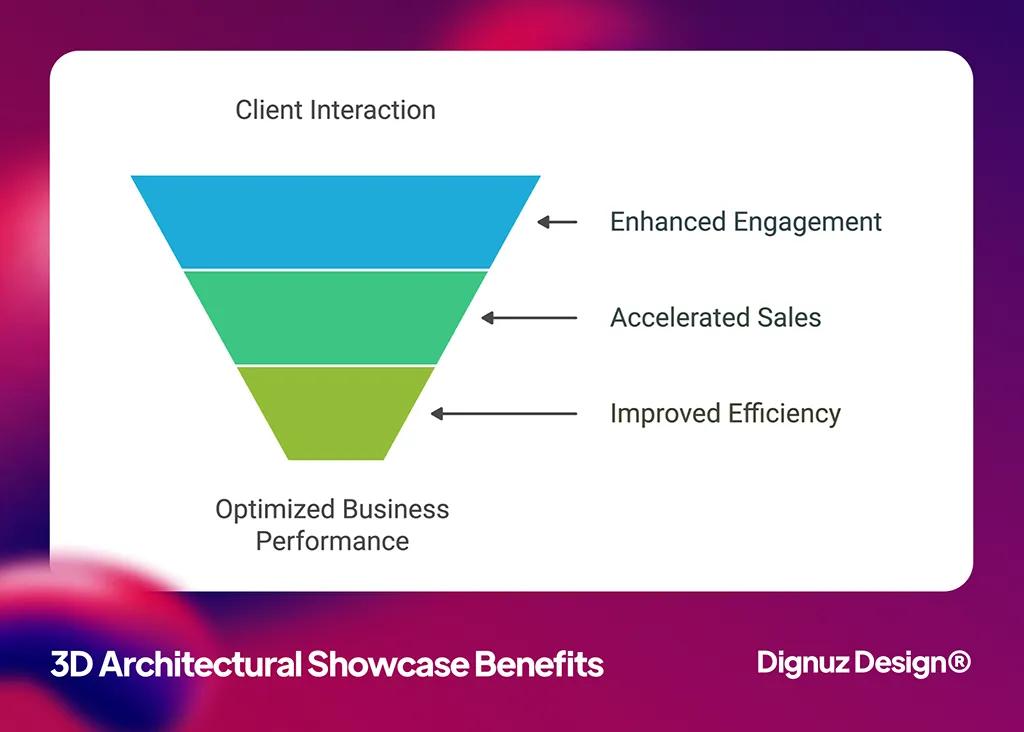
It helps to be clear about what 3D content actually does at each stage of the funnel, because the answer is different at each stage and many studios treat 3D as a single asset class.
At the awareness stage, where someone unfamiliar with the studio first encounters the work, the strongest assets are hero stills and short cinematic clips. These are the assets that perform on Instagram, in pitch decks, and on landing pages where attention is measured in seconds. The investment here is in composition, lighting, and post-production. The Royal Institute of British Architects has documented Instagram's role for architectural practices, where it functions effectively as the second portfolio for most firms. The still images that perform there have a different quality bar than internal presentation visuals.
At the consideration stage, when a developer has shortlisted the studio, the assets that matter shift toward navigable experiences. Walkthroughs, interactive viewers, exterior context flythroughs. This is where engagement time multiplies. A visitor who spends four minutes inside an interactive viewer has self-qualified in a way no pageview can.
At the decision stage, when the conversation has moved to a specific project, the relevant 3D content is no longer general portfolio material but project-specific previs of the proposed scheme. This is the one most architects already deliver well, because it is part of the bid. The work to do here is making sure that project-specific previs is captured and reused as marketing content after the project closes, with permission. Most studios deliver beautiful project previs and then never put it on the website. That is a missed asset.
For a deeper look at when each format earns its place, the comparison between flat 2D visualization and full 3D treatment covers the production tradeoffs in more detail.
Build versus embed: where the website usually breaks
Architectural sites tend to fail in one of two predictable ways when it comes to 3D integration.
The first failure mode is heavy. The studio loads a multi-gigabyte WebGL scene on the project page, the initial render takes ten seconds, mobile devices struggle, and the bounce rate on that page quietly rises. The studio's developer either does not realize how much performance has degraded or assumes that 3D content "naturally" takes time to load. Neither is acceptable when you are competing for a developer's attention.
The second failure mode is detached. The studio embeds an iframe from a third-party platform, treats the integration as complete, and moves on. The frame loads, the visitor interacts with it, but every analytics signal during that interaction belongs to the third party, not the studio. When the visitor leaves the page, the studio has no record of what they explored. The contact form three clicks later cannot be tied back to which model the visitor spent time inside.
Both failures are solvable but they have to be solved deliberately. On the performance side, the model has to be properly decimated, baked, and progressively loaded, and the hosting needs to be on a fast edge network rather than the studio's shared hosting account. Site speed for property websites is not a luxury concern; it is the precondition for any 3D content to perform commercially. On the integration side, the viewer either needs to expose event hooks back into the parent page or has to be built natively into the site stack. This is one of the reasons I tend to build property websites on Astro, Cloudflare, or a Jamstack architecture. The static shell stays fast, and the interactive viewer can be loaded as a discrete island with its own performance budget. Jamstack architecture for property developer sites lays out that pattern in more detail.
Production realities most marketing articles skip
When architects ask me what a 3D showcase actually involves to produce, the honest answer involves more than software choices. The asset starts from the studio's existing model files, typically Revit, Rhino, ArchiCAD, or SketchUp. Whatever the source, the model has to be cleaned, simplified, and prepared for real-time rendering, which is a different process from preparing it for offline cinematic rendering.
The cleanup work is where production timelines either hold or slip. A model authored for documentation contains geometry that real-time rendering does not need. Hidden interior layers, redundant components, polygons inside walls. Stripping this down without losing the surfaces the camera will actually see is a craft. Faraday3D handles this part in-house because handing it to a generalist visualization studio without an architectural background tends to produce models that look correct but feel wrong. Proportions slightly off, materials too clean, lighting too studio.
Materials are the second realism trap. The default PBR libraries that ship with most engines look fine in isolation and uncanny in context. A floor that scans as oak in a sample reads as plastic in a corridor when the scale of the wood grain is wrong relative to the door frame next to it. This kind of detail is what separates a render that closes a deal from one that gets a polite reply. The point worth making here for architects briefing a visualization partner is that material accuracy is worth more than render resolution. A 2K image with accurate materials reads better than a 4K image with off-scale wood. I covered the practical production decisions for property 3D rendering in more depth elsewhere if the cost and timeline questions are live.
The third trap is lighting. Architectural renders that look synthetic or "AI" almost always have lighting issues. Flat ambient, identical exposure between interior and exterior shots, no time-of-day variation across a set. A coherent set of images for a single project should look like they were taken across a believable morning or afternoon. This is a directorial decision and worth being explicit about in the brief.
Distribution: where your 3D content actually lives outside your site
A common mistake is treating the studio website as the only home for 3D content. The site should be the canonical home, the place where the full interactive experience lives. But the same assets, repurposed correctly, drive traffic from elsewhere.
The short clip cut for Instagram should not be the same clip cut for LinkedIn. Instagram rewards saturated, fast-cut, vertical compositions. LinkedIn rewards slower pacing and context cards. YouTube is the underused channel for architectural practice. Long-form project walkthroughs with proper narration are indexable, searchable, and rank well for project-name queries by future homeowners and journalists.
Email distribution is the channel almost every architect undervalues. A monthly studio update with a single new project and an embedded clip outperforms a quarterly newsletter with five updates. This is where a tool like AmplyDigest, my AI-powered content digest service, has changed my own intake of architectural and property newsletters. The studios I now follow most closely are the ones whose updates earn space in a curated digest, which is a different competitive bar than just landing in an inbox.
The deeper point is this. Distribution is not a separate stage from production. The 3D content has to be produced from the start in a way that yields the variants needed for each channel. A 4K cinematic clip is not the asset; it is one variant of the asset, and the studio's production partner should be delivering the others alongside it.
Measuring what matters and what to ignore
Most architectural sites I audit report pageviews and bounce rate and stop there. Neither metric tells you whether your 3D investment is paying back. The metrics that matter for architect digital marketing fall into three buckets:
- Depth-of-engagement signals on project pages. Time spent inside the interactive viewer, number of camera positions visited, percentage of visitors who reach the second interior view. These signals indicate whether the content is doing its job at the consideration stage.
- Qualified-inquiry rate per project page. Which projects on the site are producing actual contact form submissions, weighted by how senior the contact is and which firm they represent. A project that drives one director-level inquiry is worth more than a project that drives ten student inquiries.
- Downstream conversion rate from inquiry to signed brief. The metric that tells you whether the inquiries the site generates are the right kind. This is the lagging indicator that ultimately decides whether the marketing investment paid back.
A useful approach to instrumenting this on architect sites is covered in how interactive showcases turn into inquiries. The mechanics are not complex but they have to be set up deliberately, and most generic web agencies skip them because they are not part of a standard analytics package.
The shift worth naming is that 3D content is moving from being marketing collateral that sits next to the project to being part of the project, captured early and used across the lifecycle. Studios that adopt this framing find their 3D budget gets easier to justify because the same asset serves the bid, the marketing site, the planning submission, and the post-completion case study. That is the leverage that distinguishes mature architectural marketing from the templated approach most generic guides describe.
💻 Let us help you create a stunning online showcase for your projects that works seamlessly across all devices. Ready to amplify your real estate business? 👉 Explore AmplyViewer now
Frequently asked questions
How much does an interactive 3D showcase cost for a small architectural studio?
The honest range for a single project showcase, fully produced and embedded on a custom site, is wider than most quotes suggest. A simple interior walkthrough with three to five rendered scenes lands in the lower thousands of pounds or dollars. A full interactive viewer of an exterior plus interior, with multiple navigable rooms and progressive loading, typically falls in the mid five-figure range. Studios that quote much below this are usually delivering pre-baked panoramas rather than true interactive content. The relevant question to ask a visualization partner is whether the final deliverable includes the source files and a hosted, embeddable build, or only the video output.
Do we need a virtual tour for every project we list?
No, and trying to do this for every project is the fastest way to make none of them perform well. Choose the projects where the architectural story is strongest, the ones where space, light, or spatial sequence are the actual selling points. For projects where the value is in the location, the planning history, or the developer's track record, conventional photography and copy will do more work. A studio that maintains five exceptional interactive showcases will out-market one that maintains twenty mediocre ones.
What software do architects need to start producing 3D marketing content in-house?
If the studio already works in Revit, Rhino, or ArchiCAD, the relevant additions are a real-time rendering engine (Unreal, Twinmotion, D5, or Lumion are the practical options) and a tour or embed platform for the output. Whether to bring this in-house or partner with a visualization studio is a question of volume, not capability. Studios producing one to two showcases a year are almost always better off partnering. Studios producing one or more a month should bring at least the previs work in-house and partner only for the final hero output. The longer comparison of in-house versus outsourced 3D production goes deeper on this.
How long should a 3D walkthrough video be for marketing purposes?
For social media variants, 15 to 30 seconds. For an embedded clip on the project page, 60 to 90 seconds is the upper bound before drop-off rises sharply. For a YouTube long-form treatment with narration, three to five minutes is the working range. The interactive viewer is unbounded in session length because the visitor controls it, which is part of why it is the highest-value asset type even though it costs more to produce.
Does 3D content help architects rank in search results?
Indirectly, yes. Search engines do not crawl inside an interactive 3D viewer or a video, but they do read the page that hosts the asset, the file naming, the structured data, and the dwell time signals from visitors. A page with a fast-loading interactive showcase tends to have substantially longer dwell time, lower bounce, and more inbound links, all of which contribute to ranking. The asset itself is not the SEO mechanism; the engagement it produces is.
Should our studio website host the 3D content or use a third-party platform?
Host it on your own site whenever feasible. Third-party platforms are useful for prototyping and distribution but should not be the canonical home. Hosting on your own site keeps the analytics signal, retains the brand, removes a redirect step, and avoids the risk of the third-party platform changing its pricing or shutting down a feature. The pattern I recommend for architect sites is canonical content on the studio domain with optional distribution variants on third-party platforms pointing back to it. The architect website showcase patterns guide covers the structural side of this in more detail.