Next.js vs NestJS: What Each Solves and When To Skip Both

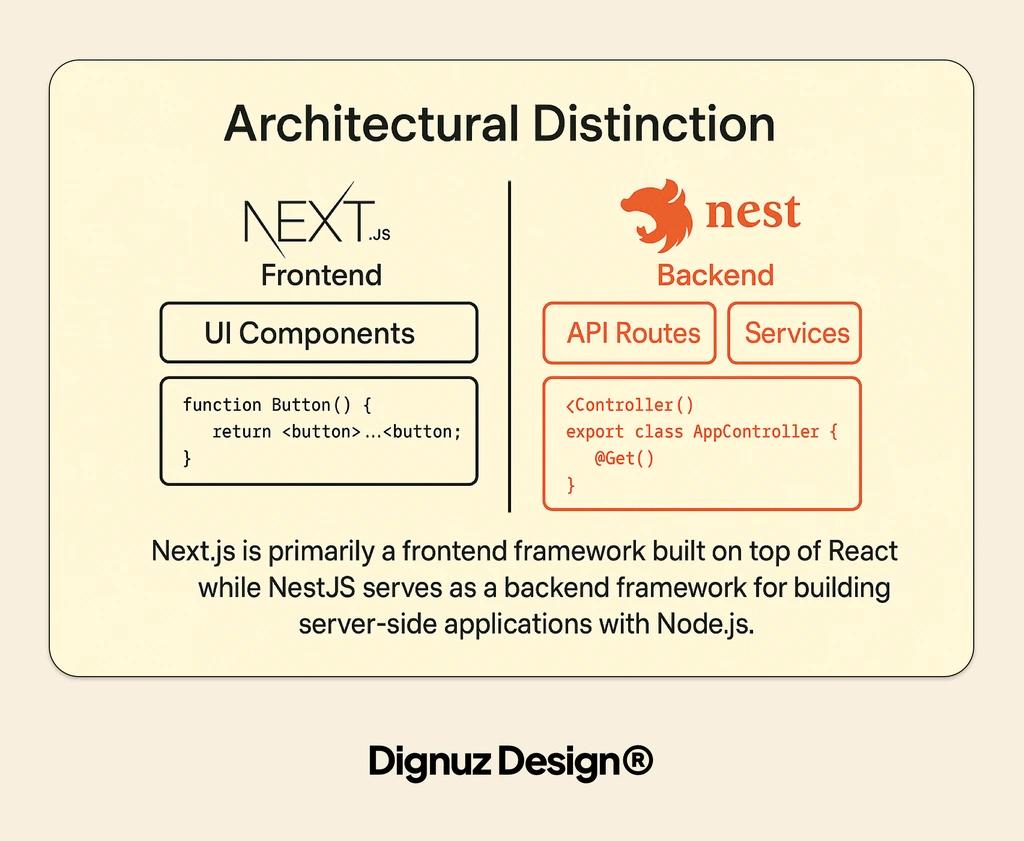
Next.js and NestJS end up in the same comparison posts because they rhyme. Both are Node frameworks, both lean on TypeScript, both have small birds in their logos. So they look interchangeable at a glance. They are not. One renders your UI, the other runs your business logic, and picking "between" them is like picking between a steering wheel and an engine.
The more useful question, and the one I want to answer here, is this: where does each framework genuinely earn its weight on a real project, where does the ceremony start to cost you, and when should you reach for something lighter on either side of the stack? I build web products at DignuzDesign - mostly for real estate developers, architects, and property portals - and I run a summarization product called AmplyDigest that lives almost entirely on Cloudflare. I have shipped with both Next.js and NestJS-style backends, and I have also shipped without them. That is the lens this article uses.
What Next.js Is and What It Is Not
Next.js is a React metaframework. It gives you file-based routing, server-side rendering, static generation, the newer App Router with React Server Components, a fetch cache, an image pipeline, and a deployment story that is essentially a push to Vercel. Everything it does is in service of shipping React UIs that are fast on the first paint and usable on slow networks. That is the whole job.
It is not a backend framework. Yes, Route Handlers exist, and yes, you can stuff a Prisma client behind them and ship. I have done it. It works until your API surface stops looking like "thin wrapper over the database" and starts looking like a domain with its own rules. At that point, the code you write inside app/api is indistinguishable from bad NestJS, except without the structure.
What NestJS Is and What It Is Not
NestJS is an opinionated Node.js backend framework that borrowed its architecture from Angular. You get modules, providers, decorators, a dependency injection container, and a CLI that generates the boilerplate for you. It runs on Express or Fastify under the hood. The official docs on modules are the shortest honest description of the mental model: you split the application into cohesive units, each with its own controllers, services, and imports, and you wire them together with an IoC container.
It is not a frontend framework, it is not a full-stack framework, and despite the marketing, it is not "Angular for the backend" in any useful sense. It is a structured way to write Node APIs for teams that benefit from having one imposed.
Where Next.js Earns Its Weight
There are three scenarios where I reach for Next.js without hesitation:
- A React-heavy product with authenticated, interactive dashboards where SEO still matters for the marketing pages.
- A site that must support server components to meaningfully cut client bundle size, such as a product catalog with dozens of dynamic filters.
- A team that is already on Vercel and wants to stay there for the preview deploy experience.
The server component model is genuinely useful. In the right hands it moves logic off the client and sends less JavaScript down the wire. The Next.js team documents the boundary rules clearly in the Server and Client Components guide, and they are worth reading before you start, not after.
Where Next.js has burned me, and where I think the comparison posts gloss over the truth, is the gap between development and production. Fast Refresh keeps state alive, streaming behaves differently, and hydration cost is effectively invisible in local dev. You only feel it on a real device on a real network. The App Router's caching defaults have also shifted between versions, which means that a cache behavior you relied on in one release can quietly change in the next. None of this is a reason to avoid the framework. It is a reason not to treat "I followed the tutorial" as a finished project. Build a production preview, test on a cold client, and look at what actually ships to the browser before you call it done.
Where NestJS Earns Its Structure
NestJS is at its best when three things are true at once: the domain is complex enough to deserve a layered architecture, the team is large enough that shared conventions save more time than they cost, and the service is going to live for years. On an enterprise platform with a dozen bounded contexts and five engineers rotating through, the dependency injection container pays for itself every week. You can mock a provider in a test, swap implementations between environments, and onboard a new hire with a CLI command that scaffolds the same shape every time.
The TypeScript-first orientation is also real. If you care about writing TypeScript that holds up under refactor, NestJS gives you enough structure to keep type boundaries meaningful instead of letting any creep in at the edges.
Where NestJS costs you is on the other end of the spectrum. On a solo project, or a small API with five endpoints, the module/provider/controller triplet is ceremony with no payoff. You will write more code describing the architecture than doing the work. I have seen founders spend a week wiring up a Nest monorepo for what could have been a single TypeScript file running on a Worker. The dependency injection container is a beautiful piece of engineering, and it is the wrong tool for a side project.
The Question Nobody in the Comparison Posts Asks
Do you need either framework for the part of the stack you are actually building?
For the majority of real estate websites I ship at DignuzDesign, Next.js is overkill. The site is content with some interactive pieces - a property search, a map, a 3D viewer embed. Astro ships the same result with smaller client bundles because it defaults to zero JavaScript and only hydrates the islands that need to be interactive. On a listing-heavy Jamstack build, the Next.js runtime is paying for capabilities the page will never exercise.
For most backends I build, NestJS is the same story. AmplyDigest is a service that fetches newsletters, runs them through an LLM, stores the summary in a database, and mails a daily digest. It is a real product with real users. It does not run on NestJS. It runs on Hono on Cloudflare Workers, which is a sub-15KB framework built on Web Standards. Hono's own benchmarks are credible because they are reproducible, and the practical numbers are what sold me: cold starts under a millisecond, p99 latency in the single-digit milliseconds, and a deploy cycle measured in seconds. NestJS on a container cluster cannot touch that, and for a CRUD-shaped API, nothing in the NestJS feature set justifies the difference.
The mental model I use: frameworks earn their weight when the problems they solve are the problems you actually have. Next.js earns it when your UI is complex React. NestJS earns it when your backend has real domain logic and a real team. Outside those bands, pick lighter.

When I Do Use Them Together
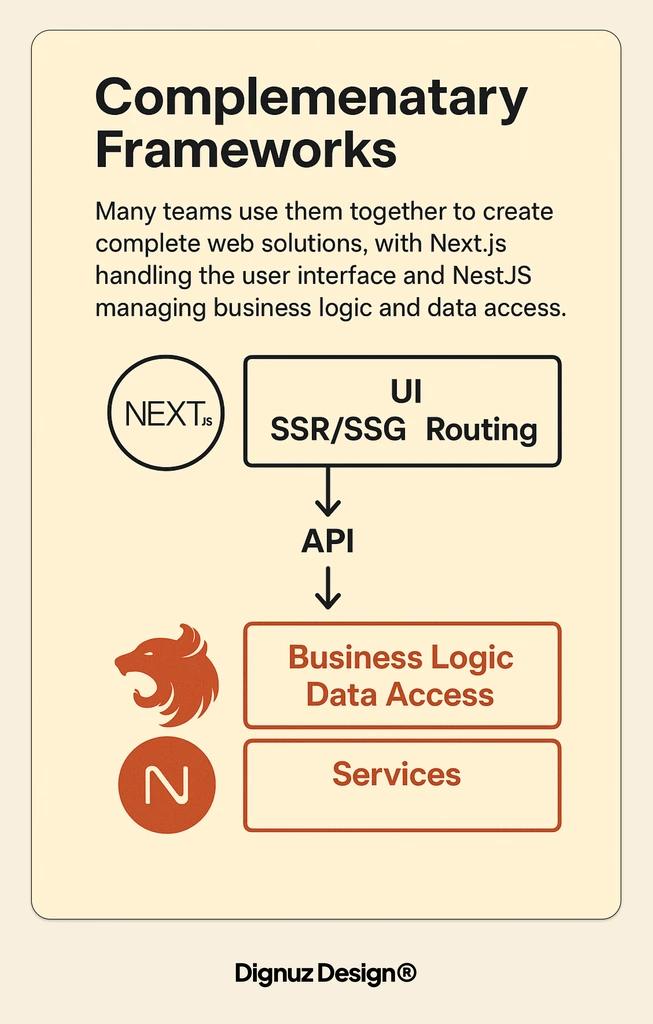
The case for the combination is real, it just is not the default. If I were building a SaaS with a heavy authenticated frontend, multi-role permissions, a domain model worth naming, and a team big enough to write tests for it, Next.js in front of NestJS is a reasonable shape. The frontend does what Next.js is good at. The backend does what NestJS is good at. You share TypeScript types across the boundary, you wire up auth once, and you accept that you are running two deploy pipelines.
What I would not do is reach for the combination by default on a small or medium project. The AmplyViewer 3D property viewer, for instance, runs its embed layer and its backend as small independent services rather than a monolithic full-stack Next.js + NestJS stack. The parts are easier to reason about, cheaper to run at the edge, and faster to iterate on.
How I Actually Pick, in Plain Language
Here is the decision I run through for every new project, stripped of framework loyalty:
- Content-led marketing or real estate site - Astro, or Webflow if the client needs to edit it without me.
- Edge-first API or small backend service - Hono on Cloudflare Workers with D1 or R2 for storage.
- React-heavy product with complex UI and SEO needs - Next.js with the App Router, used carefully.
- Enterprise Node backend with a team and a domain - NestJS, and take the DI container seriously.
- Full-stack SaaS that genuinely needs both - Next.js and NestJS together, with a shared types package.
That list is not exhaustive, but it covers about 90 percent of what lands on my desk. The principle behind it is simple: optimize for the shape of the problem, not the shape of the framework.
Performance, Honestly
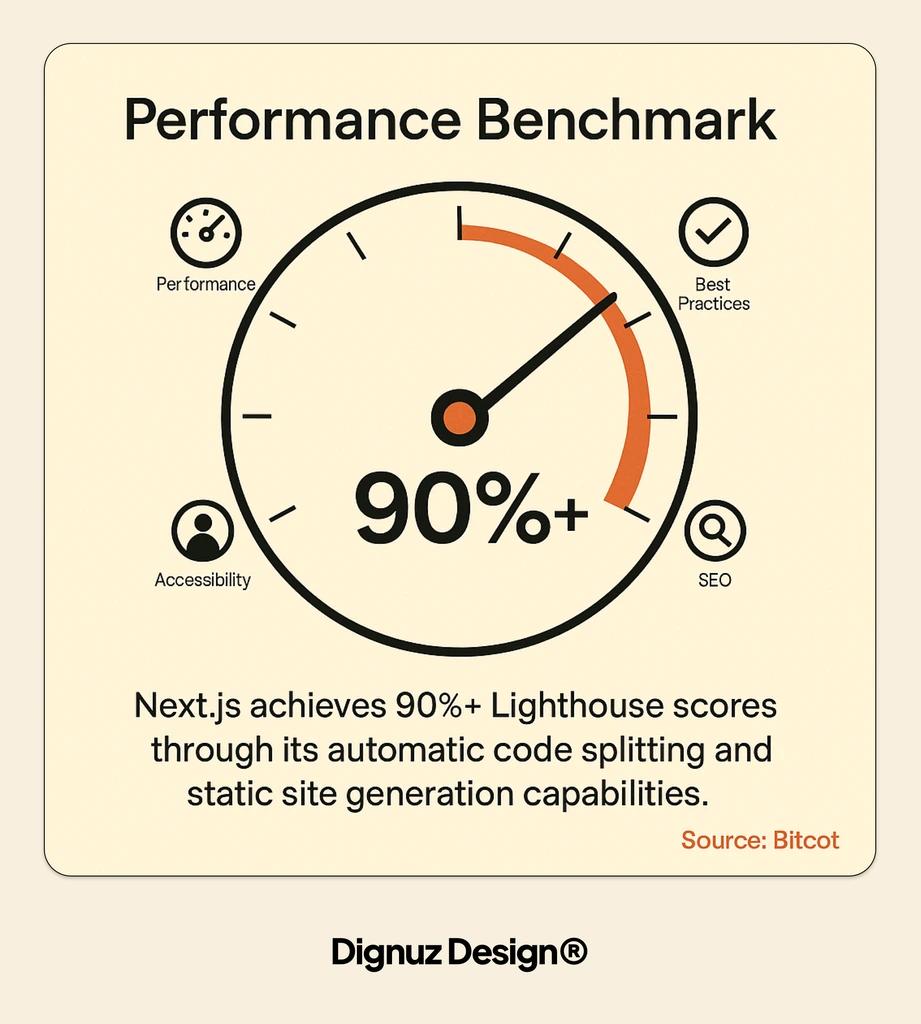
Both frameworks are fast enough for most businesses. Next.js scores well on Lighthouse when configured properly, and NestJS can handle thousands of requests per second on modest hardware. The honest performance conversation is about where your app spends its time, not which framework has better headline benchmarks. A Next.js site with a hundred client components hydrating on load will lose to a well-built Astro site every time. A NestJS API making an unoptimized database call per request will lose to a Hono Worker with a correctly indexed D1 query every time. If performance matters, profile the real path, not the framework.
One specific thing I have learned the hard way: never treat local dev numbers as production numbers. I have had Next.js pages that felt instant in development turn into 400ms hydration blocks on a mid-tier Android phone. Test on slow hardware on a slow network before you sign off.
Frequently Asked Questions
Are Next.js and NestJS alternatives to each other?
No. They sit on different layers of the stack. Next.js is a frontend framework built on React that adds server rendering and routing. NestJS is a backend framework for Node.js that structures your API code. You can use one without the other, both together, or neither.
Can Next.js replace NestJS for the backend?
For thin API wrappers, yes - Next.js Route Handlers will do the job. For anything with real domain logic, multiple services, background jobs, or a team that needs enforced structure, no. You will end up reinventing NestJS inside your app/api folder, and the reinvention will be worse than the original.
Is NestJS better than Express?
"Better" depends on team size and project lifespan. NestJS actually runs on top of Express by default, and adds architecture, a CLI, and a DI container. On a solo project, bare Express or a minimal framework like Hono or Fastify is faster to ship. On a team of five building a platform for multiple years, NestJS's structure is worth the upfront cost.
When should I use Hono instead of NestJS?
When you are deploying to Cloudflare Workers or any edge runtime, when the API is not carrying deep domain logic, when cold start latency matters, or when you want a minimal dependency footprint. Hono is built on Web Standards, has zero dependencies, and is the framework I reach for on most backend work I do at DignuzDesign today.
Does Next.js App Router make NestJS obsolete?
Not even close. The App Router is a better way to structure a React frontend. It does not change what a backend does. Server Components can move data fetching to the server, but they do not replace a proper API layer for anything beyond simple read paths.
What do you use for real estate websites specifically?
Astro for the site itself, Webflow when the client needs full editorial control, Hono on Cloudflare Workers for any custom API, and the AmplyViewer embed for interactive 3D walkthroughs. Next.js only shows up when the client already has a React team that will maintain the codebase after I hand it over.

Conclusion
Next.js and NestJS are both good at what they do. They are not competitors. The mistake in most "Next.js vs NestJS" articles is treating the comparison as the interesting question. The interesting question is whether the problem in front of you is complex enough to earn either framework's weight, and if it is not, what lighter option is a better fit. A content site does not need Next.js. A CRUD API does not need NestJS. Reach for the heavy tools when the problem asks for them, and reach for something smaller when it does not.