Java vs JavaScript: What Actually Separates Them
The first time a client asked me whether their new website would be "built in Java or JavaScript", I learned that this confusion is not a problem only beginners have. It runs all the way up to the people writing the cheques. Java and JavaScript share four letters of their name and nothing else. They were born in the same year, they ended up with similar marketing positioning, and the world has spent thirty years sorting out the mess. At DignuzDesign I ship JavaScript every working day on top of Astro, Svelte, Hono, and Cloudflare Workers. I have written Java when the job called for it. The comparison is not really a comparison - it is two tools built for two different jobs, and the interesting question is not "which is better" but "why does anyone still confuse them, and where would either actually belong on a real project?"
The name is a marketing artifact and the confusion is not your fault
JavaScript was originally called Mocha, then LiveScript. Netscape renamed it to JavaScript in late 1995 because Java was the hot new technology and the marketing department wanted a halo. Java had been released a few months earlier and was the language everyone in serious computing was talking about. Brendan Eich's small scripting language for the browser borrowed the name to ride the wave. It worked. It is also why, three decades later, you still meet senior managers who think one is a dialect of the other.
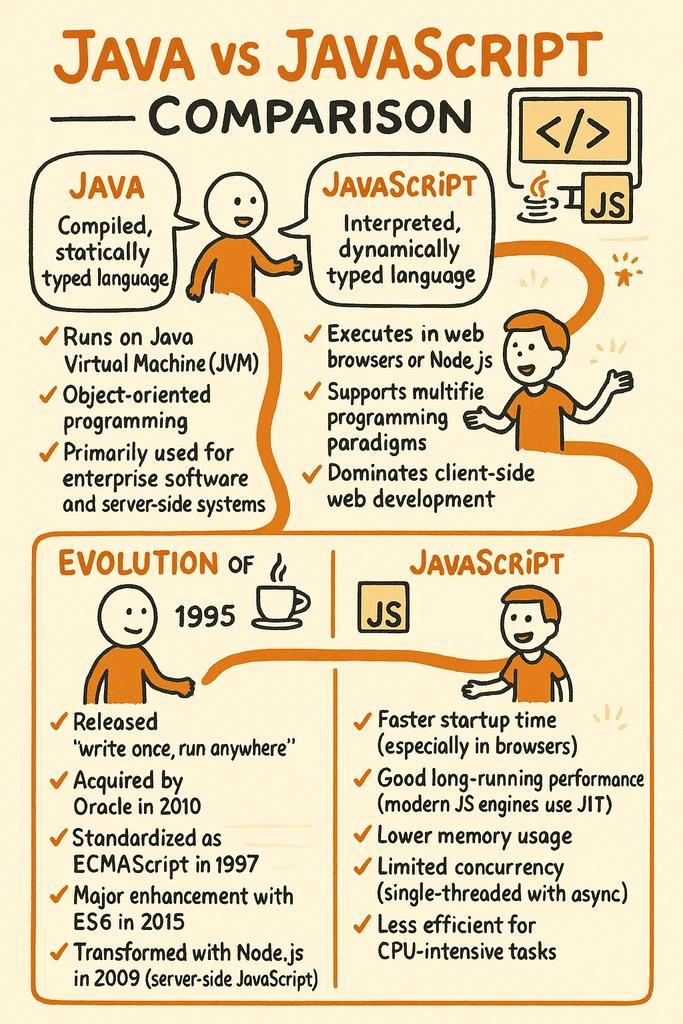
They are not. The syntax overlap is shallow. Both use curly braces, both have for loops, both have if statements. So does C. So does Rust. So does PHP. The deeper you get, the less they have in common. Java has nominal typing, classical inheritance, a strict compilation step, and a virtual machine that runs the resulting bytecode. JavaScript has structural typing, prototype-based inheritance, no compilation step in the traditional sense, and a runtime that executes the source directly through engines like V8 or SpiderMonkey. I have written elsewhere about how JavaScript actually works under the hood, which is worth reading if you want to understand why this matters for everyday code.
The real divergence is the runtime, not the syntax
Most comparison articles get hung up on syntax. Java is more verbose. JavaScript has weird type coercion. Fine, both true. Neither matters once you are past the first month. What matters in production is the runtime model, and the runtimes are entirely different beasts.
Java runs on the Java Virtual Machine. You compile source to bytecode, the JVM loads it, an optimising JIT compiler converts hot paths to native machine code, and a garbage collector reclaims memory in the background. The JVM is genuinely brilliant engineering. It has had thirty years of investment from Oracle, IBM, Red Hat, and the entire enterprise world. For long-running processes that handle high throughput on big multi-core servers, almost nothing matches it.
JavaScript runs in one of a handful of engines, almost always V8. In the browser it powers every interactive site you have ever used. On the server it powers Node.js, Deno, and Bun. At the edge it powers Cloudflare Workers, where the runtime model gets really interesting. According to the Cloudflare Workers documentation, a single V8 isolate can start around a hundred times faster than a Node process running in a container, with an order of magnitude less memory at startup. That is the architecture I built AmplyDigest on top of - the JavaScript runtime cost is paid once, and individual scripts run with almost no per-request overhead. You cannot do that with the JVM today. You can get close with GraalVM Native Image, which I will come back to.
Concurrency: threads against an event loop
This is where the practical difference shows up fastest. Java's traditional concurrency model is threads. Real OS threads, one per request in classic Spring applications, each consuming around a megabyte of stack memory just to exist. Project Loom changed this with virtual threads, which the JVM manages internally so you can have millions of them. The programming model still looks like the imperative, blocking code Java developers have written for decades. The async complexity is hidden inside the JVM.
JavaScript flips it. The runtime is single-threaded and the event loop dispatches I/O completions back into the main thread. Async is in the language itself - async, await, Promise, the works. You cannot write blocking code without consequences, which is annoying for the first week and liberating after that. For I/O-bound work (databases, HTTP, files) JavaScript scales beautifully on small machines. For CPU-bound work (image processing, large numeric computation, anything that pegs a single core) it falls over and you reach for worker threads or, more honestly, a different language.
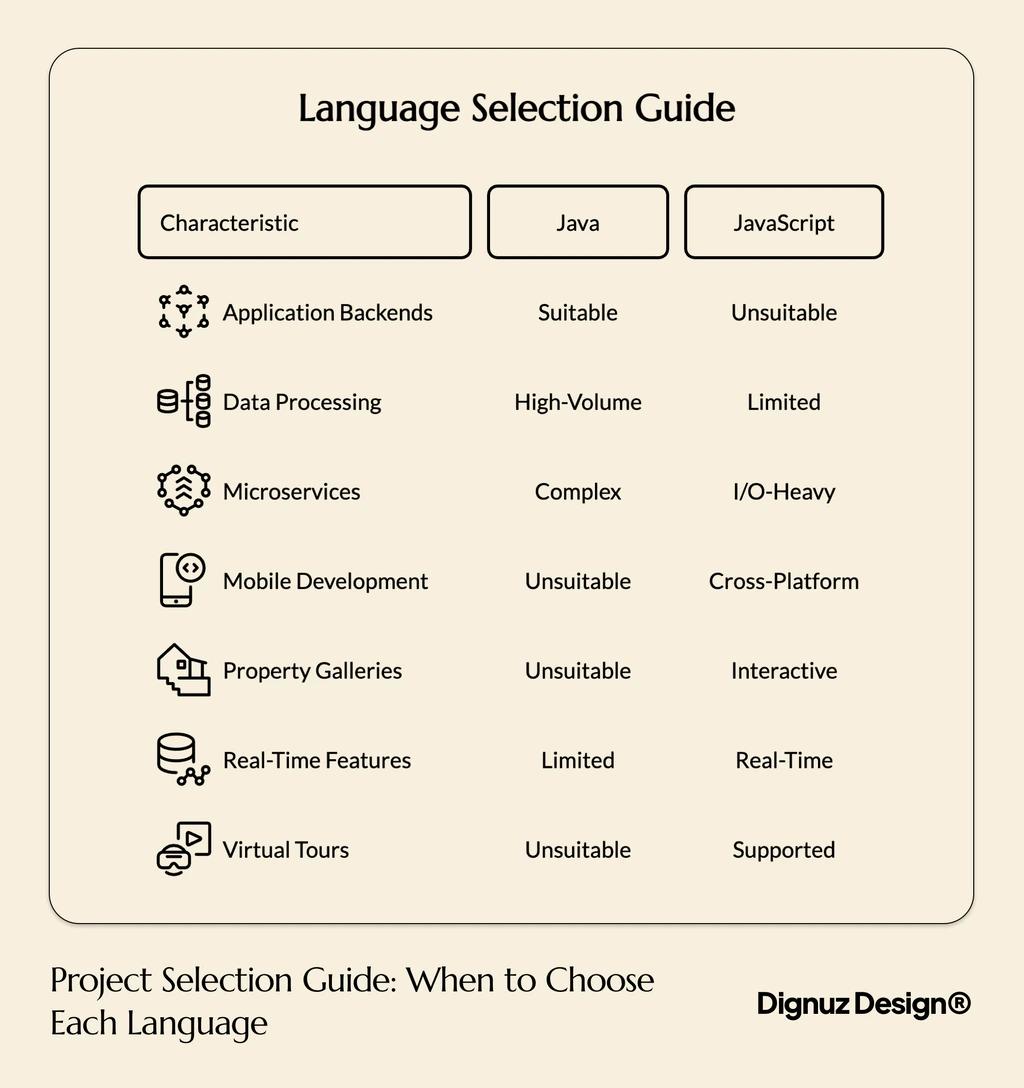
The way I think about it in practice: if your service spends its life waiting on the network, JavaScript is the cheaper, lighter, faster-to-iterate choice. If your service spends its life crunching, Java (or Rust or Go) is going to use the hardware better.
Where JavaScript wins on my projects
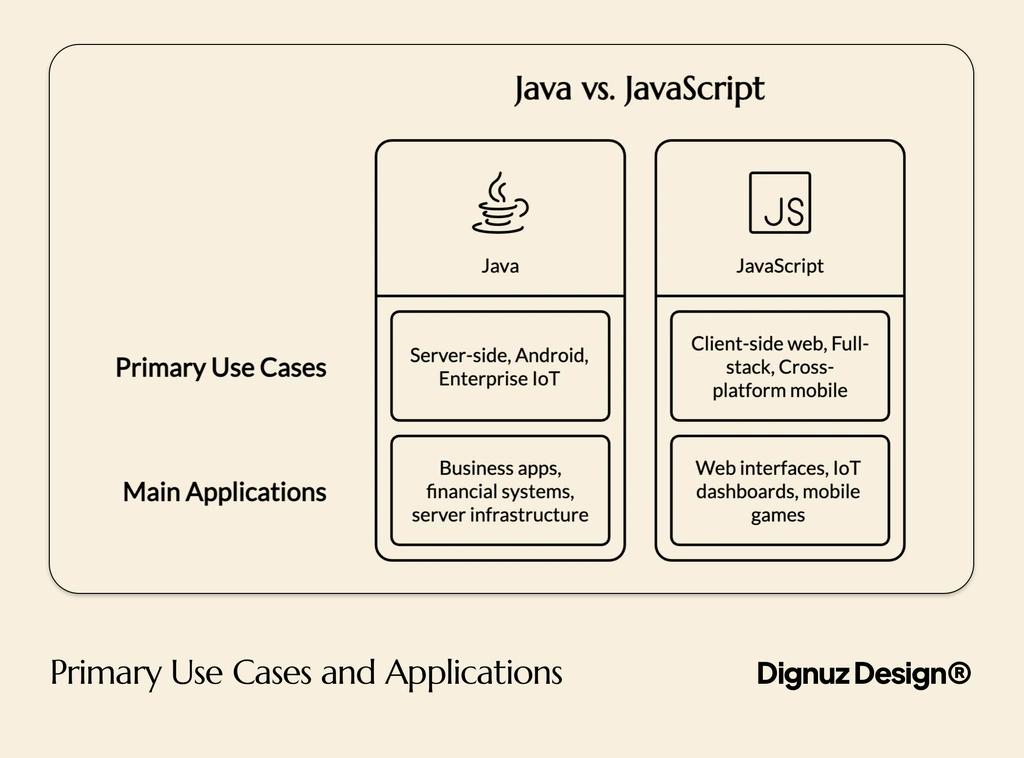
Almost everywhere, frankly. I will be honest about why. The work I ship is browser-facing: real estate marketing sites, property developer landing pages, the AmplyViewer embed for interactive 3D properties, the Faraday3D portfolio site. All of it lives in a browser tab. JavaScript is the only language a browser actually runs natively. Everything else compiles down to it or to WebAssembly. So at minimum, JavaScript is non-negotiable on the frontend.
On the backend the picture is more genuine choice, and I still pick JavaScript for almost everything. Specifically I pick TypeScript - the type-safe superset that solves most of the genuine criticism people levy at JavaScript. I have written about how TypeScript compares to plain JavaScript in more detail. The reason I lean on TypeScript with frameworks like Hono on Cloudflare Workers is not ideological. It is that:
- Cold starts on Workers are effectively zero, which matters when you have unpredictable traffic.
- The deployment model is one command and the cost at low scale is genuinely free.
- I can share types between the frontend and backend, which removes an entire category of bugs.
- The ecosystem of libraries for the kinds of jobs I do - rendering pages, talking to APIs, processing webhooks - is unmatched.
- One language across the whole stack means I context-switch less and ship faster.
If you are evaluating what backend stack to learn from a JavaScript starting point, my notes on JavaScript backend frameworks cover the trade-offs between Express, Fastify, NestJS, Hono, and the rest.
Where Java is still the right answer
I am not the developer to write a real estate marketing site in Java. I am also not the developer to write a bank's core ledger in JavaScript. The places where Java still dominates are not random - they share a profile:
Long-running, high-throughput services that handle thousands of concurrent transactions, where mature tooling, decades-old libraries, and strict static types are worth more than rapid iteration. Banks, insurance, logistics, large e-commerce backends, Android applications, big data pipelines on Spark or Flink. The JVM has had three decades to optimise for exactly these workloads. The hiring market for senior Java developers is enormous and stable. The codebases are huge and they last. None of this is going away.
According to the 2025 Stack Overflow Developer Survey, JavaScript leads the field with 66% of developers reporting use over the past year, while Java sits at 29.4%. JavaScript wins on breadth - it is the language with the widest job description. Java wins on depth - one-in-three developers is using it, and they are largely working on systems that move serious amounts of money. Those are not the same thing. A guide on how to actually learn Java if that is the world you are aiming at sits elsewhere on this site.
Cold starts and the edge: the one comparison that matters in 2026
For years, the cleanest argument for choosing JavaScript over Java in serverless contexts was cold start time. A JavaScript Worker starts in milliseconds. A Spring Boot app on AWS Lambda used to take seconds, sometimes ten or more. This is the gap that defined "is the JVM dead at the edge?" debates for the last five years.
That gap is closing. GraalVM Native Image compiles Java code ahead of time into a native binary with no JVM startup. Reported cold starts drop into the hundreds of milliseconds. Project Leyden in OpenJDK is pursuing the same goal from a different direction. The catch is real, though: GraalVM Native Image cannot deal with reflection, dynamic proxies, or runtime class loading without hand-written metadata, which breaks a lot of mature Java code that depends on exactly those patterns. If you can live within those limits - or if you start a project specifically to target them - you can ship serverless Java that does not embarrass itself.
I have not moved any production workload to GraalVM Native Image. The trade-off for the kinds of projects I work on is not worth it. But it is the most credible answer Java has to JavaScript's dominance at the edge, and anyone making a backend choice today should know it exists.
If you are starting out, which one should you learn?
Pick the language that matches what you want to build. This is the only honest answer. If you want to build websites, web applications, or anything browser-adjacent, learn JavaScript. You will end up needing it anyway, regardless of what else you learn. If you want to work on Android, on enterprise backends, or on serious data engineering pipelines, learn Java. Do not try to learn both at once. The investment to be useful in either is substantial and the overlap is smaller than you think. I have collected my broader notes on which programming languages are worth learning depending on career goals - the short version is that Java and JavaScript almost never sit in the same column.
The one exception: if you are going to learn JavaScript, learn modern JavaScript and then TypeScript. The combination is the closest the JavaScript world has to the static-typing safety net Java developers take for granted, and the gap in real-world bug rates between a well-typed TypeScript codebase and a plain JavaScript one is large.

FAQ
Is JavaScript a watered-down version of Java?
No. They are entirely separate languages, designed by different people for different purposes. JavaScript was named after Java in 1995 for marketing reasons. The two languages have no shared ancestry beyond surface-level C-style syntax that almost every modern language uses.
Can I use Java in a web browser?
Not in any practical sense in 2026. Java applets are dead and have been for years. Modern browsers do not run Java. If you write code that runs in a browser, you are writing JavaScript, TypeScript, or something that compiles to JavaScript or WebAssembly. Java on the web means Java on the server, behind an API that a JavaScript frontend talks to.
Which is faster, Java or JavaScript?
It depends on what you measure. For CPU-bound work on a multi-core server with long-running processes, Java is faster because the JVM's JIT compiler and threading model use the hardware better. For request-response web work on small or distributed infrastructure, JavaScript is typically faster end-to-end because of lower memory overhead, faster startup, and a runtime that is built for non-blocking I/O. There is no answer in the abstract.
Do I need to know both Java and JavaScript to build a website?
No. A modern website needs JavaScript on the frontend, full stop. If the backend is also written in JavaScript - which is increasingly common with Node, Deno, or Cloudflare Workers - you do not need any Java at all. Java enters the picture only when you are integrating with a Java-based backend, which is common in enterprise contexts and rare in small business or marketing sites.
Is Java losing ground to JavaScript?
Not in the places where it dominates. Java continues to grow in absolute terms and remains essential to enterprise software, Android, and big data. What has changed is the boundary - the rapid, lightweight web work that might once have been split between a Java backend and a JavaScript frontend is now often built end-to-end in JavaScript. Java has retreated from the easy ground and consolidated in the hard ground, and that is a healthy position for any thirty-year-old language to be in.
Should I learn Java first or JavaScript first?
Whichever matches the thing you want to build. There is no general-purpose right answer. If you want to see code running in a browser within the first hour, JavaScript. If you are aiming at a backend engineering job at a large company, Java. Choosing based on which is "easier" is a trap - both have steep curves once you go past basic syntax, and the curve is steeper in whichever you picked for the wrong reason.