Webflow Development Cost for Real Estate Websites

What You Actually Pay and Why
When a property developer or estate agent asks me what a Webflow website costs, the honest answer is that the number on its own tells you very little. A Webflow site can cost four thousand euros or forty thousand euros, and both quotes can be entirely reasonable for the project they describe. What actually matters is understanding what drives the difference - and what the right scope is for your particular business.
I have been building Webflow sites for real estate clients long enough to have a clear view of where budgets go, what is genuinely necessary, and what tends to be oversold to clients who do not know what to ask for. This article is a practitioner's take on the real cost structure, not a compilation of pricing tiers from Webflow's plans page.
The Two Costs You Are Always Paying
Every Webflow project has two cost layers that work completely independently of each other, and confusing them is the source of most budget misunderstandings.
The first is the Webflow platform subscription - the monthly or annual fee you pay to Webflow directly for hosting your site. For a property website with a manageable number of listings, this is typically the CMS plan at around $23 per month billed annually, or the Business plan at $39 per month if you need more CMS items or higher bandwidth. These are operational costs, not development costs, and they continue indefinitely after launch.
The second is what you pay a developer or studio to design and build the site. This is where almost all of the budget variation lives. The subscription cost is predictable and documented on Webflow's pricing page. The development cost is where the real conversation happens.
Most articles on this topic spend disproportionate attention on the subscription tiers, because those numbers are easy to find and compare. The development cost is harder to generalize, which is precisely why it deserves the more careful treatment.
What Drives Development Cost on a Property Website
In my experience building sites for real estate developers, architects, and estate agents, the cost of a Webflow project is determined by three things more than anything else: whether the design is custom or template-based, how complex the CMS structure needs to be, and how many integrations are required to connect the site to other tools the client uses.
A genuinely custom Webflow design - starting from brand guidelines and Figma wireframes rather than a purchased template - takes significantly more time and therefore costs more. But for a property developer marketing a luxury scheme or a boutique agency distinguishing itself from competitors, a custom design is usually the right investment. The brand identity of a property developer needs to be consistent across every touchpoint, and a template that three hundred other agencies are also using does not serve that.
The CMS structure is the second major driver. A basic Webflow CMS setup for property listings - fields for price, type, location, status, images, floor plan - is straightforward. The complexity and therefore cost rises when you need multiple interconnected collections (say, properties linked to a development, developments linked to a location area, each with its own page template), dynamic filtering by multiple criteria, or conditional visibility rules that show or hide content based on property status. These are achievable in Webflow, but they require thoughtful architecture and meaningful build time.
Integrations are the third driver, and the most underestimated. Connecting a Webflow site to a CRM so that contact form submissions appear in the right place, setting up email automation when an enquiry comes through, embedding a property mapping tool - each of these adds development time. The cost is not in the integration itself but in the testing, edge-case handling, and making sure everything works reliably under real conditions rather than just demo conditions.
💻 Let us help you create a stunning online showcase for your projects that works seamlessly across all devices. Ready to amplify your real estate business? 👉 Explore AmplyViewer now
Realistic Budget Ranges for Real Estate Webflow Projects
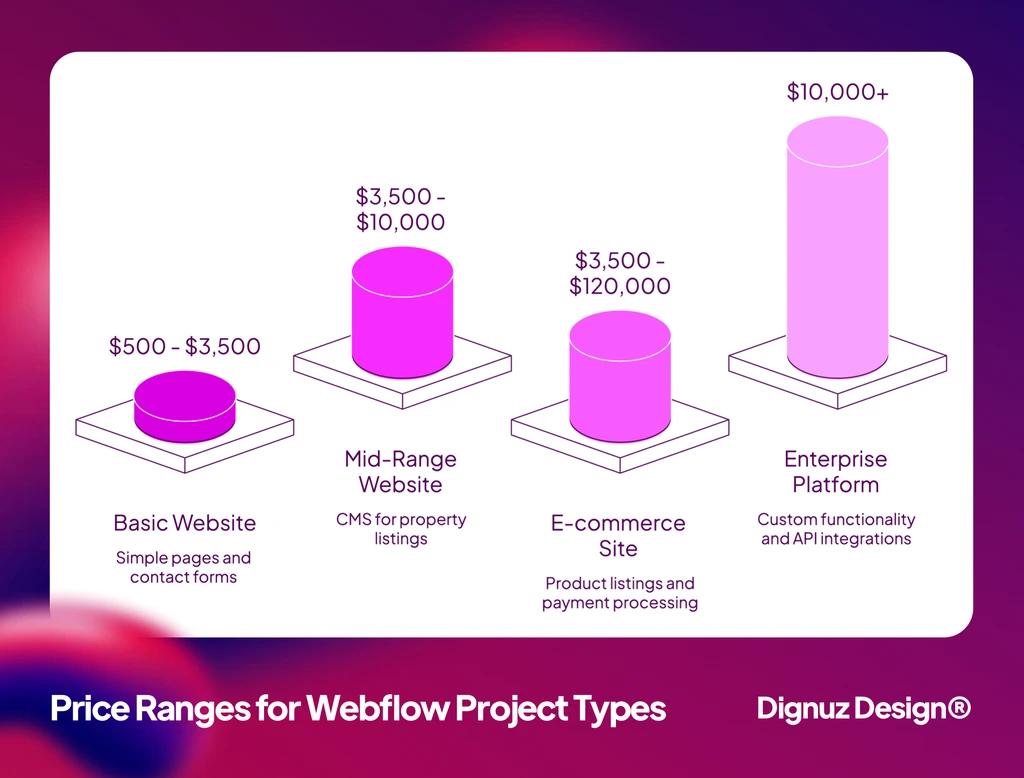
The market for Webflow development is wide, with freelancer rates ranging from $50 to $150 per hour and boutique agencies pricing full projects from around $8,000 to $40,000 for mid-complexity builds. According to market research aggregated across verified client reports, Webflow websites for freelancer-led projects typically range from $2,000 to $10,000, while boutique agency builds run from $8,000 to $40,000, with larger enterprise or multilingual projects exceeding $80,000.
For the kind of work DignuzDesign does - custom property developer websites and estate agency brand sites - the meaningful range for most clients sits between $6,000 and $18,000 for a complete launch-ready build. Here is what that range typically corresponds to in practice.
At the lower end of that range, the project has a relatively contained scope: a homepage, an about section, a project or development portfolio using Webflow CMS, a team page, and a contact page with a form. The design is custom but works within an established visual identity. The CMS structure is clear and does not require complex relationships between collections. There are no deep third-party integrations. This is a strong, professional brand website for a developer or agent who needs a credible digital presence without complicated technical requirements.
At the higher end, the project typically includes a more complex CMS architecture - multiple development projects each with individual unit listings, filterable by type and status, with a structured approach to showing which units are available versus reserved versus sold. There may be an interactive map integration showing project locations. The design involves more pages, more considered animations and transitions appropriate for luxury property presentation, and more time spent on the details that separate a good website from an exceptional one. There may also be integration with a CRM or email automation platform.
Beyond that range, you are typically adding scope that is genuinely enterprise-level: multilingual sites for international developer markets, live IDX or property database feeds requiring custom integration work, client portals with authentication, or custom search and filtering that goes beyond what Webflow's native CMS filtering supports natively.
Template Versus Custom: The Most Consequential Decision
The temptation to use a Webflow template to reduce cost is understandable, and for some projects it is the right call. A template for a small estate agency that primarily needs to list properties and generate enquiries, with a limited marketing budget, makes sense. Templates for Webflow exist specifically for real estate use cases, with property listing structures already built in.
The case against templates for most property developer clients is not about aesthetics - it is about brand differentiation and long-term flexibility. A template that looks fine at launch starts to show its constraints the moment you try to make the site genuinely reflect your brand. The spacing feels off. The section structure does not quite match how you want to tell your story. The CMS fields do not map cleanly to how you actually describe your properties. Each customization adds developer time, and after enough of those adjustments, you have spent significant money on top of the template cost without actually having a site that feels custom.
For developers working in the luxury segment, the template problem is more acute. The visual standard that luxury property marketing demands - the photography presentation, the typography, the pacing of information - is not something a template built for general real estate use will achieve without substantial rework. A luxury real estate website needs to feel designed with intention, not adapted from a starting point someone else established. This is one of the areas where the gap between a template and a custom build is most visible to buyers who are assessing credibility before they ever make contact.
The Hidden Cost Nobody Budgets For
The cost item that consistently surprises clients is content entry and data migration. Building the Webflow site is one thing. Populating it with the actual content - the development descriptions, the property specifications, the floor plans, the photography properly formatted for web, the team bios, the project history - is a substantial amount of work that often falls entirely on the client team, and is often underestimated until they are in the middle of it.
For a developer with ten to twenty properties or completed projects, this is manageable. For a larger agency migrating from an existing site with hundreds of listings, or for a new development project that needs every unit type properly documented in the CMS, the data entry work can take as much time as the technical build. This is not a hidden charge from the developer - it is simply work that has to happen, and it should be explicitly scoped and budgeted, either as a developer task or as a clear client responsibility with a realistic time estimate.
The same applies if you are bringing high-quality visual content to the project. A Webflow site built to showcase architectural CGI and renders is only as strong as the renders themselves. If the visual assets are not ready at the right resolution and format when development begins, the site launch gets delayed. Getting this sequenced correctly - briefing the visualisation work before the web project begins, so that assets are available when the site is ready for content - is something I factor into project planning explicitly.
Ongoing Costs After Launch
The Webflow subscription continues monthly. Beyond that, the main ongoing costs for a property website are content updates and any future development work.
Webflow's Editor mode is genuinely usable by non-technical team members. A marketing executive or assistant can update property listing status, add new images, edit copy, and publish new content without any development knowledge. This is one of the real practical advantages of Webflow over platforms that require developer access for routine content changes. It reduces the ongoing maintenance cost significantly compared to sites where every content update requires going back to the agency.
Where ongoing developer involvement is typically needed: structural changes to the CMS, adding new page templates, updating integrations when third-party tools change their API, and any new feature development. A modest retainer arrangement with the studio that built the site - covering a few hours per month - handles most of this for typical property websites. For larger agencies with more active development requirements, a more substantial ongoing arrangement makes sense.
The question of who updates the site is worth resolving explicitly before launch. A clear handover, a training session on the Editor, and documented processes for adding new properties and updating existing ones make a significant difference to whether the site stays current after the agency relationship ends. A well-structured real estate web page that nobody maintains becomes a liability rather than an asset within twelve months.
What the Right Webflow Investment Looks Like for Property
The framing that serves property clients best is not "what is the cheapest way to get a website" but "what is the minimum investment that gives me a site I am not embarrassed by and that generates qualified enquiries." These are very different questions, and the second one leads to better decisions.
A property developer marketing a residential scheme worth several million euros who invests eight thousand euros in the website is spending a fraction of a percent of the project value on a marketing asset that will be the first point of contact for every potential buyer who finds the development online. The opportunity cost of a weak website - a buyer who clicks away because the site loads slowly, looks generic, or fails to communicate the development's quality - is not a hypothetical. It happens, and it happens at a price point that dwarfs the development cost.
Conversely, not every property website needs to be a high-end custom build. An individual agent or a small local agency with a straightforward brief and a realistic budget can get a professional, functional Webflow site in the lower range of the cost spectrum and have it serve them well. The key is matching the scope to the business need rather than either over-engineering or under-investing relative to what the market and the client segment demands.
For developers working with high-quality visualisation assets and interactive property tools like AmplyViewer, the website is the frame that holds everything together. In that context, it deserves design treatment that is consistent with the quality of the assets it presents. If the renders are exceptional and the website presenting them is mediocre, the disconnect communicates something about the standard of the project that no amount of good renders can overcome.
A useful starting point when building a budget is to separate the questions: what does this need to do, who needs to be able to update it after launch, and what is the visual standard appropriate for this client segment? Those three answers define the scope more reliably than any generic pricing guide.
FAQ: Webflow Development Cost for Real Estate
How much does a Webflow site cost for a property developer?
For a mid-range custom Webflow build - a brand website with a development portfolio, property listing CMS, and contact functionality - expect to budget between $6,000 and $15,000 for the development, plus the ongoing Webflow CMS or Business plan subscription at $23 to $39 per month. Projects that require more complex CMS structures, multiple integrations, or luxury-grade design treatment typically sit toward the higher end of that range or above it. Template-based builds with light customisation can come in considerably lower, at $2,000 to $5,000, but with trade-offs in design uniqueness and long-term flexibility.
Which Webflow plan does a real estate website need?
Most property developer brand sites and estate agency websites are well served by the CMS plan at $23 per month, which supports up to 2,000 CMS items. If you have an extensive portfolio of completed developments or a large active listings database, the Business plan at $39 per month gives you up to 10,000 CMS items and higher bandwidth limits. Very few property websites genuinely need the Enterprise plan - that conversation typically only arises for large agencies managing tens of thousands of listings or complex multi-tenant platforms.
Is it worth paying more for a custom Webflow design versus a template?
For property developers and agents in the mid-to-luxury segment, yes. A template communicates that the digital presence is a cost to be minimised rather than a marketing asset. For buyers and investors making high-value decisions, that signal matters. Custom design allows the website to reflect the development's visual identity consistently, present photography and renders at the quality they deserve, and build the kind of credibility that converts a website visitor into an enquiry. The premium over a template build is real, but so is the return in terms of brand perception.
What are the ongoing maintenance costs for a Webflow real estate site?
The Webflow subscription continues at $23 to $39 per month depending on the plan. Beyond that, routine content updates - adding new properties, changing listing status, updating copy and images - can typically be handled by a non-technical team member using Webflow's Editor mode at no additional cost. More substantive work - adding new page types, modifying the CMS structure, updating integrations, or building new features - requires developer time. A modest retainer of a few hours per month covers this for most property websites. Larger agencies with active ongoing development requirements typically arrange a more substantial ongoing engagement.
Should I get multiple quotes for a Webflow project?
Yes, but compare them carefully. A large variation in quotes - for example, $4,000 from one provider and $18,000 from another for what appears to be a similar scope - usually reflects either a significant difference in what is actually included, a difference in the provider's experience and process, or a template-versus-custom distinction. The lowest quote is not always the best value. Ask each provider what specifically they are delivering, how they handle revisions, what happens after launch, and for examples of comparable property website work. The depth of those answers tells you more than the number itself.
What hidden costs should I budget for in a Webflow real estate project?
The most consistently underestimated cost is content entry. Populating the CMS with property listings, writing page copy, formatting images to correct dimensions, and uploading supporting documents takes significant time - either yours, your team's, or the developer's, and in the last case it will be invoiced. Third-party integration work is also often underestimated: connecting to a CRM, setting up email automation, or embedding a mapping tool costs more in development time than clients typically expect. Finally, if you do not have professional photography or rendered visualizations ready at project start, asset production delays will push the launch timeline out, which in turn affects when the business value of the site begins.