Real Estate Logo Design Trends That Actually Sell Property
Most real estate logos I see were designed on a plain white artboard in Figma and then copied into a brand guide PDF. The problem is nobody ever sees the logo on a plain white artboard. They see it as a 24-pixel favicon in a browser tab, a watermark on a drone shot, a tiny avatar on a Rightmove or Zillow agent card, a vinyl cutout on a For Sale board seen from across the street, and a semi-transparent overlay sitting over an interior photo on a property website hero. Those are the surfaces that decide whether the logo does any work.
I run DignuzDesign, a studio building custom websites for real estate companies, property developers, and architects. Most weeks I am placing a client's logo across a dozen contexts at once: a hero over an exterior render, a sticky header that has to read against three different photographs, a PDF brochure, a mailer, a social card. The design choices that matter are almost never the ones that marketing blogs emphasize. Simplicity versus richness, serif versus sans, symbol versus wordmark - those are real debates, but they are downstream of one harder question: what is this logo going to do, and where.
The article you probably landed on before this one walked through five generic trends and cited a couple of vague consumer-values statistics. I want to do something different. I want to show you what the actual research says, then translate it into the decisions you face when you pick up your current logo and ask whether it is costing you business.
What the research actually says about real estate logos
There is more serious academic work on logo design than the industry realises, and almost none of it agrees with the "minimalism always wins" narrative.
The most rigorous recent study is Luffarelli, Mukesh, and Mahmood's 2019 paper in the Journal of Marketing Research, which analysed 597 logos across multiple experiments and field studies. Their finding, summarized in a Harvard Business Review writeup, is that descriptive logos (ones that visually tell you what the brand does) outperform non-descriptive abstract marks on perceived authenticity, brand commitment, and measurable gross profit. A tiny house icon, a roof silhouette, a stylized key - these beat a geometric abstraction for a property business, on average. The one real exception is when a brand is associated with something unpleasant (a bankruptcy firm, say); abstraction then helps you stand apart from the category.
For real estate, the category signals are universally positive - home, refuge, future, family - so the descriptive route is almost always available. Yet a huge share of new agent and developer brands I review are built around abstract geometric marks with a sans-serif wordmark, because that is what the reference boards on Pinterest are showing. You are leaving equity on the table to look like a tech startup.
A second useful body of work focuses on simplicity itself. Research published across the Journal of Marketing Communications and more recent 2025 work in Journal of Business Research consistently shows that simple logos enhance perceptions of competence, while more complex logos enhance perceptions of warmth. Simple marks get recognised faster in the short term; complex marks gather positive associations more strongly in the long term once recognition exists. That matters because the right answer is not a universal "simpler is better." A ten-year-old family brokerage that trades on relationships is not the same design brief as a brand-new developer trying to be taken seriously on a 200-unit tower.
The third relevant piece of research is not about logos at all - it is about how buyers actually find and choose the agents behind them. The NAR 2025 Profile of Home Buyers and Sellers reports that 66% of sellers found their agent through a referral or repeat relationship, and 35% name the agent's reputation as a deciding factor. The logo does not make the sale. What it does is either support the recognition cue a referred buyer was given, or fail to. If a friend says "call Mark at Oakridge Realty," Oakridge's logo has to look like what Mark's client expected when she arrives on the website. A mismatch there is pure friction.
Where your logo actually gets seen
Before we talk about trends, walk through the real touchpoint sequence for a single property brand. This is what I audit every time I onboard a real estate client, and it almost always changes the brief.
The favicon in the browser tab. The Google search result next to the meta title. The agent avatar circle on a listing portal. The 200-pixel-wide watermark in the corner of a listing photo. The 48-pixel-wide logo in the sticky header of the agency website, on both a dark and a light background. The map pin or card logo in a listings grid. The logo on a printed For Sale board seen from a car at 20 meters. The sign-off on a DocuSign contract. The logo on a PDF floor plan. The logo on a social square and a social horizontal. The logo on a 3D viewer overlay, like the ones we build into real estate sites using AmplyViewer, where the brand sits permanently in the viewer's corner while the buyer explores the property.
There is no single logo file that performs well in all of those surfaces. That is the single most important thing a real estate brand owner can understand. What you actually need is a logo system, with a full mark for hero placements, a simplified version for small applications, a monogram or icon for favicons and watermarks, and clear rules for when each appears. The 2025 Zillow Consumer Housing Trends Report puts 89% of buyers using at least one digital tool during their search, with the largest share of their attention spent on listing grids and photo carousels - both of which are exactly where small-format logo versions do all the heavy lifting.
Minimalism, but calibrated
Minimalism became the default trend for a good reason. Simpler marks scale down more gracefully, which matters when half your exposure is at a 40-pixel size on a phone. Simpler marks are also faster to commit to short-term memory, which is useful when someone sees your sign boards for the first time and is expected to remember the name two days later.
But simplicity taken too far creates another problem: your brand looks interchangeable with the next brokerage on the same street. When every local agency adopts a thin sans-serif wordmark and a single geometric icon, none of them stand out on a listing portal where they appear stacked next to each other in identical avatar circles. The advantage that simplicity was supposed to give you is negated by everyone using the same playbook.
The practical calibration I apply is this. The mark itself should survive a reduction to 32 pixels without losing what makes it recognizable. That is a real constraint - grab your current logo and test it. But the overall identity, including type, color, and supporting elements, should include at least one feature that none of your direct local competitors share. A distinctive letterform, a specific accent in the typography, a color outside the navy-charcoal-sage cluster that every real estate brand defaults to. Recognition is produced by difference, not by conformity.
Typography is doing more work than the icon
Experienced brand designers know this, but the marketing blogs rarely mention it: on a property listing card, a social share image, or a sign board, the wordmark is doing more work than the icon. The icon gets cropped, shrunk, or removed. The name survives. That means the type choice is the most consequential decision in a real estate logo redesign, and the one most frequently outsourced to whatever the template generator served up.
The useful research here comes from the logo simplicity-versus-complexity work I cited earlier. A serif used with intention signals heritage, permanence, and trust - competence stacked with warmth. A geometric sans signals scale and modernity, which suits a developer brand more than a neighborhood agent. A humanist sans can split the difference, but usually ends up reading as generic. The worst outcome is the default - whatever came with the logo maker. I have seen real estate brands spend £8,000 on a rebrand and still end up with Montserrat.
My practical guidance: look at the names of the five most trusted brokerages in your region or, as a starting reference, the Lifestory Research 2025 Most Trusted Real Estate Brokerage rankings. Notice how the wordmark alone tells you something about the brand's positioning before you even see the icon. Then look at yours on its own, stripped of the mark. Does it do anything? If not, that is your first fix.
Colour against the photograph, not in isolation
Most logo decks show the logo on pure white. Real estate logos almost never appear on pure white. They appear on top of interior photographs, exterior drone shots, 3D renders, and map screenshots. I have spent enough time compositing logos into overlays for clients at Faraday3D to know that the color that looks best in the brand PDF often becomes invisible on a warm interior shot or fights with the sky in an aerial.
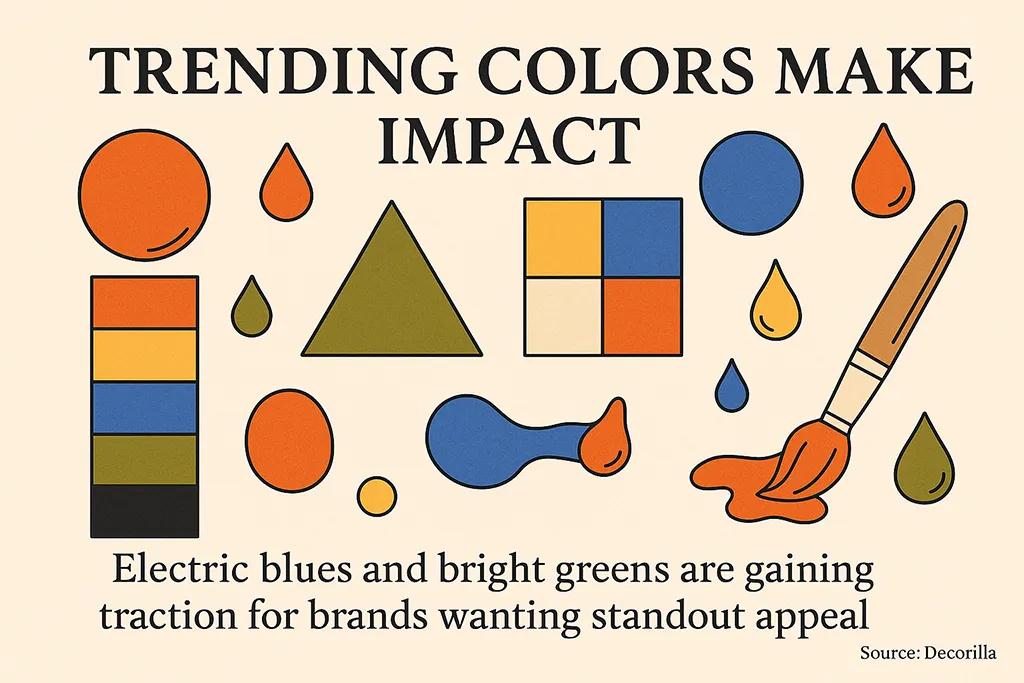
This is why I push clients toward a two-tier color system: a primary mark that works on white and on dark, plus an explicit rule for what happens when the logo sits on a photograph. Usually this means a mono version (white or deep-tone) that always wins, reserved for image overlays. Bold signature colors live on collateral where the background is controlled. The logo does not have to be the same every time - it has to be recognisable every time. Those are different design goals.
If you want the practical checklist: take your logo file, drop it onto a bright exterior shot, an interior with warm wood tones, a dusk drone shot, and a floor-plan PDF. If any of those four tests fail, you do not have a finished logo, regardless of what the brand deck says.
Heritage brands and newcomer brands play different games
The generic trend articles collapse every real estate brand into one mould. In reality, there are two very different starting positions, and the design logic for each runs opposite.
A heritage brand - an agency that has operated for twenty or more years, built on referrals and repeat clients - already has brand equity locked into its current mark, however ugly it may look by current standards. The mistake I see heritage brokerages make is throwing out recognizable equity in pursuit of a "modern refresh." The Journal of Marketing Communications exposure research I referenced earlier is directly relevant here: complex or idiosyncratic marks benefit from long-term exposure. If your logo has been on thousands of For Sale boards for two decades, that is earned recognition you do not want to discard. The right approach is a refinement, not a replacement. Modernise the type, clean the mark, adjust the proportions - keep the silhouette that the local market already associates with you.
A newcomer brand has the opposite problem. No exposure, no equity, and a need to be legible instantly. Here the research on short-term benefits of simple logos applies cleanly. Start with something clear and memorable, and let the complexity accrue later as the brand earns it. The common mistake newcomers make is the reverse: they over-design a logo with a story stuffed into every curve, trying to communicate everything at launch. Buyers do not decode logos. They recognize them.
One bullet list worth reading: what to test before you approve a logo
- Favicon test. Export the logo at 32 pixels and 16 pixels. If the mark is unreadable, you need a dedicated favicon version or a monogram. Do not ship without this.
- Listing portal test. Drop the logo into the avatar circle on a Rightmove, Zillow, or Idealista agent card mockup. Does it look confident next to three other agency logos on the same result page?
- Dark-background test. Place the logo on the hero image you actually intend to use on your website. If it disappears, fights the photo, or needs a drop shadow to survive, redesign the mono version, not the photograph.
- For Sale board test. Print it at the size of your physical signage and walk twenty meters away. At that distance, does the name read? Is the icon even doing useful work or is the wordmark carrying everything?
- Referral test. Imagine a past client telling a friend the name of your agency by phone. When the friend Googles it, does the first result carry a visual identity that matches what a referrer would describe? If your typography or color looks unrelated to the name, you are introducing friction into the warmest channel you have.
Rollout: where a good logo often gets undone
Even a strong new logo fails in execution more often than in concept. The order of rollout matters. In real estate, digital exposure compounds faster than printed collateral, so the sequence I recommend to clients starts with website, favicon, email signature, social avatars, and portal profiles. These are the places where the next buyer is going to see you in the next 48 hours. Printed signage, stationery, and brochures come second, updated as they naturally cycle. Chasing a full print overhaul on day one is expensive and rarely changes a buyer's decision.
One detail that is almost always forgotten: your listing photographs and 3D viewer overlays. If you have hundreds of published property photos with the old watermark, decide early whether you rebadge them in bulk or let them age out. I prefer the latter for most agencies - it distributes the effort and avoids re-uploading thousands of images. For interactive tours and 3D viewers the story is different, because those assets live longer and are seen in a more focused context. Rebadge those deliberately.
The cost conversation also deserves more honesty than the usual "tier one, tier two, tier three" article. A meaningful rebrand for a small real estate agency - new mark, proper type selection, full system with small and large-format variants, brand guidelines, and rollout across web and social - lands realistically between £2,000 and £6,000 with an independent designer. Anything below that is a logo refresh, not a rebrand. Anything above that starts to include strategic work that most regional agencies do not need.
FAQ
Does a real estate logo actually affect listing inquiries?
Not directly, and anyone claiming otherwise is selling you something. Listing inquiries are driven by the photography, the price, the property description, and the portal placement. What the logo affects is the trust interaction that happens after the inquiry: the moment the buyer clicks through to your website or searches your brokerage name. A logo that signals permanence and attention to detail reduces friction at that step. A logo that looks like it was made in Canva adds friction. The effect is small per interaction and large across a year of interactions.
Should a real estate logo include a house icon or a key?
The 2019 research in the Journal of Marketing Research on descriptive versus non-descriptive logos suggests yes for most property brands. A descriptive element performs better on authenticity and commercial outcomes in almost every category that is not associated with unpleasant emotions. Real estate is one of the cleanest descriptive categories. That said, it does not have to be a literal house or a key - an abstracted architectural silhouette, a window, or even a doorway does the same job. The important thing is that a viewer can identify the category within a second.
How often should a real estate agency redesign its logo?
Less often than designers suggest. For a heritage agency with existing brand recognition, a full redesign every 15 to 20 years is normal, with refinements every 5 to 7. For a newer brand, the first redesign usually happens around the two-to-three-year mark when the agency has learned what it actually sells and who it actually sells to. Outside of those triggers, resist cosmetic updates. Recognition is cumulative; every redesign resets it.
What is the single biggest mistake in real estate logo design?
Designing for the brand deck instead of the listing card. A logo that looks beautiful on a hero image in a pitch presentation but disappears on a 48-pixel listing portal avatar is a logo that is failing 95% of the time it is seen. The fix is to design the small version first and let the large version be an expansion of that, not the other way around.
Does color psychology matter for real estate logos?
It matters, but not the way most articles describe it. The precise emotional association of a color varies heavily by culture, generation, and context, so claims like "blue equals trust" are weak. What does matter is category differentiation and contrast against the environment where the logo lives. In a market full of navy-and-white brokerages, a warm clay palette is genuinely differentiating. In a market full of cream-and-gold luxury brands, a confident monochrome mark stands out more than another gold variation. Make the colour decision against your local competitor set, not against a generic emotion chart.
Can I use an AI logo generator for my real estate brand?
You can, and the output will look competent on the day you generate it. The problem comes three months later when you need a favicon version, a mono version, a version that works on your 3D tour overlay, and a typographic rule for the estate agent digital business card you just ordered. Generators produce a file, not a system. If your brand is going to live across websites, social, signage, and interactive viewers, you need the system. For a solo agent testing a side business, the generator is fine. For anyone serious about competing on trust, it is a false economy.
Conclusion
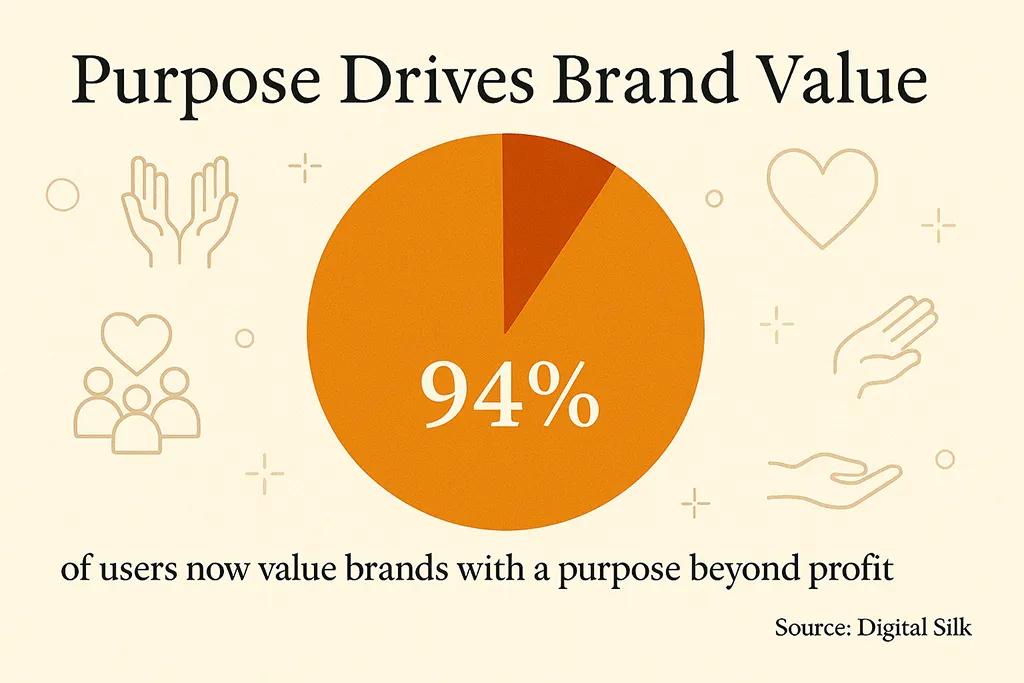
Real estate logo design is not really about trends. The trends that matter - descriptive marks, controlled simplicity, careful typography, color calibrated to the environment, and system thinking over single-image thinking - are the ones supported by two decades of marketing research and by the way buyers actually encounter property brands. Minimalism, purpose-driven storytelling, and bold colour are useful ideas only once they are translated through the reality of favicons, listing cards, drone watermarks, and For Sale boards.
If you are a real estate agency, a developer, or an architect looking at your current logo and wondering whether it is pulling its weight, do the five tests in the list above before you commission anything new. Most of the time the answer is not a full rebrand. It is a disciplined system built around a mark you already have.